Thursday, 20 September 2012


20 September 1914: John Redmond, the Leader of the Irish Parliamentary Party encouraged members of the Irish Volunteers to join the British army on this day. He did this in a speech at Woodenbridge, Co. Wicklow. He pledged his support to the Allied cause. The words he addressed to the Irish Volunteers assembled there were:

‘The interests of Ireland—of the whole of Ireland—are at stake in this war. This war is undertaken in the defence of the highest principles of religion and morality and right, and it would be a disgrace for ever to our country and a reproach to her manhood and a denial of the lessons of her history if young Ireland confined their efforts to remaining at home to defend the shores of Ireland from an unlikely invasion, and to shrinking from the duty of proving on the field of battle that gallantry and courage which has distinguished our race all through its history. I say to you, therefore, your duty is twofold. I am glad to see such magnificent material for soldiers around me, and I say to you: “Go on drilling and make yourself efficient for the Work, and then account yourselves as men, not only for Ireland itself, but wherever the fighting line extends, in defence of right, of freedom, and religion in this war”’. 

His words were a watershed in Modern Irish History as for the first time a Leader of Nationalist Ireland called upon Irishmen to enlist in the British Army. In the months that followed tens of thousands of Nationalist Irishmen took up his call and joined up. But while initially a very shrewd move by Redmond the tides of History went down other channels and Redmond’s bold stroke cost his Party dear and darkened his own legacy to Ireland.

Wednesday, 19 September 2012


19 September 1836: Mount Jerome Cemetery, Dublin, was consecrated on this day. The name of the cemetery comes from an estate established there by the Reverend Stephen Jerome, then vicar of St. Kevin's Parish. Opened on a forty-seven acre site in Harold's Cross, by the General Cemetery Company of Dublin (which was constituted by an Act of Parliament in 1837).

Mount Jerome was the first privately owned cemetery in Ireland, when it first opened in 1836. It is one of the most impressive of Dublin's cemeteries. Mentioned in James Joyce's Ulysses, Mount Jerome was the burial ground for many of Dublin's Protestant businessmen and their families. It has witnessed over 300,000 burials but it was not until the 1920's that the first Catholic burials took place there. Mount Jerome has a large number of highly ornate crypts and memorials. A series of sunken roads throughout the grounds allows for below ground access to many of the crypts.

Many well-known people are buried there. There is a large plot to the deceased members of the Royal Irish Constabulary (RIC) and the remains of the French Huguenots from the St Stephens Green Cemetery, as are also prominent members of the Guinness family. Amongst its more notable internees are: Sir William Wilde, Thomas Davis, Joseph Sheridan Le Fanu, John Millington Synge, Æ (George Russell), Jack B. Yeats, Sir William Rowan Hamilton and George Petrie.

Tuesday, 18 September 2012


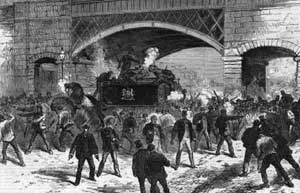
18 September 1867: The rescue of the Fenian Leaders Colonel Thomas Kelly and Captain Timothy Deasy on this day. They were freed from captivity in Manchester, England. Col. Kelly was the head of the revolutionary Irish organisation, the Fenians, at the time. He was arrested with his aide de camp, Timothy Deasy. His identification by an informer led the Manchester Fenians to decide on the prison rescue.

A rescue party of some 30 men secured their release from a closely guarded Police Van. Unfortunately Sergeant Brett of the escort was shot dead when one of the assailants fired a pistol shot through the keyhole of the van to smash the lock. By misfortune Brett had put his eye to the keyhole to ascertain what the commotion was outside. The shot killed him.

As a result three men - Allen, Larkin and O'Brien (The Manchester Martyrs) - were publicly hanged at Salford on 23 November 1867 for taking part in this raid and their alleged complicity in shooting Brett dead. Colonel Thomas Kelly and Captain Timothy Deasy were never recaptured.

Monday, 17 September 2012


17 September 1860: Men of the Irish Battalion of St. Patrick of the Papal army fought a Piedmontese army under the command of General Brignone at Spoleto, Italy on this day. Spoleto is a walled city south of Florence with the fortress of Rocca on the side of a hill. Three companies of the Battalion of St. Patrick (312 soldiers & 15 officers) under the Battalion Commander, Major Myles O'Reilly (County Louth) were stationed there. Major O'Reilly commanded 645 men in total at Spoleto including 150 Italians, 160 Swiss, and 24 Franco-Belgians.

In spite of a long and heavy bombardment, the advancing Piedmontese troops were met with a withering fire by the Irish on the walls that stopped them in their tracks. However the bishop of Spoleto, distraught at the destruction and the loss of life, arranged a cease-fire. O'Reilly was nearly out of ammunition at that anyway. A Papal representative was sent to General Brignone and surrender terms were arranged. Brignone described O'Reilly as "both honourable and brave" and allowed the Irish to march out as prisoners with officers retaining their swords.

Given the task of protecting the North Wall and the vital Gate House of the majestic Castle Albornozian, the Irish performed with distinction, holding their ground and the gate for 14 hours despite heavy hand-to-hand fighting and under constant bombardment from General Brigonne's field artillery. After withstanding repeated attacks, Major O'Reilly eventually negotiated a favorable surrender when reinforcements had become unlikely.
http://www.thewildgeese.com/pages/popeirb2.html

Sunday, 16 September 2012


16 September 1945 –Count John McCormack, the great Irish Tenor died at his residence, Glena, Booterstown, Co. Dublin on this day. His remains were interred at Deansgrange cemetery. Born in Athlone in 1884 he went to Italy in 1903 to perfect his voice and enjoyed huge International success touring England, Australia, America and elsewhere. He became the most celebrated lyric tenor of his day. Famous for his extraordinary breath control, he could sing 64 notes on one breath in Mozart's Il Mio Tesoro from Don Giovanni, and his Handelian singing was just as impressive in this regard. He also made many popular recordings including It’s a Long way to Tipperary, The Wearing of the Green, The Ministrel Boy and The Last Rose of Summer.

He became a naturalized US Citizen in 1917 but returned to Ireland in the 1920’s. His last professional performance was in London at the Royal Albert Hall in 1938. He is best remembered at home though for his magnificent performance of César Franck's Panis Angelicus to the hundreds of thousands who thronged Dublin's Phoenix Park for the 1932 Eucharistic Congress. Pope Pius XI made him a Count of the Church in 1928.

His last professional performance was in London at the Royal Albert Hall in 1938. During the War he gave Concerts gratis for the Red Cross in Britain but had to stop in 1942 due to failing health. He moved back to Dublin and eventually settled in Booterstown. As his end approached he wrote in his Diary the folowing words:

I live again the days and evenings of my long career. I dream at night of operas and concerts in which I have had my share of success. Now, like the old Irish Minstrels, I have hung up my harp because my songs are all sung.


Saturday, 15 September 2012


September 15 1643: The Cessation of hostilities in Ireland was signed on this day. James Butler, the Marquis of Ormonde [above], acting in the name of King Charles I, signed a twelve month truce with his grand Uncle, Richard Butler, 3rd Viscount Mountgarrett representing the Catholic Confederation of Kilkenny. This Agreement brought a shaky Peace to most of the Country after almost two years of bloody and violent battles, sieges and massacres.

In exchange for contributions of money and supplies to the Royalists in England, the Confederates were allowed to retain control of all the lands they had secured in Ireland. In addition, the King promised to consider granting freedom of worship to Catholics and making constitutional reforms in Ireland. Confederate representatives went to Oxford to negotiate a permanent treaty, but this came to nothing because the King was reluctant to antagonise his Protestant supporters.

The Cessation allowed Crown troops stationed in Ireland to return to England to fight for the Royalists. The Scots of Ulster refused to recognise the Cessation and Sir Robert Monro's army remained active there, though the local Protestant Lagan army was divided over whether to accept the Cessation or back the Rebellion against the King that was underway in Britain.


A proclamation concerning a cessation of arms.
Agreed and concluded on at Siggings-town, in the county of Kildare, the fifteenth day of September, in the nineteenth yeer of His Majesties raign, by and between James Marquesse of Ormonde, Lieutenant Generall of His Majesties army in the Kingdom of Ireland, for and in the name of our gracious soveraign lord Charles, by the grace of God, King of Great Britain, France, and Ireland, &c. By vertue of His Majesties commission bearing date at Dublin the last of August, in the said nineteenth year of His Majesties raign, of the one party. And Donogh Viscount Muskerry, Sir Lucas Dillon Knight; Nicholas Plunket Esquire; Sir Robert Talbot Baronet; Sir Richard Barnwell Baronet; Torlogh O Neale, Geoffrey Brown, Ever Mac-Gennis and John Walsh, Esquires; authorized by His Majesties Roman Catholique subjects, of whose party they are, and now in arms in the said kingdom, &c. To treat and conclude with the said marquesse for a cessation of arms, by vertue of an authority given unto them, bearing date at Cashel, the seventh day of September, in the said nineteenth yeer of His Majesties raign, of the other party. Whereunto is added, an instrument touching the manner of payment of 30800 pounds sterling by severall payments. Ordered by the Commons in Parliament, that this proclamation be forthwith printed: H: Elsynge, Cler. Parl. D. Com.


Friday, 14 September 2012


14 September 919 AD:  The King of Ireland at the time, Niall ‘Glundubh’ mac Aeda, (Niall ‘Black Knee’, son of Aed) raised an Army from amongst the the Gaels  and marched to Dublin to retake it from the Vikings. On this day a great battle was fought outside the walls, the battle of Ath Cliath/Cell Moshamog, which was probably by the banks of the river Liffey at Islandbridge. The Irish were badly defeated and lost many of their warriors, King Niall himself being among the fallen. It was the Vikings greatest military victory over the Irish.


Niall was one of the Cenél nEóġain from what is now Co Tyrone in the North of Ireland. Son of Aed Finliath, Niall is first recorded succeeding his brother Domnall mac Áedo as King of Ailech upon his death in 911. Extending his control to neighboring kingdoms, Niall defeated the Kings of Dál nAraidi and Ulaid at the Battles of Glarryford (in present day County Antrim) and Ballymena before his defeat by high-king Flann Sinna mac Maíl Sechnaill of the Clann Cholmáin Uí Néill at the Battle of Crossakiel (in present day County Meath). Following Flann's death in 916, Niall succeeded him as High King of Ireland. It was during his reign in which he would reestablish the Óenach Tailteann, a traditional gathering of Irish clans. But his reign was short lived as he met with defeat by the banks of the Liffey.

Though some place the battle at Kilmashoge, near Rathfarnham in County Dublin as a location, the Ford at Islandbridge is a more likely spot as Niall was advancing from the North and had to cross the Liffey to get around to the river's right bank to attack the city's walls. It is from him that the O'Neills of the North trace their ancestry.

Mournful today is virginal Ireland 
Without a mighty king in command of hostages; 
It is to view the heaven and not to see the sun 
To behold Niall's plain without Niall
Annals of Ulster