Thursday, 5 September 2019

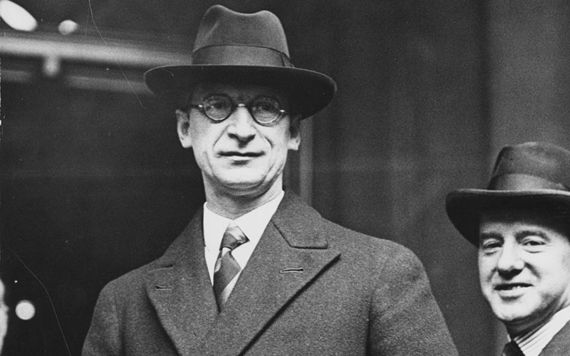
Image result for eamon de valera


3 September 1939: The Irish Free State enacted a State of Emergency and declared herself Neutral in the Second World War.

Early on the morning of Sunday 3rd September 1939 a marathon session of Dáil Éireann was wound up that gave the Government of Mr Eamon DeValera [President of the Executive Council of the Irish Free State] draconian rights under the Emergency Powers Act to rule the State with an Iron Hand.

 The Constitution had the previous day been amended so that Article 28.3.3° now read as follows [with the addenda highlighted in black]:
Nothing in this Constitution shall be invoked to invalidate any law enacted by the Oireachtas which is expressed to be for the purpose of securing the public safety and the preservation of the State in time of war or armed rebellion, or to nullify any act done or purporting to be done in pursuance of any such law. In this sub-section "time of war" includes a time when there is taking place an armed conflict in which the State is not a participant but in respect of which each of the Houses of the Oireachtas shall have resolved that, arising out of such armed conflict, a national emergency exists affecting the vital interests of the State.

‘A time of War’ was therefore officially declared to exist and thus the EPA could be triggered to respond to the rapidly developing situation that now confronted the State. 

The Emergency Powers Act empowered the government to:
make provisions for securing the public safety and the preservation of the state in time of war and, in particular, to make provision for the maintenance of public order and for the provision and control of supplies and services essential to the life of the community, and to provide for divers and other matters (including the charging of fees on certain licences and other documents) connected with the matters aforesaid. 

This was done as Europe tethered on the brink of widespread War following Nazi Germany’s invasion of Poland. It was expected that a Declaration of War by Britain and France on Germany would shortly be announced. It was a Conflict in which the State could well be embroiled with or without its consent. Dev had already let it be known as early as February that he would remain Neutral and that we would not allow either side to use our territory to be used to attack any belligerent.

As the morning rolled on tension mounted as it became known that the British Prime Minister Neville Chamberlain was due to make an announcement on BBC Radio. As expected he issued a Declaration of War on Germany*. Dev who listened to the speech at home with two of his sons declared that ‘life will never be the same again’.

His day though was far from over. He too had to take to the airwaves and publicly explain where the State stood in relation to these dramatic and dangerous developments that threatened the Peace of Europe. He needed to let the World know that we were Neutral and also reassure the Irish People here that we could see our way through this impending Crises and survive the experience.

He went on Radio Éireann at 10.45 pm that night and declared:
We have decided to keep out of this war; but this will not save us from many of the consequences of the conflict. If it lasts for a long period, it is going to effect everyone of us in our daily lives...But there is no reason why we should be unduly anxious. United and disciplined, we have nothing to fear.

The Irish Free State was far from alone in declaring her Neutrality at this time but she was the only Dominion within the British Commonwealth to do so - much to the chagrin of many in Britain. But it was a policy that had the overwhelming support of the citizens of the State. While the War was to hold many perils & pitfalls it turned out that against the odds and with some deft compromising DeValera managed to keep the State out of it right till the Wars’ end in 1945. The only other sizeable European states that kept their territories intact from invasion start to finish were Sweden, Switzerland, Spain and Portugal.
* France declared later that afternoon.


Monday, 2 September 2019

Image result for ireland 1000 ad

2 September 1022 AD: The death of the King of Mide (Meath), Máel Sechnaill mac Domnaill, on this day. He died on an island in Lough Ennell in what is now County Westmeath. His passing marked the end of an era in Irish History. Since the Battle of Ocha in circa 483 AD the southern and northern O’Neill’s had shared back and forth the title of King of Temair (Tara) in Meath between them on a more or less continual basis. This made the holder of the title the most influential king in Ireland - if he had the wherewithal to make use of the status the title gave him.

For it was believed that in ancient times Ireland had been ruled from the Royal seat of Tara. The O’Neills believed that any man who held that hallowed ground was the heir to a lost Kingdom - and thus had precedence over the other kings of Ireland. However King Brian Boru of Munster in 1002 had pushed aside King Máel and had himself recognised as the superior king in his stead. The line of succession had been broken.

But with the death of King Brian at the Battle of Clontarf in 1014 it came about that Máel Sechnaill had regained his position. However he was by then an old man and Ireland had changed greatly since his predecessors had established their dual kingdoms all those centuries before. After him Mide(Meath) would no longer be the force it was in Irish Wars and Politics. It never regained what it had lost in terms of Power & Prestige in the ‘Game of Thrones’ that dominated Irish politics at that time.

Mael Sechnaill son of Domnall son of Donnchad, overlord of Ireland, pillar of the dignity and nobility of the western world, died in the 43rd year of his reign and the 73rd of his age on Sunday the fourth of the Nones 2nd of September, the second of the moon.
Annals of Ulster 1022 AD

Mael Sechnaill son of Domnall, son of Donnchad, overking of Ireland, the flood of honour of the western world, died in Cró-inis of Loch Aininne in the forty-third year of his reign on the 4th of the Nones 2nd of September, that is, on Sunday, the second day of the moon, the one thousandth and twenty-second year after the Lord's Incarnation, and died penitent and at peace, with the successors of venerable saints Pátraic and Colum Cille and Ciarán present and assisting him.
Chronicon Scotorum


Sunday, 1 September 2019


1 September 1701: The Irish Brigade in the service of France fought in the Battle of Chiari [above]*on this day. This clash of arms took place in Lombardy in northern Italy during the War of the Spanish Succession. The French Army was under the command of Marshal Villeroy who was opposed by Prince Eugene of Savoy in the service of the Austrian Empire. Villeroy decided to attack the town of Chiari as he felt it was his duty to fight for King Louis rather than just observe the enemy.
Villeroy ignored the warnings of his subordinate Marshal Catinat that Eugene was in a strong position, remarking his deputy that the King had not sent so many brave men there just to look at the enemy through their spy glasses!
The attack was however a fiasco as the French were cut down in droves. Amongst the regiments leading the attack was the Irish regiment of Galmoy (Its Colonel was Pierce Butler, 3rd Viscount Galmoy), which suffered heavily in the assault. Eventually the attempt was called off and the surviving troops were told to retire. The French losses were over 2,000 men killed or wounded while their enemies sustained a loss in the low hundreds. The most prominent Irish casualty was Dominick Sarsfield, 4th Lord Killmallock who was killed at the head of his men in the attack.
Some of the Irishmen who survived were badly wounded. Felix MacNamee, aged 35, a native of Armagh, had had his left arm taken off by a cannon ball and, put out of service, was admitted into the military hospital of Les Invalides in Paris, dying at Arras in 1726. The ensign of the Colonel’s company, Terence Sweeny, aged 33, was hit in the right thigh by cannon shot and across the body by a musket ball. He too, was admitted to Les Invalides and survived until 1750. Also hit by a cannon shot in the right leg was the reformed Lieutenant Thomas Meade, aged 31, a native of Kilmallock, who survived until 1736. John Conor, aged 31, a Kerryman and the sergeant of grenadiers, lost his right arm through a musket ball but lived until 1721.
* Battle of Chiari, by Jan van Huchtenburg


Saturday, 31 August 2019


31 August 1994: The IRA announced a complete cessation of military activities on this day as their long awaited ‘Ceasefire’ came into effect. The efforts to bring the Provisonal IRA to this point had been years in the making but had faced many obstacles along the way, both within and without the Republican Movement.
The IRA announced: "Recognising the potential of the current situation and in order to enhance the democratic process and underlying our definitive commitment to its success, the leadership of the IRA have decided that as of midnight, August 31, there will be a complete cessation of military operations. All our units have been instructed accordingly....
The genesis for moving away from violence and towards a purely peaceful strategy began at the time of the 1981 Hunger Strikes when a number of republican representatives were elected both North and South of the Border - most notably Bobby Sands who was on hunger strike in the Long Kesh prison camp at the time.
In the aftermath of those events Sinn Fein decided to contest elections across Ireland and while initially any success they had was in the North they had made a start and there was no going back.
Gerry Adams and Martin McGuinness, as the acknowledged leaders of the Republican Movement, were the two individuals most closely associated with developing a strategy that would see a metamorphosis of Sinn Fein into a purely political Party and an end to its support for the IRAs campaign. However they realised that at the end of the day only the IRA could call it.
Initially there was scepticism and hostility in many quarters but a number of factors, some positive and some negative helped push things along the way.
On the positive side was the election of Bill Clinton as President of the USA from 1991, a man with an Irish background and a real interest in helping to bring Peace about. Here in Ireland the appointment of Albert Reynolds as Taoiseach in 1992 brought to power a man of calibre who carried no baggage on the issue and was prepared to take risks to get the end result. In Britain John Major became Prime Minister in 1990 and if not as committed as others to the process he was of a practical turn of mind who was prepared to cut a deal at the end of the day.
On the negative side many people, not least in Nationalist areas of the North of Ireland were sick and tired of years of violence with no end in sight. The yearning for Peace was high and in addition the Loyalist paramilitaries had been re armed and re organised and were launching effective counter strikes of their own. The British Army were still on the streets. Though the IRA were well armed and motivated it was clear the Armed Struggle had reached Deadlock.
The Hume Adams initiative was an internal attempt by Adams and John Hume, the leader of the SDLP, then the biggest nationalist party in the North, to develop a framework for Peace but was stymied by its utter rejection by Unionists and the British Government. The Unionist community did not trust what was happening and were wary of any initiatives that emanated from Dublin or indeed from any parties on the Nationalist side. Major in turn was reliant on Unionist votes to keep him in power and would not risk pushing them too far. Albert Reynolds had other ideas and had Hume and Adams sidelined as he went for cutting a deal with the British Prime Minister that would put them in the driving seat and steering the process down a road that all could follow.
Thus came about in December 1993 the 'Downing Street Declaration' when Reynolds and Major issued a joint statement which laid out the guidelines on which a settlement could be built.
It argued for self-determination on the basis of consensus for all the people of Ireland. It argued that any agreement had to be based on the right of people on both parts of the island to "exercise the right of self determination on the basis of consent freely and concurrently given, North and South, to bring about a united Ireland if that is their wish." Not everyone was happy with this but at least there was now something to build upon.
Another significant breakthrough came at the end of January 1994 when Gerry Adams was given a 48 hour visa to visit the USA in order to be able to convince Republican supporters to support his efforts to stop the violence. The visa was granted on the personal authority of Bill Clinton, despite the opposition of his own State Department, FBI, CIA and speaker of the House,Tom Foley.
That same month the broadcasting ban under Section 31 of the Broadcasting Act was lifted in the Republic of Ireland. This allowed Sinn Féin access to the Irish media and marked the end of official political censorship in the South.
At Easter 1994 the IRA announced a three day ceasefire and across Ireland there was a growing expectation that a permanent one would follow. Behind the scenes the Irish government had given written assurances that in the event of an IRA cessation, it would end its marginalisation of the Sinn Féin electorate and that there would be an early public meeting between Taoiseach Albert Reynolds, John Hume and Gerry Adams.
Despite some twists and turns and secret negotiations the momentum held. Not even shocking acts of violence like the Shankill road bombing in October 1993 in which eleven innocent people were killed by an IRA bomb and the revenge murders by the UVF at Greysteel were enough to derail the process. When it came though many were relieved that what had seemed almost impossible had at last come about. It was a seminal moment in Modern Irish History.


Friday, 30 August 2019


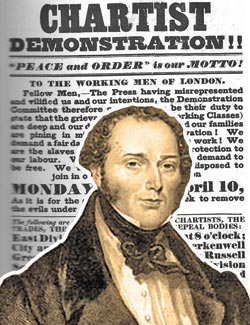
30 August 1855: The Death of Feargus Edward O'Connor, Chartist Leader on this day. He was the son of Roger O'Connor, a United Irishman, and was born in 1796 in County Cork.

 When Feargus O'Connor was twenty-four he inherited an estate there. Although a Protestant, O'Connor was a reforming landlord and denounced the religious Tithes & the power of the Established Church. Daniel O’Connell soon spotted his potential and secured a candidacy for him in the General Election of 1832 in which he was returned as an MP for County Cork. But O’Connor rashly decided to try and unseat the Great Dan as Leader of the Irish MPs in the House of Commons and the two fell out.

O’Connor thereafter focused his attentions on Radical English Politics, moving to Manchester where he published the highly successful Northern Star newspaper. He became a leading light in the Chartist Movement, dedicated to Universal Suffrage and Annual parliaments. Here again though his maverick personality and impatience with pacific political activity led him into trouble with him advocating the threat of violence to achieve political Reform. O'Connor responded to criticism by forming a new Chartist organisation, the East London Democratic Association.

He was found guilty of sedition in 1839 and sentenced to eighteen months imprisonment. O'Connor continued to edit the Northern Star newspaper from his prison cell and upset the other Chartist leaders when he told his readers that from "September 1835 to February 1839 I led you single-handed and alone."

In 1845 O'Connor launched his Chartist Land Plan. His objective was to raise money to buy a large estate that would be divided into plots of three and four acres. Subscribers would then draw lots and the winners would obtain a cottage and some land. O'Connor promised that his Land Scheme would "change the whole face of society in twelve months" and would "make a paradise of England in less than five years". 

But the scheme backfired and the estate went bankrupt before too long. Some of the tenants ended up being evicted and the whole disastrous enterprise badly damaged O’Connor’s credibility with the English Working Class. The stress and effort involved took its toll on O’Connor’s mental health. In 1847, O'Connor was elected MP for Nottingham, becoming the first and only Chartist MP.

His finest moment should have been the Great Demonstration he organised to assemble in Kensington London in 10 April 1848 that was to march on the Houses of Parliament. 200,000 people were expected to attend and this projected assembly put the wind up the British Establishment. The Duke of Wellington was put in charge of the Military and tens of thousands of citizens were made temporary policemen to control the situation.

In the event it proved a damp squib as only about 25,000 people turned up in a heavy downpour to hear O’Connor make outlandish claims that proved to be untrue- namely that over five million people had signed his Petition on workers rights when it was really about two million. Even then on examination it was discovered that many were clearly forgeries including those of the Queen and the Iron Duke, who appeared to have endorsed the petition no fewer than seventeen times! It was all over by 2 O'clock that afternoon and the Establishment could breath again.

His mental health began to deteriorate even further after this fiasco.  The circulation of the Northern Star fell steadily and it lost money. He fell out with friends and coleauges but the final straw came in 1852 when he struck three of his fellow MPs in the House of Commons. His sister had him put under the care of a specialist in mental disorders at the Manor House Asylum in Chiswick London.  He died on 30 August 1855 at 18 Albert Terrace, Notting Hill Gate and on 10 September was buried in Kensal Green cemetery. No fewer than 40,000 people witnessed the funeral procession.


Thursday, 29 August 2019


29 August 1975: Éamon de Valera died on this day. His active political career spanned the years 1913-1973 from when he first joined the Irish Volunteers until his retirement as President of Ireland.
Born in New York City in 1882 he was brought back to Ireland two years later and raised by his wider family in Co Limerick.

He was one of the leading commandants of the Easter Rising in Dublin in 1916 and was sentenced to death by the British but this was commuted to Life Imprisonment as being born in the USA he was eligible to claim US citizenship.

In 1917 he was elected as MP for East Clare but did not take his seat and in 1918 he was again imprisoned by the British but escaped from Lincoln Jail in England 1919. He returned home where he was elected by Dáil Éireann as Príomh Aire (President). He then made his way to America where he campaigned hard to gain support for the Irish Republic especially amongst the huge Irish American community there.

Returning home in 1920 he and the British began tentative negotiations which led to the Truce of July 1921. But he broke with many of his colleagues in December that year when the Treaty was signed. The Civil War of 1922-1923 saw him side lined and after another period of imprisonment by the Irish Free State he in 1926 founded his own Party Fianna Fáil which he led until 1959.

In 1927 he led the Party into the Irish Parliament Dáil Éireann and took the Oath to the British King George V - but under protest that he felt not bound by it! A dodgy tactic but it worked and he carried most of the Republican Movement with him to back this approach.

After the General Election of  January 1932  he was elected by the Dáil as President of the Executive Council of the Irish Free State and governed it until 1948 - being returned as Leader in every election. In the early 1930s he faced down General Eoin O’Duffy and his fascistic Blueshirt Movement and contained the threat from the IRA who wanted to re start the War with Britain over their continued Occupation of the North.

He refused to pay the Annuities due to the UK and this triggered the Economic war with England which brought great hardship to many farmers & others. While he was right in Principle the cost was high. He got rid of the Oath to the British Monarch in 1936 & brought before the People a New Constitution - Bunreacht na hÉireann - which was passed in a Referendum and came into operation in 1937. It is still the Constitution to this day - though somewhat amended now. In 1938 he got the British to hand back the Treaty Ports they still held and made a final settlement to the Economic War with a once off payment to them which finished the matter. 

In 1939 the Second World War began and this State declared itself Neutral - the British were disgusted but had to accept it. However Dev played it well and ensured that co operation with England while low key was real nonetheless. He allowed anyone who wanted to go to cross the water to join up or work there if they wanted to. At War’s end in 1945 he offered condolences to the USA on the death of President Roosevelt but also to Germany on the death of Adolf Hitler - a gaffe in most people’s eyes.

He lost the General Election of 1948 and was out of power until 1951 when he was returned once again. However he was to lose it once more in 1954 and by this stage he was well into his 70s. The State could not provide enough jobs for its young people and Emigration was astronomical + there was widespread poverty in many parts of the Country. No Party seemed to have the solution. When he was returned to power in 1957 he came under pressure to look for new ways to change things and in 1958 it was decided to open up Ireland to Foreign Investment and Trade to which Dev gave his Imprimatur. This led to rapid economic expansion that continued until 1974. 

But Dev was old and tired by now and his eyesight was failing. He resigned as Taoiseach in 1959 and was then elected President of Ireland  in June of that year by popular vote. Probably the highlight of his term in Office was the visit of President John F Kennedy in 1963 and the celebrations in 1966 of the 50th anniversary of the Easter Rising. In that year he also was re elected President defeating the Fine Gael candidate Tom O’Higgins by a narrow margin. His last years were much more low key as age caught up with him. By that stage he was seen by many younger people as an archaic figure out of touch with Modern Ireland. 

Always a divisive figure and a controversial one he led his followers through many crises - though many would consider some at least self inflicted ones! There was no doubting his fine mind and his ability to think a few steps ahead of his opponents on most occasions. His abiding legacy must be though the Constitution of 1937 and keeping the Irish State out of the Second World War + initiating the change that started our rise in living standards from 1958. 

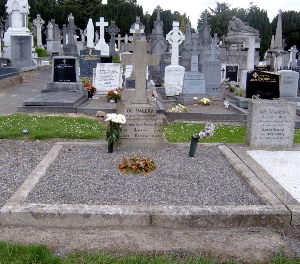
At his retirement in 1973 at the age of 90, he was the oldest head of state in the world. His wife of many years Sinéad de Valera died some months before he did and he was buried alongside her in Glasnevin Cemetery [above] in Dublin after a State Funeral.


Wednesday, 28 August 2019

See the source image

28 August 1814: Sheridan Le Fanu was born in Dublin on this day. His family name has French Huguenot roots. He was the author of many seminal works of Gothic Horror novels and short stories that influenced other writers and film directors down into modern times.

A great-nephew of the playwright Richard Brinsley Sheridan, Le Fanu was the son of a Protestant churchman. He studied law at Trinity, but neglected the bar in favour of journalism and writing. Having made extensive use of his father’s library in his youth, Le Fanu went on to read Classics at Trinity College Dublin, before studying Law at King’s Inn in London. However the family fell on hard times and eventually the Library had to be sold to pay off debts.

From 1844 to 1858, he was married to Susanna Bennett, and they eventually moved into the Bennett family home in Merrion Square, Dublin. Susanna was prone to mental disorders that eventually killed her and that must have influenced Le Fanu's depiction of extreme neuroses. They had four children together. He wrote at the time of her death, as quoted by Kathryn West in the Dictionary of Literary Biography: "The greatest misfortune of my life has overtaken me. My darling wife is gone… . She was the light of my life."

He was among the first practitioners of the psychological ghost story, in which the haunting might be the result of supernatural intrusion into the everyday world but could also arise from the broken psyche of a protagonist. He tried his hand at a number of genres but it was as a writer of Horror stories that he had the greatest success. He published his first ghost story, The Ghost and the Bonesetter in the Dublin University Magazine in 1838. Originally set in Ireland his publications met with only limited recognition. When his editor suggested that he switch the locations to England he finally got the recognition he desired. 

The novel Uncle Silas was his masterpiece and though ostensibly set in Derbyshire Le Fanu actually wrote it with Ireland in mind. The year before his death he published In a Glass Darkly which is a collection of five short stories first published in 1872. The second and third are revised versions of previously published stories, and the fourth and fifth are long enough to be called novellas.

The title is taken from Corithinans 13- a deliberate misquotation of the passage which describes humanity as perceiving the world "through a glass darkly". Some are set in Dublin and some abroad. The most famous one though is the ground breaking novella Carmilla which featured what was in effect a lesbian vampire sucking the blood of her innocent female victim Laura, this too was set abroad in eastern Europe. 

Sometimes after an hour of apathy, my strange and beautiful companion would take my hand and hold it with a fond pressure, renewed again and again; blushing softly, gazing in my face with languid and burning eyes, and breathing so fast that her dress rose and fell with the tumultuous respiration. It was like the ardour of a lover; it embarrassed me; it was hateful and yet overpowering; and with gloating eyes she drew me to her, and her hot lips travelled along my cheek in kisses; and she would whisper, almost in sobs, "You are mine, you shall be mine, and you and I are one for ever".
( "Carmilla" , Chapter 4)

Le Fanu died in his native Dublin on 7 February 1873, at the age of 58. Today there is a road and a park in Ballyfermot near his childhood home in the village of Chapelizod in south-west Dublin, named after him. He is buried in Mount Jerome cemetery in Dublin [above].