Friday, 17 May 2013


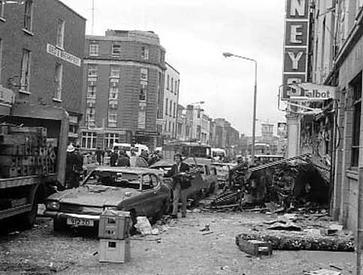
17 May 1974: The Dublin and Monaghan Bombings.  Three car bombs exploded in Dublin, immediately killing 23 people and injuring more than 100 others during the rush hour. Five more people died and another 20 were hurt in a blast, which hit the town of Monaghan an hour later. The final death toll was 34 people. The bombings were the work of a UVF gang that had links to elements within the British Army Intelligence services. No one has ever been charged with these attacks.

It was a hot day in early summer when the terrorists launched their attacks. The City centre of Dublin was full of shoppers and workers heading home that Friday afternoon, little suspecting that such a murderous deed was about to be inflicted upon them.

 In the North a huge Loyalist Strike was underway with the aim of bringing down the Power Sharing Executive that had been formed in January that year. Its aim was to allow both sides a share in the Government of the North so that no side would feel excluded. It also had as one of its terms the formation of an All Ireland Council. To many Unionists this was a step too far and a possible 'foot in the door' to a United Ireland without their consent.


The perpetrators of these bombings knew that the Executive at Stormont was in grave danger of collapse. It was clear the British Government under Harold Wilson was dithering with indecision as to what to do in the face of such a massive level of civil disobedience by most of the Unionist Community in Ulster. This was backed by widespread intimidation of those who tried to go about their business regardless.

Only the the Dublin Government under the Taoiseach Liam Cosgrave stood firm against any collapse of what they had tried so hard in negotiations to have set up and running. While the Troubles had claimed hundreds of lives north of the Border the south had escaped relatively unscathed up until then - but not entirely free of atrocities either.

Clearly the aim of the attackers was to jolt the people of the South, and the Dublin Government in particular, out of any sense of complacency that they could escape the consequences (as they saw it) of unwarrented interference in Ulster.

At approximately 17:30 on Friday 17 May 1974, without prior warning, three car bombs exploded almost simultaneously in Dublin's city centre at Parnell Street, Talbot Street, and South Leinster Street during rush-hour. According to one of the Irish Army's top bomb disposal officers, Commandant Patrick Trears, the bombs were constructed so well that one hundred per cent of each bomb exploded upon detonation.

The explosives used in the attacks were of the type used by the Provisional IRA and were probably from a haul that members of the Crown Forces had captured and that rogue elements had got their hands on to launch these attacks.

The first of the three Dublin car bombs went off at approximately 17:28, in a parking bay outside the Welcome Inn pub and Barry's Supermarket and close to a petrol station, in Parnell Street near its southwestern intersection with Marlborough Street. Ten people were killed in this explosion, including two infant girls and their parents, and a World War I veteran.

The second of the Dublin car bombs went off at approximately 17:30 at number 18 Talbot Street near the northwestern Lower Gardiner Street intersection, outside O'Neill's shoe shop opposite Guineys department store. At least four bodies were found on the pavement just outside Guineys.

The third bomb went off at approximately 17:32 in South Leinster Street near the railings of Trinity College, Dublin. Two women were killed instantly in that explosion; they had been very close to the epicentre of the blast.

Ninety minutes later, at approximately 18:58, a fourth bomb (weighing 150 pounds) exploded outside Greacen's pub in North Road, Monaghan.This bomb killed five people initially, and another two died in the following weeks. 

On the evening of the bombings, the Taoiseach, Liam Cosgrave, said in a TV and radio broadcast that he wanted to express 'the revulsion and condemnation felt by every decent person in this island at these unforgivable acts.' He said it would help 'to bring home to us here what the people of NI have been suffering for five long years.' He added 'everyone who has practised violence, or preached violence or condoned violence must bear a share of responsibility for today's outrage'.

In Belfast, the UDA and the UVF denied responsibility for the explosions and in Dublin a statement issued by the Provisional IRA called the explosions 'vile murder'. Mr. Brian Faulkner, NI Chief Executive, sent a message to Mr. Cosgrave expressing 'deepest regret' from himself and his colleagues. The UDA Press Officer, Mr. Samuel Smyth, said: 'I am very happy about the bombings in Dublin. There is a war with the Free State and now we are laughing at them'.

But within days the official attitude had changed and the feeling in Government ranks was to play down this huge atrocity to avoid heightening tensions and giving credibility to the Provisional IRA. As the weeks rolled by the Garda investigations were wound down and then effectively stopped. It has been rumoured that names of the killers were known to the police forces in both parts of Ireland even if it could never be proved. The event was buried by the forces of Officialdom over the years and forgotten about. No one has ever been charged with these crimes on that terrible day.

LOST LIVES 

Dublin and Monaghan Bombings - 17th May 1974:

Patrick Askin (44) Co. Monaghan
Josie Bradley (21) Co. Offaly
Marie Butler (21) Co. Waterford
Anne Byrne (35) Dublin
Thomas Campbell (52) Co. Monaghan
Simone Chetrit (30) France
Thomas Croarkin (36) Co. Monaghan
John Dargle (80) Dublin
Concepta Dempsey (65) Co. Louth
Colette Doherty (20) Dublin
Baby Doherty (full term unborn) Dublin*
Patrick Fay (47), Dublin & Co. Louth
Elizabeth Fitzgerald (59) Dublin
Breda Bernadette Grace (34) Dublin and Co. Kerry
Archie Harper (73) Co. Monaghan
Antonio Magliocco, (37) Dublin & Italy
May McKenna (55) Co. Tyrone
Anne Marren (20) Co. Sligo
Anna Massey (21) Dublin
Dorothy Morris (57) Dublin
John (24), Anna (22), Jacqueline (17 months) & Anne-Marie (5 months) O'Brien, Dublin
Christina O'Loughlin (51), Dublin
Edward John O'Neill (39), Dublin
Marie Phelan (20), Co. Waterford
Siobhán Roice (19), Wexford Town
Maureen Shields (46), Dublin
Jack Travers (28), Monaghan Town
Breda Turner (21), Co. Tipperary 
John Walsh (27), Dublin
Peggy White (44), Monaghan Town
George Williamson (72), Co. Monaghan
*Baby Doherty was recognised as the 34th victim of the Bombings by the Coroner for the City of Dublin during the course of the Inquests held in April and May 2004
http://www.dublinmonaghanbombings.org/index2.html

Thursday, 16 May 2013


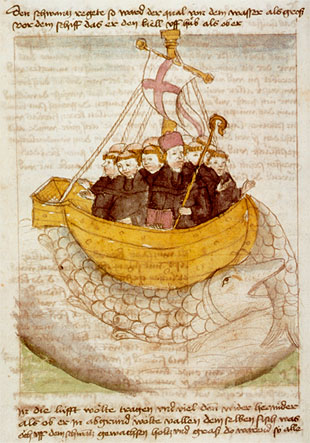
16 May circa 583 AD: Saint Brendan of Clonfert/Brénainn of Cluain Ferta aka 'St. Brendan the Navigator', early Atlantic voyager, died on this day. In the liturgical calendar, today is St. Brendan's Feast Day.


Saint Brendan/Bréanainn is one of Ireland's most famous saints, a man whose exploits on the High Seas have become legendary and whose fame spread throughout western Europe in the Middle Ages. He is reputed to have sailed far out into the Atlantic and discovered isles unknown to Europeans at that time. The Brendan Voyage/Navigatio Brendani was included in maps of Columbus’ time, which often showed an island called 'St. Brendan’s Isle' that was placed in the western Atlantic ocean. 


Map makers of the time had no idea of its exact position of this island but did believe it existed somewhere out in the Atlantic. It was mentioned in a Latin text dating from the ninth century called Navigatio Santi Brendani Abatis (Voyage of Saint Brendan the Abbot). It described the voyage as having taken place in the sixth century. Several copies of this text have survived in monasteries throughout Europe. It was an important part of folklore in medieval Europe and may have influenced Columbus when he planned his great voyage to the Indies.

The account of Brendan’s voyage contained a detailed description of the construction of his boat which was not unlike the currachs still made in Ireland today.


Skeptics could not accept that such a fragile vessel could possibly sail in the open sea. Several passages in the legend also seemed incredible—they were “raised up on the back of sea monsters”, they “passed by crystals that rose up to the sky”, and they were “pelted with flaming, foul-smelling rocks by the inhabitants of a large island on their route”.


Brendan and his companions finally arrived at the beautiful land they called “Promised Land of the Saints.” They explored until they came to a great river that divided the land. The journey of Brendan and his fellow monks took seven years. The return trip was probably the longest part of the odyssey.


The evidence that we have points to Brendan sailing North, possibly along the western coast of Scotland and onto Iceland and maybe as far as Greenland.


It is a story full of wonderful and strange adventures that while physically improbale in the way they have been handed down to us have enough information in them to point to actual happenings embelished by later medieval storytelling.


In the 1970's the Explorer Tim Sevrin embarked in a specially built Currach based on tehe one described as used by Saint Brendan and proved that it could survive a long sea voyage on the Atlantic.


He encountered whales who swam alongside and even underneath his ship. Saint Brendan's Voyage described the ancient mariners landing on a whale!


Sevrin encountered icebergs - St Brendan saw 'towering crystals'


The foul smelling rocks could well be from an Icelandic volcano that the poor monks thought was been thrown at them by the 'natives' of that fiery island!


St Brendan while one of the most famous of Irish Saints both at home and abroad is also one whose Life we can only reconstruct from the tales and legends about him. His fame meant that many Abbies and monastries wanted his name associated with him and which ones would (if it were possible) hold up to examination and which would not we now alas cannot determine.


St. Brendan,The Navigator - World Cultures European

Wednesday, 15 May 2013


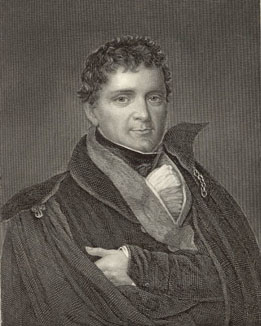
15 May 1847 : The Death of Daniel O’Connell ‘The Liberator’ at Genoa while making his way to the Holy City. His heart (now lost) was taken on to Rome and his body was returned to Dublin for internment in Dublin’s Glasnevin Cemetery.

On May 15, 1847, Father Miley, O'Connell's companion on his last journey, wrote from Genoa:

“The Liberator is not better. He is worse – ill as ill can be. At two o'clock this morning I found it necessary to send for the Viaticum and the holy oil. Though it was the dead of night, the cardinal archbishop (he is eighty-eight years old), attended by his clerics and several of the faithful, carried the Viaticum with the solemnities customary in Catholic countries, and reposed it in the tabernacle which we had prepared in the chamber of the illustrious sufferer. Though prostrate to the last degree, he was perfectly in possession of his mind whilst receiving the last rites. The adorable name of Jesus, which he had been in the habit of invoking was constantly on his lips with trembling fervour, His thoughts have been entirely absorbed by religion since his illness commenced. For the last forty hours he will not open his lips to speak of anything else. The doctors still say they have hope. I have none. All Genoa is praying for him. I have written to Rome. Be not surprised if I am totally silent as to our own feelings. It is poor Daniel who is to be pitied more than all.”
Henry Peel OP
St Martin de Porres Magazine, a publication of the Irish Dominicans.


Daniel O'Connell died at Genoa, in Italy, at 9.35 p.m. on the evening of May 15th, 1847, on his way to Rome

Born near Cahirciveen, County Kerry and adopted at an early age by his uncle Maurice ‘Hunting Cap’ O’Connell. His family had strong trading links with the Continent and he was educated at Saint-Omer and Douai; entered Lincoln’s Inns in 1794 and was called to the Bar in Dublin in 1798. A co-founder of the Catholic Association in 1823, he realised the movement’s enormous potential with the creation of the Catholic rent, enabling ordinary Catholics to become members for one penny a month and creating a substantial reserve of funds for a political campaign. A series of election victories culminated with O’Connell being returned as MP for Clare in 1828 and the Government introducing Catholic emancipation the following year. At the same time, however, they disenfranchised the forty-shilling freeholders who had been the bedrock of the Association’s success.

Giving up his immensely successful practice at the bar, O’Connell now turned his prodigious energy to the campaign to repeal the Act of Union. The 1830s saw swings in his political fortune and the momentum of the movement generally, the Irish Repeal MPs on occasion holding the balance of power at Westminster and some reform being effected on matters such as tithes and municipal administration. He was elected Lord Mayor of Dublin in 1841 and with subscriptions to his Repeal Association reaching enormous proportions, he began to organise monster rallies throughout Ireland, a meeting at Tara being attended by an estimated 750,000 people. A meeting scheduled for Clontarf on 8 October 1843 was proscribed and, to the dismay of his followers, O’Connell called it off. He was subsequently arrested, tried for conspiracy, convicted, fined £2,000 and sentenced to one year’s imprisonment. He was released after five months but emerged from his imprisonment physically and mentally weakened. His influence over a fragmented movement continued to wane and the Great Famine removed the last of the popular fervour for repeal. He set out for Italy in March 1847 and died in Genoa on 15 May.
http://www.ucd.ie/archives/html/collections/oconnell-daniel.htm

Sunday, 12 May 2013


12 May 563: Saint Columba and his twelve companions crossed the sea from Ireland in a currach of wickerwork covered with hides.

Columba was in his forty-fourth year when he departed from Ireland. He and his twelve companions crossed the sea in a currach of wickerwork covered with hides. They landed at Iona on the eve of Pentecost, 12 May, 563. The island, according to Irish authorities, was granted to the monastic colonists by King Conall of Dalriada, Columba's kinsman. ... It was a convenient situation, being midway between his countrymen along the western coast and the Picts of Caledonia. 

He and his brethren proceeded at once to erect their humble dwellings, consisting of a church, refectory, and cells, constructed of wattles and rough planks. 

After spending some years among the Scots of Dalriada, Columba began the great work of his life, the conversion of the Northern Picts. 
CATHOLIC ENCYCLOPEDIA: St. Columba


But mystery surrounds why exactly did Saint Columba, a powerful and influential man in Ireland, depart the land of his birth for such a bleak and remote spot far from any place of influence in this World.

Columba was like many other Irishmen of the Faith motivated by a desire to convert as many Pagans to Christianity as he could in order to save their souls from Damnation. But what exactly was the catalyst that pushed him over the edge to leave here? The idea of pilgrimage, or peregrinatio, which was central to Irish monks and to Columba, involved a permanent sense of exile, renunciation and searching for one's own place of resurrection; one's desert. But it did not necessarily mean a complete seperation from the World, rather as search to find a place where solitude and reflection were needed they were readily at hand.

The Battle of Cúil Dreimne 560/561 AD was considered in later years to be the event that triggered Columba's peregrinatio


Saint Columba, also known as Colum Cille, is the greatest of the Irish saints. His involvement is considered central to the subsequent story of this battle. It is probably the only one in Irish History in which the copyright to a book was remembered as one of the reasons for a battle! However that was not the only factor involved and indeed it is only fair to mention that whether the dispute over a copywrite was one of the real reasons cannot be traced to a contemporary written source. We know that historically Columba fell foul of the Church authorities in the wake of this battle and the copywrite story became accepted in later times as the reason for his subsequent exile.


The High King at the time was Diarmait Mac Cerbhall ,a descendant of the great Niall of the Nine Hostages. Saint Columba was himself of the Uí Néills of Cenel Conal and thus of Royal blood. However he was also a man of ambition and drive. He made the mistake of copying a holy book belonging to another saint and was caught red handed. He appealed to the High King for judgement, possibly hoping that familial ties, however distant, would swing things in his favour. The King decided otherwise and in a famous judgement declared that: to every cow its calf and to every book its copy.

Much incensed Columba returned home to the North and raised the issue with his immediate kinsmen, of Royal blood themselves, against the High King. They brought the King of Connacht into their alliance, who seems to have become involved due to the treacherous death of his own son by King Diarmait, despite being under the protection of Saint Columba. He also owed his position as King of Connacht to the northern Uí Néills, who had helped him win the throne in 550 AD at the battle of Cuil Conaire.

No doubt land and power played a huge part in all this too that we are unable to trace in an exact path in the historical accounts. It is probable though that the northern Uí Néills viewed Diarmaid of the southern Ui Neills with some suspicion. He was certainly a character who was hard-hitting and ruthless and who brooked no opposition. He in turn felt that by siding with St. Columba in this dispute the northern Uí Néills were interfering in his affairs.

This great and important battle of Cúil Dreimne was fought at the foot of Ben Bulben, just above the Columban Church of Drumcliff in County Sligo. From the location it looks like it was Diarmait who initiated the Campaign by marching north to meet his enemies in battle. He probably wished to place himself between his opponents in Connacht and Ulster and defeat them in turn. While a good strategy his plan of campaign backfired and the High King was soundly defeated with a great loss of life to both sides. It is recorded that 3,000 men fell that day. As it turned out neither the northern Uí Néills nor the king of Connacht followed up their success, and Diarmait lived to fight another day. However the defeat of Diarmait was to have far reaching consequences that were not readily apparent at the time.

Columba was full of remorse afterwards. He was too good a man not to realise the enormity of what he had unleashed, however unwittingly. The Church too was less than impressed with his involvement in all this. He had foolishly allowed his personal pride to be used as a catalyst for War between the various branches of the Ui Neills, his own kinsmen. This in turned had pulled in the kingdom of Connacht so that three of Ireland’s five ancient provinces were involved in a bloody encounter that he had played a large part in starting. As a result of the battle of Cúil Dreimne St. Columba was banished from Ireland by his peers in the Church and made to swear he would never put his feet on the ground here again. Thus in the year 563 AD he made his momentous decision to sail for the island of Iona off the west coast of Scotland. From here his missionaries and their successors were one day to spread the word of the Gospel to the heathen Picts and the Pagan English of Northumberland.

They landed at the little island of Iona off the east coast of Scotland on the eve of the Feast of Pentecost. The island, according to Irish sources, was probably granted to the monastic colonists by King Conall of Dalriada, Columba's kinsman. It was a convenient situation, being midway between his countrymen along the north western coast of Ireland and the Picts of Caledonia. He and his brethren proceeded at once to erect their dwellings, consisting of a church, refectory, and cells, constructed of wattles and rough hewn wood.

However not only was Saint Columba to have great influence on the development of Christianity in Scotland but it is believed that it was here and in this year that the first Annals of contemporary events back home in Ireland were recorded on a regular basis.


Saturday, 11 May 2013


11‭ ‬May‭ ‬1745:‭ ‬The battle of Fontenoy was fought on this day.‭ ‬It occurred in what was then the Austrian Netherlands in present day Belgium.‭ ‬The French under Marshal De Saxe defeated the British‭ ‬-‭ ‬Dutch Army under the Duke of Cumberland.

The Allied Army was on the advance to relieve the siege of Tournai when they encountered the French under Marshal De Saxe drawn up in prepared positions.‭  ‬In all the French army numbered‭ ‬93‭ ‬battalions,‭ ‬146‭ ‬squadrons and‭ ‬80‭ ‬cannon,‭ ‬some‭ ‬70,000‭ ‬troops,‭ ‬of which‭ ‬27‭ ‬battalions and‭ ‬17‭ ‬squadrons were left to cover Tournai.‭ ‬In support of this position was a reserve of picked infantry and cavalry regiments,‭ ‬including the Irish Brigade,‭ ‬the‭ “‬Wild Geese‭’’‬.

Cumberland reconnoitred the French position on‭ ‬10th May and decided to pin down the French right wing by attacking with the Austrian and Dutch contingents between Antoing and Fontenoy.‭ ‬While these attacks were being made the British and Hanoverians would advance between Fontenoy and the Bois de Bary across what appeared to be open ground.‭ ‬The Pragmatic Army was comprised of‭ ‬56‭ ‬battalions of infantry and‭ ‬87‭ ‬squadrons of cavalry supported by‭ ‬80‭ ‬cannon,‭ ‬in all around‭ ‬53,000‭ ‬men

The French Army however put up a formidable defence and the Allies found the advance heavy going,‭ ‬taking many casualties as they attempted to break their opponents line.‭ ‬But Cumberland pressed on and eventually forced his way into the centre of the French position.‭ ‬The troops opposing him began to buckle.‭ ‬It was the critical moment of the battle.‭ ‬It was at this point that Marshal De Saxe unleashed his reserve who enveloped the flanks of the British Column.‭ ‬The Irish Brigade was in the think of it,‭ ‬the men fired up by thought of revenge against their Country’s Oppressor.‭  ‬The Irish Regiments advanced upon the British lines to the cry:‭  ‬'Cuimhnigidh ar Liumneac,‭ ‬agus ar fheile na Sacsanach‭’ – ‘‬Remember Limerick and British faith.‭’

It consisted that day of the regiments of Clare,‭ ‬Lally,‭ ‬Dillon,‭ ‬Berwick,‭ ‬Roth,‭ ‬and Buckley,‭ ‬with Fitzjames‭' ‬horse.‭ ‬O'Brien,‭ ‬Lord Clare,‭ ‬was in command.‭ ‬Aided by the French regiments of Normandy and Vaisseany,‭ ‬they were ordered to charge upon the flank of the English with fixed bayonets without firing‭… 

The fortune of the field was no longer doubtful.‭ ‬The English were weary with a long day's fighting,‭ ‬cut up by cannon,‭ ‬charge,‭ ‬and musketry,‭ ‬and dispirited by the appearance of the Brigade.‭ ‬Still they gave their fire well and fatally‭; ‬but they were literally stunned by the shout,‭ ‬and shattered by the Irish charge.‭ ‬They broke before the Irish bayonets,‭ ‬and tumbled down the far side of the hill disorganized,‭ ‬hopeless,‭ ‬and falling by hundreds.‭ ‬The victory was bloody and complete.‭ ‬Louis is said to have ridden down to the Irish bivouac,‭ ‬and personally thanked them‭…

George the Second,‭ ‬on hearing it,‭ ‬uttered that memorable imprecation on the penal code,‭ '‬Cursed be the laws which deprive me of such subjects.‭' ‬The one English volley and the short struggle on the crest of the hill cost the Irish dear.‭ ‬One-fourth of the officers,‭ ‬including Colonel Dillon,‭ ‬were killed,‭ ‬and one-third of the men.‭ ‬The capture of Ghent,‭ ‬Bruges,‭ ‬Ostend,‭ ‬and Oudenard,‭ ‬followed the victory of Fontenoy.‭"

STORY OF IRELAND
By A.‭ ‬M.‭ ‬Sullivan

It was their most famous Victory though it came at a high cost,‭ ‬with hundreds of men dead and wounded.‭ ‬The Pragmatic Army lost almost‭ ‬10,000‭ ‬men,‭ ‬while the French suffered between‭ ‬6,000-7,000‭ ‬casualties


Friday, 10 May 2013


10 May 1318: The Battle of Dysert O'Dea was fought on this day. It took place near near Corofin, Co Clare. The battle occurred during the Bruce Invasion of Ireland.

The Anglo Norman Lord Richard De Clare ( a descendant of Strongbow) attacked the Irish chieftain Conor O’Dea, chief of the Cineal Fearmaic and the ally of King Muircheartach O’Brien of Thomond. De Clare made the mistake of dividing his army in three in the face of the enemy and he led the van towards Castle Dysert O’Dea – the home of the Irish Chieftain. O’Dea held them at the ford of Fergus and sent messengers out to bring up reinforcements as De Clare charged at his opponents only to be surrounded and cut down by the axe of Conor O’Dea himself.

As the rest of the Anglo Norman force came up they waded into the Irish and were on the point of extracting a bloody revenge when Felim O'Connor's troops charged down the hill of Scamhall (Scool) and cut a path through the English to join the battle. De Clare's son then arrived on the scene and was cut down and killed by Felim O'Connor.

As the two forces were locked in this deadly struggle both expected reinforcements to arrive and as King Muircheartach O'Brien’s men galloped onto the scene Conor O’Dea almost lost heart until he heard the Irish war cries and knew the victory was won. Soon Lochlann O'Hehir and the MacNamaras joined the fight and it was all over for the English who went down fighting.

The power of one of the great Anglo Norman families was shattered forever. In the wake of this victory King Muircheartach O'Brien advanced upon Bunratty Castle, home of the De Clare’s to find it burnt by De Clare’s widow who promptly fled to England. The De Clare’s never returned and Thomond west of the Shannon remained under Irish rule until the early 17th Century. It was the greatest Gaelic victory of the Bruce War.

Thursday, 9 May 2013


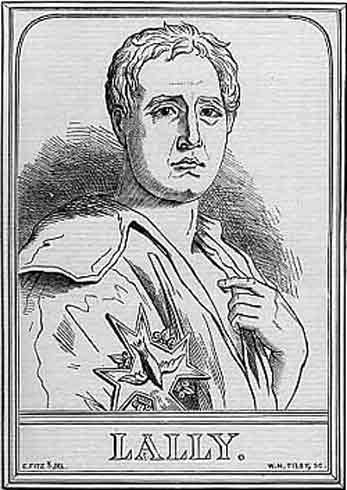
9 May, 1766 - Thomas Arthur Lally, Comte de Lally was executed for losing Pondicherry in India to the English. The General was convicted of ‘treason’ as a result. He was decapitated by sword before a huge crowd at the Place de l'Hôtel de Ville in Paris on this day.

He was born at Romans-sur-Isère, Dauphiné, the son of Sir Gerald Lally, an Irish Jacobite from Tuam, County Galway, who married a French lady of noble family, from whom the son inherited his titles.

Entering the French army in 1721 he served in the war of 1734 against Austria; he was present at Dettingen (1743), and commanded the regiment de Lally in the famous Irish brigade at Fontenoy (May 1745). He was made a brigadier on the field by Louis XV.

He had previously served the Jacobite cause, and in 1745 accompanied Prince Charles Edward to Scotland, serving as aide-de-camp at the battle of Falkirk (January 1746). Escaping to France, he served with Marshal Saxe in the Low Countries, and at the capture of Maastricht (1748) was made a maréchal de camp.

When war broke out with Britain in 1756 Lally was given the command of a French expedition to India. He reached Pondicherry in April 1758, and at the outset met with some measure of military success.

He was a man of courage and a capable general, but the desperate situation he found himself in -short of troops, money and supplies, and been put in charge of what was really a pretty hopeless task made him take severe measures to raise cash from both natives and Frenchmen alike. He tried to enforce rigid discipline on those who were slow at obeying. His relations with the Admiral of the east Indian French Fleet were disastrous and he he felt abandoned when the fleet departed for Mauritius.

In consequence everything went wrong with him. He was unsuccessful in an attack on Tanjore, and had to retire from the Siege of Madras (1758) owing to the timely arrival of the British fleet. He was defeated by Sir Eyre Coote at the Battle of Wandiwash (1760), then besieged in Pondicherry. On January 16 1761, Lally was forced to capitulate at Pondicherry where he had been besieged for months. The fortress was razed and Lally was sent to Great Britain as a prisoner of war.

On arrival in London in September 1761 he heard that he was accused in France of treason, and insisted, against advice, on returning on parole to stand his trial. He was kept prisoner for nearly two years before the trial began; then, after many painful delays, he was sentenced to death on May 6, 1766, and three days later beheaded. Louis XV tried to throw the responsibility for what was undoubtedly a judicial murder on his ministers and the public, but his policy needed a scapegoat, and he was probably well content not to exercise his authority to save an almost friendless foreigner.

The son of an Irish Jacobite exile The Count de Lally was 64 years old when he was beheaded and had been a loyal servant of the Ancien Regime throughout his lifetime. This execution was one of the worst inequities of the government of Louis XV. Lally was eventually pardoned and his Name restored to the honourable position it had held before these unfortunate events unfolded. His judicial murder is one of the most infamous cases in French legal History.