Tuesday, 28 May 2013
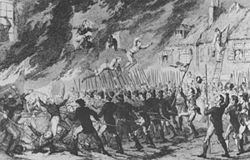
28 May 1798: The Wexford insurgents, amounting to several thousand people, marched northwards to Camolin on this day. By midday they were at Ferns and by the early afternoon they had reached the outskirts of Enniscorthy. They now numbered about 7,000 people. The Crown Forces that opposed them there were supplied with small arms but had no artillery and numbered only about 300 soldiers. The Wexfordmen were without artillery too and mostly carried pikes and homemade weapons. Nevertheless they stormed the town and drove the British southwards toward Wexford Town. Enniscorthy was left more or less a blackened ruin. As a result the United Irishmen made Vinegar Hill, just to east of the town their headquarters.
Members of the Crown Forces under Sir James Duff slaughtered 350 insurgents at the Curragh, Co Kildare. They had gathered there to surrender their weapons on agreed terms. Once they had laid down their arms the massacre began. The chief culprits in this were Roden's Light Dragoons, including the Monasterevan cavalry along with other militia units. Many others were wounded and others either fled on realising what was happening or feigned death till the troops departed.
At Enniscorthy the released captives Edward Fitzgerald and John Henry Colclough, arrived from Wexford Town with a message from the British Commander there. They gave a message that they should disperse and return to their homes or face retribution. Fitzgerald and Colclough had both been arrested two days before as suspected members of the United Irishmen. The British seemed to have assumed they might have enough influence with the Insurgents to persuade them to call off their campaign. In a dramatic moment though, the crowds in the town persuaded both men to join them and the Leadership decided to lead the thousands of armed men they now had under their control, southwards to attack Wexford Town.
Sunday, 26 May 2013
26 May 1315: Edward de Bruce (the younger brother of Robert de Bruce of Scotland) and his fleet (estimated at in excess of 6,000 men) landed on the Irish coast at points at and between Olderfleet Castle at Larne and Glendrum on the north east coast of Ireland. This was the start of his ultimately futile bid to seize Ireland from the English – an attempt that was to cause much bloodshed and suffering here for three long years.
Edward knew there was much dissatisfaction with English Rule in Ireland. He had helped his brother fight the Sassanach in Scotland and defeat their attempts to secure that Kingdom. But he was also a man of ambition and pride. He did not want to spend his life in his brother's shadow. King Robert in turn did not want is ambitious sibling as a thorn in his side either. He steered his focus onto freeing the Gaels of Ireland from English Rule. If he could achieve that then he would be shot of him and would have also diverted the attentions of King Edward II of England away from Scotland and onto Ireland.
Edward the Bruce intended from the start to rely on the Gaels of Ireland to provide support, both in men and material, to the Scots. In this the Scotsman met with a measure of success but as he moved south the number of Irish Chieftains ready to throw in their lot with the newcomers diminished considerably.
At first the Irish/Scottish alliance seemed unstoppable as they won battle after battle, in less than a year they had most of Ireland in their control. However by the beginning of 1317 famine had stricken the country making it difficult for either side to undertake military operations. The Famine was of unusual intensity and struck right across Europe, killing countless numbers as crops failed and the weather turned much colder.
Then in the late summer of 1318, Sir John de Bermingham with his army began a march against Edward de Brus. On 14 October 1318, the Scots-Irish army was badly defeated at the Battle of Faughart by de Bermingham's forces. Edward was killed, his body being quartered and sent to various towns in Ireland, and his head being delivered to King Edward II. The Annals of Ulster summed up the hostile feeling held by many among the Anglo-Irish and Irish alike of Edward de Brus:
Edward de Brus, the destroyer of Ireland in general, both Foreigners and Gaels, was killed by the Foreigners of Ireland by dint of fighting at Dun-Delgan. And there were killed in his company Mac Ruaidhri, king of Insi-Gall Hebrides [i.e. Ailean mac Ruaidhri] and Mac Domhnaill, king of Argyll, together with slaughter of the Men of Scotland around him. And there was not done from the beginning of the world a deed that was better for the Men of Ireland than that deed. For there came death and loss of people during his time in all Ireland in general for the space of three years and a half and people undoubtedly used to eat each other throughout Ireland."
The Annals of Ulster
Saturday, 25 May 2013
25 May 1921- The Custom House in Dublin was burnt out by members of the Dublin Brigade IRA. In an audacious and well planned operation some 200 IRA members seized control of the Custom House building on Dublin’s North Quay and set it alight. The purpose of the raid was to destroy the Local Government records of the British Administration in Ireland in order to further undermine their ability to rule the Country.
The Operation had been decided upon by the senior members of the Republican Movement at the time incl Michael Collins and Eamon De Valera. It was hoped that such a devastating blow would undermine British rule to such a degree that it would never recover it ability to collect taxation at local level.
The 2nd battalion Dublin IRA was tasked with carrying out the Operation.
Vinny Byrne - a member of Collins hit men unit - ‘the Squad’ - recalled:
'However a 25 May IRA attack on the Customs House in Dublin made it clear that the advocates of continued force within the Irish Independence movement were more than content to keep the fight going. The attack, waged largely by the Dublin Brigade's 2nd Battalion, marked the largest armed deployment by the rebel forces since the Easter Rising. With some 200 men involved in all, the attack in retrospect might be judged to have been as foolhardy for the IRA as it was dramatic in scale. While the objective of damaging the Customs House and destroying thousands of tax records was achieved, in all the attack resulted in the loss of some seventy-five members of the Dublin Brigade due to arrests at the scene and the deaths of six others...
The objective for attacking the Customs House in fact dated back to the end of 1918, when the Irish Volunteers devised a plan for the building's destruction if and when the British Government imposed conscription on Ireland. Vincent Byrne, a member of the execution gang attached to Michael Collins Intelligence Department, recalled his role in the attack and subsequent escape.
I got a tin of petrol and proceeded to the second floor. I opened the door and sitting inside there were a lady and a gentleman, civil servants having tea. I requested them to leave, stating that I was going to set fire to the office. The gentleman stood up and said 'Oh, you can't do that.' I showed him my gun and told him I was serious. . . The lady then asked me if she could get her coat, and I replied: 'Miss, you'll be lucky if you get out with your life.'
The Irish Revolution and its Aftermath 1916-1923 - Years of Revolt
Francis Costello
So while the immediate objective was achieved the operation was a costly one for the IRA as many of its top operatives were captured. The building was quickly surrounded by the Auxiliaries of the RIC who while ruthless were all combat experienced men. Many of the Volunteers were unable to effect their escape in time and were captured. So it was something of a Pyrrhic Victory for the men of the Dublin Brigade to burn out such an important edifice (both symbolic and real) of the British presence in Ireland that day.
Thursday, 23 May 2013
23 May 1798: The Battle of Prosperous and the outbreak of the Rising of 1798.
The Rising was fixed for the night of 23rd May 1798. The signal was to be the simultaneous stopping of the mail coaches that left Dublin General Post Office daily for Belfast, Cork, Athlone and Limerick. On the 23rd of May the mail coaches were to be seized and burnt at Santry, Naas, Lucan and the Curragh, and the rising began.
In the City itself attempts to trigger an outbreak were thwarted as the British Army moved to seize strategic assembly points and thus nip things in the bud. Small crowds of men had set out from the poor districts of the city of Dublin to seize the Castle and other key public buildings. Agents of the Crown had infiltrated their revolutionary organization, the United Irishmen, and had already arrested several of their key leaders, Lord Edward FitzGerald being the most important of them.
The Militia mobilized before the revolutionaries could assemble in large groups and what their leaders had hoped would be an almost bloodless coup turned into a debacle. Outside the City though the insurgents fared better and many gathered in rural areas of County Dublin as well as southern County Meath, northern County Kildare and northern and western County Wicklow. These groups attacked towns and villages in their respective localities and stopped and destroyed some of the mail coaches that were making their way out to the provinces.
From 24 May there was fighting at Prosperous, Clane, Kilcock, Maynooth, Rathangan, Timahoe, Monasterevan, and other places.
But it was at Prosperous, Co Kildare that the first military engagement began at 2 a.m on 24 May 1798 by a United Irishmen force about 600+ strong which targeted the British garrison consisting of Cork militia and a detachment of a Welsh regiment, the "Ancient Britons".
The garrison consisted of 35 of the City of Cork militia and 22 ancient Britons who were housed separately near the barracks. Captain Richard Longford Swayne, commander of the militia, had terrorised the area at free-quarters, since his arrival on the 20th May. Throughout Wednesday the 23rd, the locals gathered in the woods. At 2 o' clock the following morning, around 500 of them under Dr. John Esmond and Andrew Farrell. Their entry into the town was preceded by the infiltration of a small vanguard who, possibly aided by female sympathisers within, scaled the walls of the Militia barracks, killed the sentries and opened the gate.
At the barracks, they forced their way into Swayne's quarters where he was piked and shot before the troops could secure the building. Lighted faggots and furze were thrown through the windows of the underground office and the barracks was engulfed. Many of those who tried to escape were piked to death in the streets. Of the 57 soldiers in the garrison, nearly 40 were killed. Swayne's body was burnt in a tar barrel.
Thus was gained the first victory over the hated forces of the British Government.
But the next day, other members of the Ancient Britons, hearing of the death of their fellow soldiers, participated in the retaliatory massacre of 34 Irish prisoners at Dunlavin Green, Co. Wicklow.
Prosperous remained under United Irishmen control until 19 June when it was retaken by troops under the command of Colonel Stewart who boasted of destroying "this receptacle of rebellion".
By the end of the Summer of 1798 some 25,000 - 30,000 people lay dead across 11 counties of Ireland and the Rising was Crushed.
Tuesday, 21 May 2013
21 May 1981
The Third and Fourth Hunger Strikers Died in Long Kesh Prison
Raymond McCreesh (24), a Irish Republican Army (IRA) prisoner, and Patsy O'Hara (23), an Irish National Liberation Army (INLA) prisoner, both died having spent 61 days on hunger strike. Tomás Ó Fiaich, then Catholic Primate of Ireland, criticised the British government's attitude to the hunger strike.
The two men were preceeded by Bobby Sands (5 May) and Frankie Hughes (12 May) in their struggle for political status.
Their 5 demands were:
The right not to wear a prison uniform;
The right not to do prison work;
The right of free association with other prisoners, and to organise educational and recreational pursuits;
The right to one visit, one letter and one parcel per week;
Full restoration of remission lost through the protest
But perhaps best summed up in the H Block Ballad:
But I'll wear no convict's uniform
Nor meekly serve my time
That Britain may call Ireland's fight
Eight hundred years of crime.
The strike was to last until 3 October 1981 and was to see 10 Republican prisoners starve themselves to death in support of their protest. The strike led to a heightening of political tensions in the region. It was also to pave the way for the emergence of Sinn Féin (SF) as a major political force in Ireland.
Monday, 20 May 2013
20 May 1311: The Battle of Bunratty/Bun Raite.
Civil War raged in north Thomond (today's Co Clare) in the year 1311, a war that had been going on and off for decades as the O'Briens of that part of Ireland fought with one another to control their own territory. The chief antagonists at the time of this battle were King Dermot O'Brien[Clan Brien] and King Donough O'Brien [Clan Turlough].
The King of England's Justicar in Dublin was worried about the situation in Thomond and in May 1311 issued instructions that:
The war in the parts of Thomond between Richard Clare and Donatus Obreen, who calls himself prince of the Irish of Thomond, disturbs the peace throughout Ire. by its continuation. ORDER to prohibit Richard and Donatus from continuing that war and cause them to keep the peace for life.
Patent Roll 4 Edward II
http://chancery.tcd.ie/roll/4-Edward-II/patent
Which both sides ignored!
Donough O'Brien had the support of the Anglo-Norman DeBurghs of Connacht while Dermot O'Brien had the support of Anglo-Norman Richard de Clare based in Bunratty Castle.
The DeBurghs, led by William DeBurgh himself, invaded Clare to support their protege and clashed with Richard de Clare's men near Bunratty Castle. While the DeBurghs won the tactical battle disaster befell them when William was taken prisoner and Donough O'Brien fled the field of battle as a result.
Lord William de Burgh was captured. On the day of the Ascension of the Lord lord john de Crok* was killed with many others in the battle of Bunratty with a great deal of booty given up in battle.
Annals of Ireland by Friar John Clyn
*He was deBurgh’s Standard bearer.
However the hapless Lord was most unfortunate as another account of this Battle relates:
A great hosting by William Burk into Mumha [Munster], against the Clarach;
and they gave battle to each other,
and the Clarach was worsted, and a great defeat was inflicted on him there.
William Burk was himself taken prisoner in the rere of his people, whilst he was following up the rout;
and although he was there taken prisoner,
it was he that had the triumph of that battle.
Annals of Loch Cé
None of this ended the War and even though King Donough was treacherously killed later that year and Dermot died in 1313 the dispute lingered on for many more years.
Sunday, 19 May 2013
19 May 1798: Lord Edward Fitzgerald was shot and arrested at the home of the Merchant Nicholas Murphy at whose house (now 151 Thomas Street, Dublin) he was taking refuge in.
Lord Edward Fitzgerald was a most unlikely 'Rebel'. He was born on 15 October 1763 at Carton House, Co Kildare, one of the most prestigious stately homes in the Country. He was the son of the Duke of Leinster, the most senior Aristocrat in Ireland. He was later brought up at Frascati House, Blackrock, Co Dublin.
He received a Commission in the British Army at an early age and served with the distinction in the American Revolutionary War, taking part in the Battle of Eutaw Springs (1781) where he was wounded.
In 1783 FitzGerald returned to Ireland, where his brother, the 2nd Duke of Leinster, had procured his election to the Irish Parliament as a Member for Athy, a seat he held until 1790. He represented then Kildare County from 1790 to 1798.
He continued his Army career and served in Canada and then travelled extensively across eastern Canada and down the Mississippi before sailing for home through New Orleans.
However it was the events of the French Revolution that proved the turning point in his life. In 1792 he went to Paris and stayed with Thomas Paine. He sat in the observers gallery to listen to the debates of the French Convention and was impressed with what he heard. While there he married Pamela, who was the love child of Madame de Genlis herself by Louis Philippe II, Duke of Orléans. The future King of the French, Louis Phillipe, was among the witnesses.
At a convivial gathering on the 18 November, after the French victory at Jemappes, he offered at a public dinner a toast to: ''The armies of France: may the example of its citizen soldiers be followed by all enslaved countries, till tyrants and tyrannies be extinct.'' He also proposed a toast to “the speedy abolition of all hereditary titles and feudal distinctions”, and gave proof of his zeal by expressly repudiating his own title. For his actions in Paris he was cashiered from the British Army.
On his return to Ireland his views both private and public became more Radical. However he did not join the revolutionary United Irishman until 1796 when he quickly immersed himself in the military plans for a Rising. He travelled as far as Hamburg to secure funds and military assistance from the French. Some of the United Irishmen wanted to wait until this was guaranteed but Lord Edward was of the opinion that it was better to strike sooner rather than later.
By early 1798 it was obvious that further delay would prove fatal and a Rising must come soon. The British Government was using forceful methods to disarm people of any weapons they might have that could used against them. However Martial Law had not yet been declared.
The forces of the State also ran a very effective network of spies and informers that had infiltrated the United Irishmen or those who were on familiar terms with them.
On 23 March the military swept on the Dublin Committee of the revolutionaries and captured nearly all of them. Forewarned Lord Edward escaped the net but was now a hunted man.
In the aftermath the British declared Martial Law and it could be only a matter of time till things exploded. In response the date for the Rising was brought forward to be launched on 23 May 1798. However on 9 May, with Lord Edward till at large, a bounty of £1,000 was put on his head for information leading to his capture - a huge sum in those days.
Lord Edward was hiding in Thomas Street, Dublin but had just been involved in a skirmish with his pursuers and it was decided that his original place of refuge must have been compromised. He then moved on the night of the 18th to the home of the Feather Merchant Nicholas Murphy at what is now 151 Thomas Street. He was ill and under the weather but at breakfast the next morning was seen to recover. Murphy was apprehensive of having such a well known fugitive under his roof and (rightly) feared that his betrayal and arrest was only a matter of time.
That evening, at around 7pm Murphy went to Lord Edward's room to call him down for tea and remembered:
He was in bed. It was, at this time, about seven o’clock. I asked him to come down to tea. I was not in the room three minutes when in came Major Swan and a person following him with a soldier’s jacket, and a sword in his hand; he wore a round cap. When I saw Major Swan, I was thunderstruck. I put myself before him, and asked his business. He looked over me and saw Lord E. in the bed. He pushed by me quickly, and Lord E., seeing him, sprang up instantly and drew a dagger which he carried about him, and wounded Major Swan slightly, I believe. Major Swan had a pistol which he fired without effect; he immediately turned to me and gave me a severe thrust of the pistol under the left eye, at the same time desiring the person that came in with him to take me into custody. I was immediately taken away to the yard ; there I saw Major Sirr and about six soldiers of the Dumbarton Fencibles. Major Swan thought proper to run as fast as he could to the street, and I think he never looked behind him till he got out of danger, and he was the parading the flags, exhibiting his linen, which was stained with blood. Mr. Ryan supplied Major Swan’s place and came in contact with Lord E., and was wounded seriously. Major Sirr at that time came upstairs and keeping a respectful distance, fired a pistol shot at Lord E., in a very deliberate manner, and wounded him in the upper part of the shoulder. Reinforcements coming in, Lord E., surrendered after a very hard struggle. Lord Edward was imprisoned in Newgate....
Account of Nicholas Murphy
Lord Edward had fought like a lion against those sent to lead him into captivity, killing Capitan Ryan and wounding Major Swan. However with him badly outnumbered by men in arms his heroic defense could only last but a short time.
Desperately wounded in the struggle he lingered for a number of days in agony as septicemia took its toll. He died on the 4th of June 1798 as the Rising he had so long planned for was well underway.
Thus died one of the bravest of men, from a conviction, I believe, that he wished to ameliorate the condition of his country
NM
Lord Edward’s remains were placed in a vault under the East end of St. Werburgh’s Church in Dublin, near to the house he was taken in.
Years later the outcome that Murphy had feared was finally revealed - Betrayal!
The two informers implicated in the betrayal of Lord Edward were Francis Higgins (proprietor of ‘The Freeman’s Journal’), at that time a paper in the interest of Dublin Castle, the seat of British rule in Ireland, and Francis Magan, M.A., Barrister at Law. On the 20th of June 1798, Francis Higgins was paid his reward of £1,000 for Lord Edward’s capture (Fitzpatrick’s “Secret Service under Pitt”)
Subscribe to:
Posts (Atom)