Monday, 10 February 2014


10 February 1173: The death of Muiredhach Ua Cobhthaigh [O’Coffey], the Bishop of Cenel-Eoghan on this day. He was a respected ecclesiastical figure in the North of Ireland and the focus of his influence was in the land of Tír Eoghan [Tyrone].

While little is known about him during his time on Earth his eulogy in the Annals makes for interesting reading as to what was expected of an Irish Bishop in the 12th Century. Purity, wisdom and innocence were all prized virtues that Muiredhach practised. He ordained Priests and Deacons. He renovated and consecrated Churches and cemeteries and also built Churches and Monasteries throughout his Diocese. He was a man of great Charity and bestowed food and clothing amongst the wretched and unfortunate of his flock. As his end approached he did penance and made his way on his last pilgrimage to the monastery of Colm Cille at Derry and ‘sent forth his spirit unto heaven’ at this sacred place.

The night of his death coincided with a great astronomical event over the skies of Ireland as a spectacular display of the Northern Lights - the Aurora Borealis - illuminated the night sky:
 
Now, a great marvel was wrought on the night he died,—the night was illuminated from Nocturne to the call of the cock and the whole world [was] a-blaze and a large mass of fire arose over the place and went south-east and every one arose, it seemed to them it was the day. And it was like that by the sea on the east.
Annals of Ulster 1173


Sunday, 9 February 2014


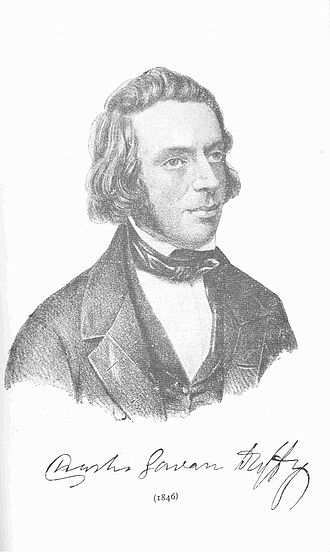
9 February 1903: The death occurred of Sir Charles Gavan Duffy, journalist and Patriot, on this day. He was born in Monaghan in 1816. In 1836 he joined the staff of the Dublin newspaper the Morning Register of which he afterwards became sub-editor. In 1839, he was made editor of the newly established The Vindicator, and he went to Belfast where he remained until 1842. That summer he returned to Dublin where along with John Blake Dillon and Thomas Davis he founded a newspaper called The Nation that was to revolutionise nationalist sentiment in Ireland. He was at first a supporter of O’Connell, and when O'Connell was prosecuted in 1844, Duffy was with him in the dock and subsequently his fellow-prisoner in jail. But he became disillusioned with the Liberator and his constitutional approach that eventually led nowhere.

After his death he partook in the abortive Rising of 1848. Despite many attempts by the British Government to convict him under the Treason Felony Act he managed to get himself acquitted at the fifth attempt and remained a thorn in their side. In 1850 he helped to found the Tenant League and two years later helped set up the Independent Irish Party, consisting of some 40 Irish MPs and of which he became the leader. The Party had a limited programme of Tenant and Ecclesiastical reform as practical first steps but internal divisions, the machinations of the British Government and the distrust of the Catholic Hierarchy led to disarray and defections.

By 1856 Duffy had had enough. He decided to emigrate to Australia and took his family with him. Here he again became active in politics. A sum of £5,000 was raised by public subscription in Victoria and New South Wales to provide him with freehold qualification for the House of either State. He was elected to the Legislative Assembly of Victoria for Villiers and Heytesbury. His first political action was to sponsor a bill to abolish the property qualification for Members; as the only Member who had also been a Member of the House of Commons, he also became an arbiter of parliamentary procedure. He was distrusted by many of the older Protestant settlers but was very popular with the growing Catholic Irish in the State of Victoria. He was elected to the Legislative Assembly for the years 1856-1864, 1867-1874, and 1876-1880. He was Knighted for his services in 1873. He was Premier of the State of Victoria for a year, between 19 June 1871 and 10 June 1872, at the head of a Ministry that combined free traders and protectionists. He was the Speaker for the years 1877-1880 but by this time he had become bored with the monotony of parliamentary affairs.

In 1880 he left Australia for Europe. He was now over 60 and had a guaranteed State pension that allowed him financial independence. He married for the third time and sired four more children. He kept up correspondence with his friends and colleagues in both Ireland and Australia after he settled in the south of France. He wrote extensively and published such works as Young Ireland: A Fragment of Irish History (1880), The League of North and South (1886), Thomas Davis: the Memoirs of a Patriot (1892) and My Life in Two Hemispheres (1898). One of his last political acts was to express support for the Boers in their struggle against the British Empire – a stance that shocked the British community in French Riviera city of Nice where he made his home. After his death his body was returned to Ireland and interred in Glasnevin Cemetery.


Saturday, 8 February 2014


8 February 1847: Daniel O’Connell’s last speech in the House of Commons on this day. In his final speech in the House, he predicted that unless more aid was forthcoming from the British Government for Ireland ‘one quarter of her population will perish’. His warning to his fellow MPs came as the full force of the Famine was raging in Ireland. The terrible outcome of the successive failures of the Potato Crop threatened to overwhelm the relief efforts at home to alleviate the worst excesses of hunger and disease that were sweeping across most the Country at that time.

His valedictory address in the House was almost inaudible and those assembled to hear what would clearly be his last speech before them strained to catch his softly spoken words. Observers reflected that he was but a dim shadow of his former self. He that on so many previous occasions had roused the House to heights and depths of emotions now struggled to exert himself so that his message of appeal could be heard and acted upon. He told the members that he had come to plead for the last time for Ireland. He made an accurate but terrible prophecy and that was:
Ireland is in your hands... your power. If you do not save her she can't save herself... I predict... that one quarter of the population will perish unless you come to her relief.

He stated that if they did not come to help her he solemnly called on them to recollect that he predicted that such a calamity would come to pass.

But O’Connell knew that while he was paid a respectful deference due to reputation and status as a powerful orator and due to his visibly declining health, that the members of the House of Commons had but a limited interest in Irish affairs and that his heartfelt and sincere appeal fell on deaf ears. He remarked some weeks after this noble but doomed appearance that:

How different it would all be if Ireland had her own Parliament.

Daniel O’Connell died in Genoa on the 15 May on his way to Rome. His heart was sent on to the Holy City and his body returned to Ireland where it was interred in Glasnevin Cemetery, which himself had helped to found.


Friday, 7 February 2014


7 February 1072 AD: Diarmait mac Maíl na mBó, king of Leinster, died on this day. He was one of the most colourful and dynamic Irish kings of the 11th Century and an ambitious ruler of his own province that wished to rule over all of Ireland. While he never achieved that lofty aim it was not for want of trying. He was of the Uí Cheinnselaigh, who had their base around the monastical centre of Ferns in Co Wexford. His family had long been excluded from the kingship of the Laigin and he was the first member of this ancient sept to hold the position in centuries. By the time Diarmait acceded to the kingship in 1042 his familial domains included sway over the Viking towns of Wexford and Waterford and with it access to Trade and Fleets that enhanced his power and wealth.

However his breakthrough into the world of being a serious player in provincial politics and international affairs came in 1052 when he captured the city of Dublin and declared himslef king – a feat not even Brian Boru had accomplished. The acquisition of one of the main trading entrepots of north western Europe meant that King Diarmait had direct control over a powerful fleet of warships and merchantmen.

These vessels plyed their way up and down the Irish Sea and interlinked into a vast trading network that stretched to Spain and North Africa to the south and across to the great rivers of Russia to the East. With this kind of naval power at his disposal he was not averse to using it and after installing his son Murchad as King of Dublin he had his offspring invade the Norse held Isle of Man in 1061 and put it under his rule.

Diarmait also became involved in the internal politics of Wales and Saxon England. He supported many of the Welsh Princes in their efforts to gain dominance in that Country. He most notably supported the attempts of Cynan ab Iago of Gwynedd to restore himself to power in north Wales, possibly in return for some kind of payoff in trade or suzerainty. In the winter of 1051/52 he had no less a visitor than Harold Godwinesson, the future King Harold of England, who sought refuge here against his enemies at home. After that King’s defeat and death at Hastings in 1066 his sons fled here and King Diarmait provided them with a fleet of sixty six ships to raid the coast of England and try to regain their Country for the Saxons. While they did not prevail the fact that the king of Leinster was where these hapless sons of the late king turned for help is indicative of his power and prestige at this time.

The King of Leinster was also active in engaging with his royal rivals within Ireland too. He allied with the Ulaid of the North and raided into Connacht and Meath. However it was in Munster he had his greatest success amongst the Gaels. He backed Turlough O’Brien as puppet king of that province, forcing the previous incumbent King Donnach to depart on a pilgrimage to Rome where he died. In 1067 he led a huge expedition into Connacht consisting of the men of Laigin, the Munstermen under Turlough O’Brien and a contingent from the kingdom of Breffni. A great battle was fought in which fell Aed O’Connor, the most powerful king of the western province. With this Victory there was no doubt that Diarmait mac Maíl na mBó was the most powerful king in Ireland and in effect an Ard Rí na hÉireann.

But while Fortune had favoured Diarmait for most of his life in 1070 tragedy struck when his beloved son Murchad died in battle against the men of Meath while on a raid. In 1072 it was Diarmait’s turn to go the way of all flesh when he too fell in battle against the warriors of the middle kingdom in the battle of Odba. His slayer was Conchobor ua Mael Sechnaill, of the traditional kings of Mide. Ironically his killer was himself treacherously slain the following year by his own nephew in an internal power struggle.

The Annals of the Four Masters [above] records Diarmait’s death as follows:

"Diarmaid, son of Mael-na-mbo, King of Leinster, of the foreigners of Ath-cliath, and of Leath-Mogha-Nuadhat, was slain and beheaded in the battle of Odhbha, on Tuesday, the seventh of the Ides of February, the battle having been gained over him by Conchobhar O'Maeleachlainn, King of Meath. There were also slain many hundreds of the foreigners and Leinstermen, along with Diarmaid, in that battle. In it was killed Gillaphadraig O'Fearghaile, lord of the Fortuatha, &c.''

It was Diarmait’s career and his relative success that coined the phrase rí Érenn co fressabra that is ‘king of Ireland with Opposition’ and indeed that is a fair summary of where he stood when he fell beneath the weapons of his enemies.



Wednesday, 5 February 2014


5 February 1820: The death of William Drennan, United Irishman, on this day. He was born in Belfast in 1754 and educated locally and at Edinburgh University where he graduated as a Medical Doctor in 1778. He returned home and practised in Belfast, Newry and later moved to Dublin in the fateful year of 1789. He became interested in Politics and Poetry. His family background was Presbyterian but he personally was a non conformist. But he was proud to be the son of a Presbyterian Minister all the same:

I am the son of an honest man; a minister of that gospel which breathes peace and goodwill among men; a Protestant Dissenting minister, in the town of Belfast; who[se] spirit I am accustomed to look up, in every trying situation, as my mediator and intercessor with Heaven.
Drennan came to National attention when in 1784 and 1785 his Letters of Orellana, an Irish Helot were published. These were the earliest expressions of his support for radical constitutional reform, Catholic Emancipation and civil rights.

However as political events both at home and abroad hotted up in the early 1790’s he dabbled deeper into the burning issues of the day. Along with Theobald Wolfe Tone and Thomas Russell he was instrumental in the foundation of the United Irishmen, at the time an open body with strictly legal aims and methods. It is generally considered that Drennan was the guiding hand in the initial philosophical basis of the new body. He had proposed even before it was established that any such organisation should be:

A benevolent conspiracy—a plot for the people—no Whig Club—no party title—the Brotherhood its name—the rights of man and the greatest happiness of the greatest number its end—its general end, real independence to Ireland and republicanism its particular purpose—its business, every means to accomplish these ends as speedily as the prejudices and bigotry of the land we live in would permit.
In 1795 he wrote his poem ‘Erin’ which is credited with the first use of the term ‘the Emerald Isle’ to describe Ireland:
 
Nor one feeling of vengeance presume to defile
The cause, or the men, of the Emerald Isle.


However Drennan was not of a sanguinary turn of mind and he recoiled from the prospect of Revolution to bring about the overthrow of the British Regime. Notwithstanding this withdrawal in the year 1794 he was charged with Sedition and narrowly escaped conviction. At first he wished to address the Court and make a highly charged political statement but his lawyer talked him out of it. If he had done so it was generally considered he would have convinced his accusers of his guilt in their eyes.

But his days of danger were now over and as his active political life receded he used his pen to attack Tyranny. His poem The Wake of William Orr in 1797 stirred passions that were to foment further opposition towards Orr’s executioners and the Government that paid them. However he kept well clear of the terrible events of 1798.
 
In 1800 he married an English Lady, Sarah Swanwick, and spent some years in the north of England moving in the Literary and Social circles there. In 1807 he gave up Medicine and returned to Belfast. He founded and edited the radical Belfast Monthly Magazine and was a leading supporter of the Belfast Academical Institution, a doomed attempt to bring to Belfast both secondary and higher level education, open to pupils from both sides of the religious divide

He died on 5 February 1820 and was buried in Clifton Street burial-ground in Belfast. His coffin was borne to the grave by three Catholics and three Protestants.


.


Monday, 3 February 2014


3 February 1919: Eamon De Valera [above] escaped with two other prisoners from Lincoln Jail in England on this day. They did this with the aid of a master key and the assistance of Michael Collins on the outside directing operations. De Valera escaped from the jail along with Sean McGarry and Sean Milroy. A skeleton key had been fashioned from a copy that Dev had secured from the Prison Chaplain who had carelessly left down his set so that it was possible to make an imprint onto a lump of wax made from old alter candles. After many trials and errors a set of keys was fashioned, which were sent into the jail in the time honoured way concealed in a cake!

On the day appointed the three prisoners put their plan of escape into action and made their way through various locked internal doors until they reached the outer one. Here it had been arranged that Michael Collins would use his copy to open the door from the street outside.

But disaster struck as Collins broke his in the lock and the end stuck in the keyhole. He hoarsely whispered into the men behind the door what had happened. Beside him stood Harry Boland aghast at the turn of events. The situation was now very desperate as it could only be a matter of time before the alarm was raised and a point of no return had already been reached. But Dev displayed his customary coolness and pushed his own key into the hole and by good grave pushed out Collins broken nub and turned the key to Freedom. A quick embrace and a sigh of relief was all there was time for as the men made their way across the fields and into a waiting Taxi that got them away and back to Ireland.

Sunday, 2 February 2014


2 February 1853: The Queen Victoria sank in a snowstorm off the Howth peninsula to the north of Dublin city - at least 55 men , women and children were lost.

This precipitous portion of the coast was the scene of a lamentable shipping disaster in 1853. The steamship Queen Victoria, on a voyage from Liverpool to Dublin, with about 100 passengers and cargo, struck on the southern side of the Casana rock during a dense snowstorm, between 2 and 3 o'clock on the morning of the 15th February. Eight of the passengers managed to scramble overboard on to the rocks, from which they made their way up the cliffs to the Bailey Lighthouse. The captain, without further delay, ordered the vessel to be backed, so as to float her clear of the rocks, but she proved to be more seriously injured than was imagined, and began to fill rapidly when she got into deep water. Drifting helplessly towards the Bailey, she struck the rocky base of the Lighthouse promontory, and sank in fifteen minutes afterwards, with her bowsprit touching the shore. The Roscommon steamer fortunately happened to pass while the ill-fated vessel was sinking, and, attracted by the signals of distress, Promptly put out all her boats and rescued between 40 and 50 of the passengers. About 60, however, were drowned, including the captain.

After a protracted inquest extending over several days, the jury found that the disaster was due to the culpable negligence of the captain and the first mate, in failing to slacken speed during a snowstorm which obscured all lights, they well knowing at the time that they were approaching land. The mate was subsequently put on trial for manslaughter.

It was believed by many that if the captain had not, in the first instance, backed off the rocks into deep water, all on board could have been saved.

Neighbourhood of Dublin.