Tuesday, 7 March 2017


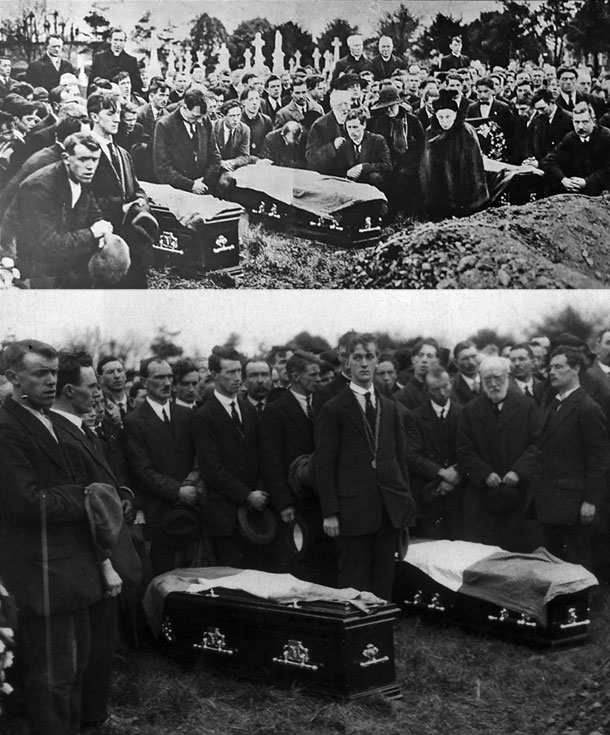
7‭ ‬March‭ ‬1921:‭ ‬George Clancy‭ ‬the Mayor of‭ ‬Limerick,‭ ‬and‭ ‬his immediate predecessor,‭ ‬Michael O'Callaghan were shot dead in their homes on this day.‭ ‬Known as‭ ‘‬the Curfew Murders‭’‬,‭ ‬as their houses were raided during the hours of curfew,‭ ‬their deaths shocked the whole City and Country and became International News.‭ ‬Mrs Clancy was wounded in a vain attempt to shield her husband from assassination and Mrs O'Callaghan also witnessed the murder of her spouse.‭ ‬Both victims were distinguished members of the Community and had been involved in the struggle for Independence.‭

‬Clancy was an ex University Professor and a friend of James Joyce.‭ ‬He is believed to have provided the background for a character in Joyce’s Classic‭ ‬‘Portrait of an artist as a young man.‭’‬ O'Callaghan’s grandfather,‭ ‬Eugene O‭' ‬Callaghan,‭ ‬was Mayor of Limerick in‭ ‬1843.‭ ‬A third leading Citizen,‭ ‬Joseph O’Donoghue,‭ ‬was taken from his house that night and found shot dead in a field some hours later.

Their‭ ‬assailants were in Mufti,‭ ‬wore goggles and with their coat collars turned up but it quickly became obvious that the gang in question were serving members of the Crown Forces.‭ ‬Mrs O’Callaghan gathered what evidence she could collect and demanded an Inquest but no inquiry other than a military one was ever carried out.‭ ‬Even the ex British Prime Minister Herbert Asquith stated that members of the RIC‭ (‬Auxiliaries‭) ‬were the culprits.‭ ‬However the particular individuals who carried these attacks were never formally identified with the crimes.‭ ‬Many years later in the‭ ‬1950s a deceased British Officer was named as one of the murderers but no conclusive proof was ever established as to his involvement.‭


Monday, 6 March 2017

Image result for medieval synod kells

6 March 1152: The Synod of Kells/Ceannas Mór was concluded on this day.  This great gathering of the churchmen of Ireland was presided over by the Papal Legate Cardinal Paparoni, sent by Pope Eugene III to conduct the proceedings. On his first attempt to get to Ireland, in 1150, Paparoni was refused a safe conduct through England by King Stephen unless he pledged himself to do nothing in Ireland that would injure England’s interests there. The cardinal refused and returned indignantly to Rome. It would seem that this was an attempt by Stephen to prevent Paparoni from bringing papal confirmation for an arrangement in Ireland that would see Canterbury’s [the seat of the Church in England] claims in Ireland finally extinguished. The Irish though sent a fresh delegation to Rome and Paparoni was induced to return but this time via Scotland under the protection of King David.

He was accompanied by Gilla Crist Ua Connairche, first abbot of Mellifont, now bishop of Lismore and permanent papal legate in Ireland (he had been a fellow monk with the current pope, Eugenius III, at Clairvaux), who may have been one of the delegation who had been sent to Rome. The cardinal arrived in Ireland at some time in October of 1151. Apart from a week he spent in Armagh, very little is known about his activities before the convening of the synod in the following March; approximately four months of his time is, therefore, unaccounted for. It is probable that he visited church leaders and lay magnates in preparation for the synod; perhaps he needed to check that the general agreement claimed for the new diocesan arrangement existed.

The purpose of the Synod was to continue the Reform of the Irish Church begun at the Synod of Rathbrassill that was held in 1111 AD. These changes followed closely the reforms that were underway on the Continent. In Ireland the most visible aspect was the reorganisation of the Church along clearly set out strict Diocesan lines with a Bishop or Archbishop having a defined territory of jurisdiction.

This synod approved the consecration of four archbishops, where before there had been two. Ireland was divided into thirty-six sees, and four metropolitan sees: Armagh, Cashel, Tuam, and Dublin. Armagh was granted Primacy. The diocese of Dublin, ruled by the Ostmen (Danes), seceded from Canterbury and was united with Glendalough.

Turlough O'Connor/Tairrdelbach Ua Conchobair, the High King of Ireland, approved the decrees, and the pallia (cloaks of office) were conferred by the Papal Legate Cardinal Giovanni Paparoni. This territorial structure of ecclesiastical governance has continued down to the present day and in its basic form is the template still used by both the Catholic and Anglican Churches in Ireland.

There has been some confusion as to the actual location of this synod. The Annals of the Four Masters say Drogheda, but the 17th Century Historian Geoffrey Keating, quoting an old book that is no longer extant, gave Kells as the location. It is probable that there were two separate sessions of this synod. The first was held at Kells and concluded by March 6; it then reconvened at Mellifont, near Drogheda, around Sunday, March 9, and concluded on Palm Sunday (March 23). It is not known how the business of the synod was divided between the two sessions, but it is likely that episcopal consecrations took place later at Mellifont and that the four pallia were then distributed to the archbishops at the last sitting on Palm Sunday.


Sunday, 5 March 2017

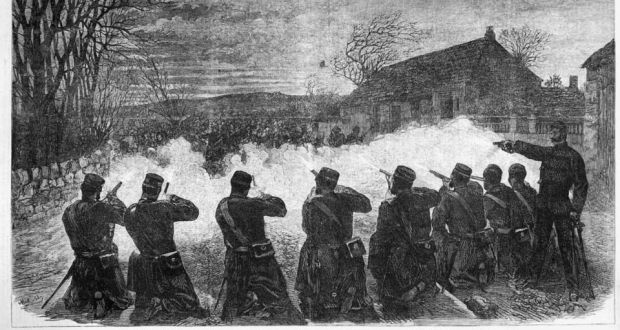
A contemporary illustration of the Battle of Tallaght from the London Illustrated News


5/6‭ ‬March‭ ‬1867:‭ ‬The Fenian Rising happened on this day.‭ ‬Long planned it turned into a complete fiasco.‭ On Shrove Tuesday that year thousands of volunteers turned up at various locations in Dublin,‭ ‬Cork,‭ ‬Tipperary,‭ ‬Limerick,‭ ‬and to a lesser extent in Clare,‭ ‬Waterford and Louth.‭

However most were armed with pikes if at all.‭ ‬Very few firearms were available.‭ ‬There was no coherent plan of operations.‭ ‬Attempts were made to take a number of police barracks and engage the Constabulary in action but all ended in failure.‭ ‬An‭ ‬informer,‭ ‬Corydon,‭ ‬betrayed the plans and to add to the insurgents woes a great snow storm made absolutely impossible not only all communications but all movements of men.‭ ‬The Constabulary knew something was afoot but decided to allow events to take their course and then take action.‭ ‬In the Dublin area it is possible that as many as two thousand men assembled with perhaps twice that number in county Cork and a few hundred elsewhere.‭ ‬One of the greatest Irish movements of the century ended apparently in complete failure.

While the British Government was caught off guard the Rising was over before they could react.‭ ‬Hundreds of men were rounded up and imprisoned.‭ ‬Some were sentenced to Death all these were commuted and no one was actually executed for their part in this affair.‭ ‬However long terms of imprisonment were handed down and many of the prisoners were subjected to very harsh conditions while in captivity.‭ ‬On top of this the Rising showed that Irish Republicanism was still a potent force and had by no means been crushed by the British.‭

This event did have important repercussions however as it led to a reorganisation of much of the underground activities of the IRB and the formation in America of Clan na Gael that was determined to prosecute a campaign against British rule notwithstanding recent setbacks.‭ ‬The failure of the‭ ‬1867‭ ‬Rising did not mark an end but a new beginning for those who were determined to end British rule over Ireland.

Saturday, 4 March 2017


4‭ ‬March‭ ‬1778:‭ ‬Robert Emmet was born in Dublin on this day.‭ ‬He was the youngest son of Dr Robert Emmet and Elizabeth‭ (‬Mason‭)‬.‭ ‬His father was a well to do Physician in the City with‭  ‬a house on St Stephens Green and another one down the Country.‭ ‬His elder brother Thomas Addis Emmet was a personal friend of Wolfe Tone who visited the family home on many occasions.‭

[Robert Emmet] was born in Molesworth-street, Dublin, in 1778. Shortly after his birth his father removed to 109 Stephen's-green West (corner of Lamb-lane). There, and at Casino, his father's country place near Milltown, his early years were passed. He was sent to Oswald's school, in Dopping's-court, off Golden-lane; subsequently he was removed to Samuel White's seminary in Grafton-street; and was afterwards put under the care of Rev. Mr. Lewis, of Camden-street. On 7th October 1793 he entered Trinity College. His college course, like his brother's, was brilliant. He exhibited great aptitude for the exact sciences, especially mathematics and chemistry.
http://www.libraryireland.com/biography/RobertEmmet.php

When he entered Trinity College in‭ ‬1793‭ ‬and joined the College Historical Society,‭ ‬a debating society.‭ ‬He became secretary to the United Irish Society in the college,‭ ‬but had abandon his studies in April‭ ‬1798‭ ‬when he and a number of students were expelled for their Republican sympathies.‭ ‬In‭ ‬1799‭ ‬he travelled to France to escape arrest and to secure support for another Rising in Ireland.‭

He returned home in late‭ ‬1802‭ ‬after the Peace of Amiens between Britain & France and began to lay plans to seize Dublin from the British.‭ ‬Unfortunately his plans were laid open by a premature explosion of his arsenal in July of the following year.‭ ‬He then banked all his hopes on an immediate eruption on‭ ‬23‭ ‬July but his venture quickly fell apart and he want into hiding.‭ ‬A few weeks later he was captured,‭ ‬tried for‭ ‘‬Treason‭’ ‬and gave the speech of his Life before the Court that quickly became a sensation and secured his reputation as a Patriot.‭

My country was my idol.‭ ‬To it I sacrificed every selfish,‭ ‬every endearing sentiment,‭ ‬and for it I now offer up myself‭ … ‬I acted as an Irishman,‭ ‬determined on delivering my country from the yoke of a foreign and unrelenting tyranny and the more galling yoke of a domestic faction,‭ ‬which is its joint partner and perpetrator in the patricide‭…
Delivered at the Session House in Dublin before the court which had convicted him of high treason, September 19, 1803.

He was sentenced to be hung,‭ ‬drawn and quartered.‭ ‬This was duly carried out on‭ ‬20‭ ‬September before a large crowd in Thomas Street Dublin.‭ ‬The whereabouts of his body today remains a mystery.‭

Friday, 3 March 2017


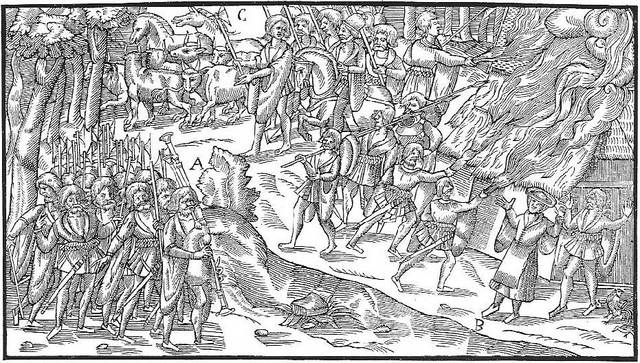
3 March 1577: The town of Naas, Co Kildare was torched by Rory Og O’More and Cormac MacCormac O’Connor on this day. These two Gaelic Chieftains with a select force of 140 men and boys ran through Naas like the ‘haggs and furies of hell, with flakes of fire fastened on poles’, and burned between 700 & 800 of the thatched houses belonging to the local townsfolk - who were still recovering from celebrating St David’s Day [1 March].

The English Lord Deputy Sydney was furious that Irish ‘rebels’ from the bogs of Laois were able to make such a surprise attack upon one of the chief towns of the Pale, cause such destruction in such a short space of time and then get clean away. He wrote that:


They had not one horseman, nor one shot with theim; they ran through the town, beinge open, like haggs and furies of hell, with flakes of fier fastened on pooles ends, and so fiered the low thatched howsies; and being a great windie night, one howse took fiere of another in a moment; they tarried not half an houre in the town, neither stoode they upon killinge or spoylinge of any.

 There was above fyve hundred mennes boddies in the towne manlyke enough in appearance, but neither manfull, nor wakeful as it seamed; for they confesse they were all aslepe in their bedde, after they had filled themselves and surfeyted upon their patrone day; which day is celebrated, for the most part, of the people of this country birthe, with gluttonye and idollatrye as farre as they dare.


But Sydney was a cold and ruthless man. An insult to his authority like this could not be passed over. He was determined to bring in Rory O’More dead or alive. All that year and well into the next he harried his elusive opponent. He killed any of O’More’s soldiers he could engage in battle and also members of the O’More family - including Rory’s wife Margaret (O’Byrne). Finally in June 1578 O’More was killed in a skirmish, his head cut off and brought to the Lord Deputy who had it stuck on a pole on the walls of Dublin Castle.


Rury Oge, the son of Rury Caech, son of Connell O'More, fell by the hand of Brian Oge, son of Brian Mac Gillapatrick. This Rury was the head of the plunderers and insurgents of the men of Ireland in his time; and for a long time after his death no one was desirous to discharge one shot against the soldiers of the Crown.


Annals of the Four Masters


Thursday, 2 March 2017


2‭ ‬March‭ ‬1914:‭ ‬John Redmond,‭ ‬the leader of the Irish Parliamentary Party,‭ ‬agreed to temporarily forego the introduction of Home Rule in the Ulster counties on this day.‭ ‬He was forced to adopt this decision in order to placate the growing opposition in the northeast to the imminent introduction of Home Rule for Ireland.‭ ‬Up until this point he had vehemently opposed such a measure.‭ ‬But he now felt that to press for a full implementation throughout Ireland would risk a Civil War and a complete break with the Unionists that would become permanent.‭ ‬He wrote to the British Prime Minister Herbert Asquith:

We are ready to give our acquiescence to the solution of the standing out for three years by option of the counties of Ulster as the price of peace.‭   

However Redmond’s decision was to prove a fatal one.‭ ‬For his obvious weakness on this issue further encouraged the Ulster Unionists to hold out for a permanent division.‭ ‬Redmond’s vacillation also disillusioned many on the Nationalist side that compromise was likely to bring about a positive result for Ireland.‭

Wednesday, 1 March 2017

1 March 560 AD: St. Senan of died on this day. Bishop and confessor. He was born at Magh Lacha, near Kilrush, Co. Clare circa 488 AD.  His parents were called Erean and Comgella.

St Senan is considered one of the ‘Twelve Apostles of Ireland’ part of an elite group of Holy Scholars who studied under the guidance of St Finnian at his Monastery at Clonard, Co Meath. He commenced his missionary career by founding a church near Enniscorthy, in around 510 and the parish is still known as Templeshannon/Tempeal Senan. He then visited Menevia, Rome and Tours before returning to Ireland.

 He founded a number of Monasteries but his most famous was on an island not far from the place of his Birth. This was on Iniscathaigh, today know as Scattery Island in the Estuary of the River Shannon. Here many Holy men and devotees came to visit him but no women – for the Saint made a strict point that no member of the fairer sex could set foot on the island. It is reputed that even his own sister, herself a saintly woman, was allowed to disembark there. To honour her dying wish to be buried near her beloved brother St Senan on her death had her body brought out on a boat near the island. When the tide was low he had her mortal remains buried beneath the tidal mud so that the spirit if not the letter of her last earthly desire was met. 

St Senan though was not against womanhood but believed in the rule of celibacy being strictly followed. He was patron to nunneries as well which he visited. It was while returning from one such visit on 1 March 560 AD that he suddenly took ill in a field outside the nuns church. Knowing his end was near, he raised his hands in thanksgiving to God, and telling his companions that his hour had come to depart from them, he bade them on his death to convey his body to Iniscathaigh.