Sunday, 25 November 2018


25 November 1913: The foundation of the Irish Volunteers in the Rotunda, Dublin on this day. The aim of the new organisation was to counter the Ulster Volunteers in providing a similar force for Irish nationalists in the event of an armed confrontation over Home Rule. The first President was Eoin MacNeill but it drew support from a wide spectrum of Irish nationalist opinion. 

The idea arose from an article he wrote some weeks previously in An Claidheamh Soluis [Sword of Light], an Irish language newspaper. His proposal was called ‘The North began’. In it MacNeill put forward the idea that a Force be established that would counter the formation of the UVF in the North. He intended to ensure that Irish Nationalism was not left unarmed and vulnerable as the political situation developed. It estimated that some 7,000 people went to the Rotunda’s Large Concert hall that night, with some 4,000 inside and another 3,000 outside. The meeting was called with the specific intention of raising a National Volunteer Force to be called ‘The Irish Volunteers’. In the Notices issued around Dublin in advance of the meeting it was stated that:

The purpose of the Irish Volunteers will be to secure and maintain the rights and liberties common to all the people of Ireland.

The new organisation quickly mushroomed and by April 1914 it was estimated to have around 80,000 members and by July that year some 160,000 men had signed up but only a few thousands had any weapons with which to fight. Nevertheless such a formidable body of public opinion could not be easily ignored by the British Government and all the indicators were that a bloody clash of arms was imminent in the late summer of 1914 between the Nationalist and Unionist armed camps over the thorny issue of Partition. 

Only the outbreak of the Great War in August 1914 precluded what otherwise would have been a Civil War here. The Irish Volunteers then split on the question of involvement in the Conflict with most though by no means all following John Redmond’s call for enlistment in the British Army while a core membership remained under MacNeill’s nominal control.


Saturday, 24 November 2018


24 November 1865: The dramatic rescue of James Stephens of the IRB from the Richmond Prison [above], Dublin on this day. The Fenian Leader was rescued from Richmond Prison in Dublin after only a few weeks captivity. He had been held only a few weeks when his escape was organised from without and within the prison itself. Inside the Richmond were John J. Breslin who was a hospital warder and a Daniel Byrne, an ordinary warder. The two men were sworn members of the I.R.B. and willing to help.

 On the outside the acting leader of the Organisation was Colonel Thomas Kelly and he helped put together a support team from within the Fenians to ensure that once on the outside Stephens remained free. At great risk Breslin managed to take wax impressions of the two keys he needed, one for Stephens cell, which was held in the Governors office and another for one of the outer doors. On the night of the actual rescue everything went according to plan. Only one other prisoner (a common criminal) was incarcerated on the same wing as Stephens and he wisely kept his mouth shut.
Once outside Stephens was ushered away to a safe house in the Summerhill area of the City where he remained for a number of months. The British put a price of £1,000 on his head but even this amount did not yield any informer willing to betray him. He eventually he made his way to Paris where he lived for many years and after a brief stay in Switzerland he returned home in 1891 and was left undisturbed by the Castle. He died in 1901.

It is curious to note that his escape from incarceration was an event that many Irish People at the time erroneously believed to have been acquiesced in by the British Government of the day. It was certainly an easy triumph for Irish Republicans that hugely embarrassed the occupying power.
The locale of Richmond Prison later became Wellington Barracks and after Independence was known as Griffith Barracks. Today the site is occupied by Griffith College on the South Circular Rd, Dublin.


Thursday, 22 November 2018


22 November 1963: President John Fitzgerald Kennedy was killed by an assassin's bullets as his motorcade wound through Dallas, Texas on this day. Kennedy was the youngest man elected President and he was the youngest to die. He was hardly past his first thousand days in office. His great grandparents hailed from Co Wexford and had fled Ireland in the 1840s to Boston, Massachusetts.

His Inaugural Address offered the memorable injunction: "Ask not what your country can do for you--ask what you can do for your country."

His untimely and brutal death triggered a wave of shock and grief throughout Ireland that very night as word rapidly spread across the airwaves and by word of mouth that the President had succumbed to his wounds. He had visited this Country only a few months previously and had been met with a huge and ecstatic welcome. His election as President in 1960 was a source of great pride to the Irish People and of some advantage to the Country in its International relations.

When the news broke at home that fateful Friday evening  people could hardly believe it. The first reports indicated he had been wounded and that he had been rushed to hospital in Dallas. Then came the terrible confirmation of his death.

It was Telefís Éireann broadcaster Charles Mitchel who was given the grim task of breaking the news that Ireland's favourite son was dead.

At 7.05pm on November 22, 1963, the nation was stunned into silence when the station broke into a sports programme to report that President Kennedy had been the victim of a shooting.

"We have just heard that an attempt has been made on President Kennedy's life in Dallas, Texas," the veteran newsreader said. "First reports say that he has been badly wounded."
Just 20 minutes later a visibly moved Mitchel came back on air to announce: "President Kennedy has been shot dead by an assassin in Dallas, Texas."
People simply didn't believe the news, and there were numerous calls to the station seeking confirmation.
http://www.independent.ie/irish-news/how-broadcasters-reported-the-shocking-killing-of-a-president-29758453.html

Wednesday, 21 November 2018


Image result for bloody sunday 1920

21‭ ‬November 1920: Bloody Sunday. IRA units organised around Michael Collins hit team ‘the Squad’ raided the premises of British spies and agents across Dublin City. The plan was to kill up to 35 men on the day. The core of this group were the notorious ‘Cairo Gang’ brought into Ireland specifically to gather information on IRA members in the City. Most of the ones on the hit list who were caught unawares did not escape. Others were more fortunate and made their escape just in time. In the event 14 people were killed incl at least one entirely innocent female victim. The IRA lost just one man captured. Nearly all of the raids were carried out in a small area of middle class Dublin in the south of the City.

The events of that morning rocked Britain’s spy network in the Capital to the core and in effect destroyed it as a viable espionage force.‭ Michael Collins justified what by necessity assassins’ work with the words:   

My one intention was the destruction of the undesirables who continued to make miserable the lives of ordinary decent citizens.‭ I have proof enough to assure myself of the atrocities which this gang of spies and informers have committed. If I had a second motive it was no more than a feeling such as I would have for a dangerous reptile. By their destruction the very air is made sweeter… For myself, my conscience is clear. There is no crime in detecting in wartime the spy and the informer. They have destroyed without trial. I have paid them back in their own coin.

That afternoon the Crown Forces raided Croke Park where Dublin were playing Tipperary and proceeded to open fire on the teams and spectators,‭ ‬killing 14 innocent people (including two young boys and a 26-year-old woman). One of the dead was Michael Hogan who was playing for Tipperary that day. 

Controversy as to who fired first was immediate with the Crown Forces insisting they were shot at before returning fire. However the most likely explanation is that members of the Auxiliary Division of the RIC fired warning shots in the air to panic the crowd and other members out of sight took it upon themselves to open up under the impression that IRA men in the crowd had targeted them.

A DMP Constable recounted to the Official Inquiry held in December 1920 by the British Military that:

‘On Sunday 21st inst. I was on duty outside the main entrance to Croke Park in Jones’s Road. At about 3.25 p.m. I saw six or seven large lorries accompanied by two armoured cars, one in front and one behind, pass along the Clonliffe Road from Drumcondra towards Ballybough. Immediately after a small armoured car came across Jones’s Road from Fitzroy Avenue and pulled up at the entrance of the main gate. Immediately after that, three small Crossley lorries pulled up in Jones’s Road. There were about ten or twelve men dressed in RIC uniforms in each. When they got out of the cars they started firing in the air which I thought was blank ammunition, and almost immediately firing started all round the ground.’

That night two senior members of the Dublin IRA,‭ Dick McKee and Peadar Clancy and a hapless civilian, Conor Clune, all of whom had been captured the previous day were done to death inside Dublin Castle ostensibly while ‘attempting to escape’.


21 November 615 AD: The Feast of St Columbanus of Bobbio in northern Italy on this day. Columbanus was the greatest of the Irish Apostles to preach the Faith on the Continent. He founded a string of monasteries that acted as bases from which his disciples spread the Word amongst the new Germanic kingdoms that emerged in the wake of the collapse of Roman power. Columbanus (the Latinised form of Columbán, meaning ‘the white dove’) was born in Ireland in 543, Prior to his birth, his mother was said to have had visions of bearing a child who, in the judgement of those interpreting the visions, would become a "remarkable genius". Columbanus was well-educated in the areas of grammar, rhetoric, geometry, and the Holy Scriptures.

Columbanus left home to study under Sinell, Abbot of Cluaninis in Lough Erne. Under Sinell's instruction, Columbanus composed a commentary on the Psalms. He then moved to Bangor Abbey on the coast of north east Ireland, where Saint Comgall was serving as the abbot. He stayed at Bangor until his fortieth year, when he received Comgall's permission to travel to the continent.

So after many years there as a leading member of the community he felt the call to go abroad and spread the Gospel amongst the Heathens. With some reluctance he was allowed to depart by his mentor and took twelve followers with him. Proceeding through Scotland and England they made their way to eastern France to the Court of the King of Burgundy. Here Columbanus was well received and given the old castle of Annegray in the isolated Vosges Mountains upon which to found a Monastery. Here the abbot and his monks led the simplest of lives, their food oftentimes consisting of nothing but forest herbs, berries, and the bark of young trees. So great was the devotion to Columbanus and so great were the numbers who flocked to witness his Piety and Sanctity that soon another site was required to cope with the influx of followers and penitents. Thus a new site was established at Luxeuil just a few miles away and Columbanus ruled his religious domain from there. However his great success evoked jealousy amongst the Frankish bishops and they conspired against him. 

Forced to flee he made his way down the Loire to catch a ship home to Ireland but a great storm swept the vessel back into the Bay. Columbanus then decided that he would make his way back across France to the Rhine Valley in order to reach the Suevi and Alamanni, to whom he wished to preach the Gospel. After a couple of years of mixed success in what is now Switzerland his small band of followers reached northern Italy and the Court of King Agilulf at Milan in the year 612 AD. The King although a follower of the heretical Arian viewpoint was favourably disposed to Columbanus and gave him a plot of land on the Bobbio river near Genoa in which to establish himself. Here the Saint passed the last years of his life. 

Columbanus is best known in monastic circles for his set of ‘Rules’ which governed the way each monk within the community had to conduct themselves. The Rule of Saint Columbanus embodied the customs of Bangor and other Celtic monasteries. It consisted of ten chapters, on the subjects of obedience, silence, food, poverty, humility, chastity, choir offices, discretion, mortification, and perfection.

However Columbanus did not lead a perfect life. According to his biographer Jonas and other sources, he could be impetuous and even headstrong, for by nature he was eager, passionate, and dauntless. These qualities were both the source of his power and the cause of his mistakes. His virtues, however, were quite remarkable. Like many saints, he had a great love for God's creatures. Stories claim that as he walked in the woods, it was not uncommon for birds to land on his shoulders to be caressed, or for squirrels to run down from the trees and nestle in the folds of his cowl. Although a strong defender of his Celtic Church traditions, he never wavered in showing deep respect for the Holy See as the supreme authority. 

It possible that Columbanus had travelled to Rome at some stage in his life to meet Pope Gregory to discuss various matters but he also communicated with his successor Pope Boniface on the Paschal question over when exactly Easter should be celebrated. The Celtic Church still followed the old ways of observance and Columbanus was eager to ensure that he did the right thing. He wrote to the Pontiff Theodore I that:

We Irish though dwelling at the far ends of the earth, are all disciples of St. Peter and St. Paul. . . Neither heretic, nor Jew, nor schismatic has ever been among us; but the Catholic Faith. Just as it was first delivered to us by yourselves, the successors of the Apostles, is held by us unchanged . . . we are bound to the Chair of Peter, and although Rome is great and renowned, through that Chair alone is she looked on as great and illustrious among us…

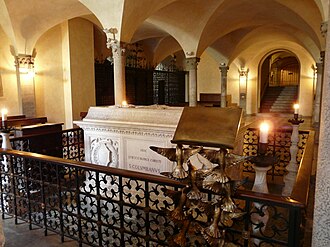
By this stage Columbanus was over 70 years old and his end was approaching. He prepared for death by retiring to his cave on the mountainside overlooking the Trebbia River and when he died his remains were interred in the Abbey Church in Bobbio. His final resting place became a site of pilgrimage and was famed throughout Western Europe as the site where one of the Christianity’s greatest advocates lay buried. It still exists today. [above]


Tuesday, 20 November 2018


20 November 1917: The Battle of Cambrai began on this day. The British High Command under General Haig wished to take a major position on the German ‘Hindenburg Line’ - a very powerful and well defended set of lines and structures to which they had withdrawn to earlier in the year. The British adapted some novel tactics to take a chunk out of the German defenses before Cambrai that had not been tried previously on such a scale. The attack was to be carried out by General Byng’s Third Army in the nature of  a coup de main, “to take advantage of the existing favourable local situation” where “surprise and rapidity of action are … of the utmost importance”. 

Initially a British victory it overwhelmed the German defenses and made - by WW1 standards - a rapid advance. The key to such success was a very brief but extremely heavy initial bombardment and the mass use of  almost 500 Tanks that took the Germans completely by surprise. The use of numerous aircraft in a tactical role was also employed. The British High Command were somewhat surprised too as they failed to have enough Reserve divisions on hand to exploit their early gains. Some days later in England church bells were rung out to celebrate a ‘Victory’ for the first time since the War began in 1914.

On this day regiments from two Irish Divisions took part -  the 36th (Ulster) Division & the 16th (Irish) Division. The 36th was deployed on the main line of advance at Cambrai on the far left flank and the 16th was further north at Bullcourt in a major diversionary attack. The attack opened with an intensive predicted-fire barrage on the Hindenburg Line and key points to the rear, which caught the Germans by surprise. Initially, this was followed by the curtain of a creeping barrage behind which the tanks and infantry followed. At Cambrai the planes of the RFC were used overhead to mask the noise of the tanks moving up to their start lines. The 36th (Ulster) Division attacked well and moved up the dry excavations of the Canal du Nord, and lay alongside the Bapaume-Cambrai road by nightfall.

The following day the advance was to be renewed  & to the north, the 36th (Ulster) Division, planning to continue their advance beyond Moeuvres, waited for the success signal, signifying that the 62nd had captured Bourlon [Wood]. It never came, for the 62nd could not penetrate beyond the sunken lane facing the wood. By the evening of the 21st, Haig was satisfied that ‘no possibility any longer existed of enveloping Cambrai from the south’
http://www.longlongtrail.co.uk/battles/battles-of-the-western-front-in-france-and-flanders/the-cambrai-operations-1917-battle-of-cambrai/

At Bullcourt further north the 16th Division went ‘over the top’ that morning of 20 November to capture a position known as ‘Tunnel Trench’ - in actual fact a very well defended line of trenches and fortifications. The morning was overcast with low visibility but that would have helped to mask the advance. The operation was very successful catching the Germans off guard. A barrage of smoke shells had convinced many of the defenders that a gas attack was underway and they donned gas masks and took cover in their dug outs. They were quickly overrun and flushed out and taken prisoners. Only on the right flank was there any serious opposition as the Connacht Rangers came under severe counter attack as to their right the 3rd Division made little progress thus leaving the Connachts flank hanging in the air.

The Germans soon gathered their wits about them and counter attacked with devastating effect on 30th November. They quickly cut swathes out of the British Front line and took back not just ground they had lost 10 days before but fresh gains where they had not initially sought to take. Chunks of the British Front line collapsed with men streaming back to the rear. Of course eventually the German advance ran of steam and the British consolidated their positions.
In the further battles around Cambrai the British Guards Division was thrown into action. It contained two Irish battalions - the 1st and 2nd battalions Irish Guards. They suffered heavy casualties in attacking Gouzeaucourt and in defending what part of Bourlon Wood that the British had managed to take. The Germans fought a determined action to take back this position as the wood was on the high ground that dominated the surrounding countryside. The British tried desperately to cling on but its advanced position made it untenable and eventually it was conceded to the Germans.

What had started as a ‘Victory’ turned into yet another bloody mess with no overall victor. But the lessons both sides learned there were to be applied on a massive scale in the battles of 1918 which decided the War.

In a battle that created many anecdotes one stands out of Irish interest involving the Irish Guards in the aftermath of the capture of Gouzeaucourt:

One grim incident stays in the minds of those who survived—the sight of an enormous Irishman urging two captives, whom he had himself unearthed from a cellar, to dance before him. He demanded the jigs of his native land, and seemed to think that by giving them drink his pupils would become proficient. Men stood about and laughed till they could hardly stand; and when the fun was at its height a chance shell out of the darkness to the eastward wiped out all that tango-class before their eyes. (“’Twas like a dhream, ye’ll understand. One minute both Jerries was dancin’ hard to oblige him, an’ then—nothin’, nothin’—nothin’—of the three of them!”)
The Irish Guards in the Great War Volume 1
Rudyard Kipling

Picture: Men of the 11th Battalion, Royal Irish Fusiliers, with German prisoners near Havrincourt, 20 November 1917. - courtesy of the Imperial War Museum London - http://www.iwm.org.uk/collections/item/object/205215567


Monday, 19 November 2018


19 November 1807: The sinkings of the Prince of Wales & the Rochdale Packet ships * in Dublin Bay on this day. A convoy of British troop transport ships set sail from Dublin. It comprised five ships: Sarah, Lark, Albion, Rochdale and the Prince of Wales. Two of the ships, the Rochdale and the Prince of Wales did not make it to their destination. They ended up being wrecked on the South Bull in Dublin Bay, with the loss of approximately 380 lives. Public outcry was one of the key factors that brought about the construction of what is now known as Dun Laoghaire East Pier. 

The Prince of Wales, the Parkgate packet ship, was a 103-ton wooden brig of Chester, originally built in Wales. It was en route to Liverpool with recruits from the South Cork and South Mayo Militia for the 18th and 97th Regiments. 

The stormy weather prevented the Prince of Wales from anchoring in Dublin Bay and it was forced to anchor off Bray Head in an attempt to gain some shelter. The wind direction changed and went SE, driving the Prince of Wales across Dublin Bay. It eventually ran ashore at Blackrock House. Captain Jones, the crew, two soldiers, a steward and his wife managed to get on board one of the ship’s boats and got ashore safely. The Prince of Wales started to break up soon afterwards and became a total wreck, with the loss of 120 lives. 

The Rochdale suffered a similar fate near Seapoint, just 20 feet from the shore. The ships were part of a military fleet bound for Liverpool that had left Dublin that morning. Snow and sleet showers backed by a heavy wind developed as the ships made their way out of Dublin Bay and as night came on they were blown onto the sandbanks just off shore where the ships capsized and foundered. It is estimated that some 120 were lost from the Prince of Wales and about 265 from the Rochdale.
The Rochdale, a brig of Liverpool, was also en route with some passengers and 265 soldiers of the 97th Regiment. It encountered an easterly gale and a snow storm shortly after leaving Dublin Bay and was driven back into Dublin Bay by strong winds and could be seen from both Dalkey and Dun Laoghaire as it burned blue lights and fired guns as signals of distress.

In an attempt to prevent the vessel from being blown ashore, several anchors were dropped, but these failed when the cables snapped. The vessel was driven helplessly past Dun Laoghaire Pier and went ashore on rocks under the Martello Tower at Seapoint, half a mile from where the Prince of Wales had gone ashore. 

Even though the wreck was only yards away from the shore all 265 aboard, including 42 women and 29 children, perished as the poor visibility and darkness of the night prevented them from comprehending their exact position. The next day the lower hull of the Rochdale was found to be completely smashed out, but the decks were relatively intact.
http://emigrant.scoilpac.com
* like above