Tuesday, 11 October 2022
Monday, 10 October 2022
10 October 1918: The sinking of the mailboat RMS Leinster in the Irish Sea on this day. The ship was sunk by a German submarine and went down very rapidly. Over 560 men, women and children were drowned. It was the greatest loss of life suffered by an Irish owned vessel in the 20th century. The ship had set sail that morning from Kingstown [Dún Laoghaire] for Holyhead, Wales. On that morning the Leinster carried about 180 civilians, 77 crew, some 500 soldiers and 22 postal workers. She was only just over the horizon soon after 10am that morning when disaster struck. The first torpedo hit her forward on the port side which blew open the mail sorting office aboard and killed many of the Royal Mail employees.
RMS Leinster (2,640 gross tons) was built in 1897 at Laird Brothers, Birkenhead for the City of Dublin Steam Packet Company. At the time she was one of the fastest ships at sea with a speed of 24 knots.
Captain Birch ordered the ship to make a U-turn in an attempt to return to port but the ship began to settle slowly by the bow; however the ship sank rapidly after a third torpedo struck her, causing a huge explosion. Attempts were made to launch the lifeboats but panic ensued as there was a mad scramble for them.
The ship's log states that she carried 77 crew and 694 passengers on her final voyage and at least 564 people are known to have been drowned - the vast majority serving military personnel from the British Army, Royal Navy and the RAF. Captain Birch was lost in the rescue operation undertaken by HMS Lively, Mallard & Seal. Survivors were brought ashore at Kingstown where emergency services treated them.
Ironically the U Boat that sank her was herself lost soon after. The UB-123 was probably lost in a minefield in the North Sea on its way back to Germany, on or about 19 October 1918. The bodies of her commander Oberleutnant zur See Robert Ramm and his crew of two officers and thirty-three men were never recovered.
The sinking of the Leinster had international ramifications. Delicate behind the scenes negotiations were going on to bring the War to an end. When US President Wilson heard the news he stalled the talks telling the Germans that, amongst other things there could be no peace as long as Germany attacked passenger ships. This was technically true but the ship was protected by Royal Navy sailors and armed with a 12 pounder. She was painted in camouflage colours and was carrying serving military personnel returning to Active Service. To the Germans she would have been seen as a legitimate target.
Nevertheless within days the German High Command realised the game was up. On 21 October Reinhard Scheer, Admiral of the German High Seas Fleet, signalled his submarines:
"To all U-boats: Commence return from patrol at once. Because of ongoing negotiations any hostile actions against merchant vessels prohibited. Returning U-boats are allowed to attack warships only in daylight. End of message. Admiral."
One Month later the War was over. In the months and years that followed the loss of the Leinster was forgotten due to the great events that followed in Ireland in the aftermath of the War. It is only within the last decade or so that this tragedy has finally been given recognition as something that has its place in Irish History.
Sunday, 9 October 2022
9 October 1834: The first railway in Ireland - the Dublin to Kingstown [ Dún Laoghaire] line - opened for business on this day. The novelty of a railway for commercial purposes was a relatively recent one the first being the Liverpool and Manchester Railway in 1830. The town of Dún Laoghaire some eight miles south east of Dublin possessed a deep water port that was viable for vessels that could not make it up the river Liffey. A group of businessmen decided to develop a rail line between the two urban centres to turn a profit from this new mode of transportation. For this purpose a company was formed the Dublin and Kingstown Rail Company, with a capital of £200,000, and the necessary Act of Parliament (I & 2 Wm. IV, Cap. 69) received Royal assent on 6th September 1831.
From the start though the scheme met with opposition from two different landowners who insisted on large cash compensations and in the case of Lord Cloncurry the building of a private foot bridge over the line to a bathing area complete with a Romanesque temple, a short tunnel and a cutting to maintain his privacy!
The contract was given to William Dargan, son of a tenant farmer from near Carlow, who had already established a reputation as a road and canal builder. Work began in April 1833. At one stage 1,800 men were toiling away. Work at the Dublin end went on around the clock. At night the scene was lit by coal and wood fires and blazing tar barrels.
The Dublin Penny Journal of 25th October 1834, gives the following description:
On the 9th instant a train of carriages, crowded with ladies and gentlemen, proceeded the entire length of the line from the station-house at Westland Row to Salt-hill. There were eight carriages attached to the train; one of the first class, three second, and four of the third class. The first trip was made by the locomotive engine called the 'Hibernia",* and with the many disadvantages attendant on a first starting, the trip to the station-house at Salt-hill was performed in fifteen minutes and a half; and back to Dublin in twenty-two and a half minutes Having joined in one of these trips we were delighted with the perfect ease and safety with which it was performed; there is so little motion perceptible even when going at the quickest rate, that we could read or write without the slightest inconvenience.
The Neighbourhood of Dublin: The History of the Dublin and Kingstown Railway
Weston St. John Joyce
When it opened in 1834, it did not go the whole way from Dublin (Westland Row) to Kingstown (Dún Laoghaire), but only to Salthill (now Salthill and Monkstown). It was originally intended to transport the Royal Mail and other goods that came into Kingstown Harbour to Dublin City.
Three years later the railway was extended to Kingstown (now Dún Laoghaire) as the Harbour Commissioners had changed their plans concerning the pier where the mail boat would come in. There were also nine stations between the termini as the railway company had realized that transporting passengers led to a higher profit than transporting goods.
* The Hibernia had been specially built for the Dublin and Kingstown Rail Company by Richard Roberts, a Welsh engineer.
The History Press | 10 facts about the first Irish railway
Saturday, 8 October 2022
8 October 1899: The foundation stone of a monument to Charles Stewart Parnell was laid in Upper Sackville (O'Connell) Street, Dublin, on this day. The Lord Mayor of Dublin, Daniel Tallon, marched at the head of a procession which that year replaced the usual demonstration at the grave of Charles Stewart Parnell in Glasnevin Cemetery, and subsequently laid the foundation stone of the Parnell Statue at the head of Sackville Street. It was completed in 1911.
When finished to monument was inscribed with a excerpt from one of Parnell’s most famous speeches:
No man has the right to fix the boundary to the march of a nation.
No man has a right to say to his country: ‘Thus far shalt thou go, and no further’;
and we have never attempted to fix the ne plus ultra to the progress of Ireland's nationhood, and we never shall.
Parnell had led the Irish Parliamentary Party to some of its greatest triumphs and to some of its greatest defeats. A man with a commanding presence he put the question of Ireland at the heart of British Politics. He was brought down as a result of his liaison with another man’s wife - Kitty O’Shea. He died in 1891 and his stature with the Irish rose again with his internment in Glasnevin Cemetery in Dublin. The monument was erected to honour his name - it still stands today.
Friday, 7 October 2022
Thursday, 6 October 2022
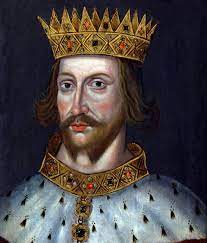
6 October 1175: The Treaty of Windsor was agreed between representatives of Rory O'Connor [below] the High King of Ireland (Ruaidrí Ua Conchobair an Ard Rí na hÉireann) and King Henry II of England on this day [above]. King Rory was the last High King of Ireland.
King Henry forced him to submit as a result of the Anglo- Norman Invasion of 1169 and King Henry’s own Expedition to Ireland in 1170/71. Basically the King of Ireland eventually submitted to circumstances and recognised Henry II as his Overlord.
The negotiations were conducted at Windsor in Berkshire, England, the home of the current British Monarch King Charles III.
The Treaty began:
This is the agreement which was made at Windsor in the octaves of Michaelmas [October 6] in the year of Our Lord 1175, between Henry, king of England, and Roderic [Rory], king of Connaught, by Catholicus, archbishop of Tuam, Cantordis, abbot of Clonfert, and Master Laurence, chancellor of the king of Connaught, namely:
The King of England has granted to Roderic [Rory], his liegeman, king of Connaught, as long as he shall faithfully serve him, that he shall be king under him, ready to his service, as his man. And he shall hold his land as fully and as peacefully as he held it before the lord king entered Ireland, rendering him tribute. And he shall hold his land as fully and as peacefully as he held it before the lord king entered Ireland, rendering him tribute...
The witnesses are Robert, bishop of Winchester; Geoffrey, bishop of Ely; Laurence, archbishop of Dublin; Geoffrey, Nicholas and Roger, the king's chaplains; William , Earl of Essex; Richard de Luci; Geoffrey de Purtico, and Reginald de Courtenea.
This Treaty marked the end of an era in Irish History as Ireland was no longer seen as a distinct kingdom
- but a Lordship under English domination.
Wednesday, 5 October 2022
.png)

.png)
.png)