Thursday, 18 July 2024


18 July 1938: Douglas Corrigan  -‘Wrong way Corrigan’ - landed at Baldonnel Aerodrome  Co Dublin after flying across the Atlantic solo in his aircraft Sunshine on this day. His arrival was totally unexpected and on being asked from whence he came he answered ‘New York’ - much the incredulity of those who had gathered around him.

 Despite his assertion that he had simply lost his way on take off and instead of turning west for California he had  inadvertently headed east for Ireland no one really believed him. He had started his working life as a mechanic and had caught the Flying Bug when he took a ride up in a plane some years previously. He got his pilots license & took up stunt flying to earn a living. But he always hankered to do something out of the ordinary and settled on Ireland (the Homeland of his ancestors) as a place he would like to fly to.

 He saved up his salary and spent $300 on buying a second hand 1929 Curtiss Robin OX-5 monoplane and flew it home, where he returned to work as an aircraft mechanic and began to modify the Robin for a transatlantic flight. Having installed an engine built from two old Wright Whirlwind J6-5 engines (affording 165 hp (123 kW) instead of the 90 hp (67 kW) of the original) and extra fuel tanks, Corrigan applied to the Bureau of Air Commerce in 1935, seeking permission to make a nonstop flight from New York to Ireland. The application was rejected; his plane was deemed unsound for a nonstop transatlantic trip, although it was certified to the lower standard for cross-country journeys.

 But Corrigan was nothing if not a tryer and on 17 July 1938 he took off at 5:15 in the morning with 320 US gallons (1,200 L) of gasoline and 16 US gallons (61 L) of oil on board. Corrigan headed east from the 4,200-foot (1,300 m) runway of Floyd Bennet Field New York to begin his epic journey. He landed at Baldonnel Aerodrome  on July 18, after a 28-hour, 13-minute flight. His provisions had been just two chocolate bars & two boxes of fig bars, and 25 US gal (94.64 L) of water.

 Corrigan's plane had fuel tanks mounted on the front, allowing him to see only out of the sides. He had no radio and his compass was 20 years old, but somehow he made it. His daring flight alone across the Atlantic Ocean made headlines across the World. Back in the USA he was nicknamed ‘Wrong Way Corrigan’ when he claimed to have flown East instead of West on take off. It was said that his tickertape parade through the streets of New York City outshone that of his great hero Charles Lindbergh - who curiously never acknowledged his achievement.

 The journalist H.R. Knickerbocker who met Corrigan in Ireland after his arrival, wrote in 1941:

 You may say that Corrigan's flight could not be compared to Lindbergh's in its sensational appeal as the first solo flight across the ocean. Yes, but in another way the obscure little Irishman's flight was the more audacious of the two. Lindbergh had a plane specially constructed, the finest money could buy. He had lavish financial backing, friends to help him at every turn. Corrigan had nothing but his own ambition, courage, and ability. His plane, a nine-year-old Curtiss Robin  was the most wretched-looking jalopy.

 As I looked over it at the Dublin airdrome I really marvelled that anyone should have been rash enough even to go in the air with it, much less try to fly the Atlantic. He built it, or rebuilt it, practically as a boy would build a scooter out of a soapbox and a pair of old roller skates. It looked it. The nose of the engine hood was a mass of patches soldered by Corrigan himself into a crazy-quilt design. The door behind which Corrigan crouched for twenty eight hours was fastened together with a piece of baling wire. The reserve gasoline tanks put together by Corrigan, left him so little room that he had to sit hunched forward with his knees cramped, and not enough window space to see the ground when landing.

 The following year, he starred as himself in The Flying Irishman, a movie biography. The $75,000 he earned was the equivalent of 30 years income at his airfield jobs! During the War he flew planes for the US Transport Command and then went back to California where he bought an Orange Farm. He died there in 1995. To the end he never admitted to anything other than flying ‘the wrong way’.


Tuesday, 16 July 2024


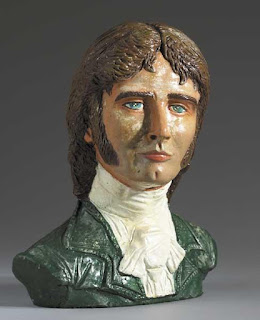
17 July 1798: Henry Joy McCracken, United Irishman, was executed OTD. His ancestors on both sides had come from the Continent to escape religious persecution. His father was a wealthy businessman and when he was twenty-two he was entrusted with the management of a cotton factory. In 1791 he co-operated with Thomas Russell in the formation of the first society of United Irishmen in Belfast and when the society in 1795 assumed its secret and military organization, he became one of the most trusted members of the council in the north.

 In 1796 he was arrested and imprisoned in the notorious Kilmainham Jail in Dublin along with his brother William. After his release he returned to Belfast and renewed the plans to bring about a Revolution in Ireland. He was appointed head of the United Irishmen of Antrim. In June of 1798 he raised the insurgents there to take arms and attack the Crown Forces. He and his followers briefly seized Antrim town but were defeated and dispersed.

 McCracken went to hiding in the vicinity but was betrayed and was taken prisoner. His trial and conviction by court-martial followed. The British offered to spare his life on condition of his giving information concerning other leaders. His aged father encouraged him to spurn the proposition. On 17 July 1798 he was executed by hanging at the Cornmarket in Belfast on the evening of the conclusion of his Trial.

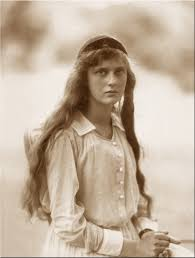
 His sister Mary Ann McCracken [above in old age] accompanied him almost to the last, and wrote:

 At five p.m. he was ordered to the place of execution…. I took his arm, and we walked together to the place of execution, where I was told it was the general's orders I should leave him, which I peremptorily refused. Harry begged I would go. Clasping my hands round him (I did not weep till then) I said I could bear anything but leaving him. Three times he kissed me, and entreated I would go... I suffered myself to be led away... I was told afterwards that poor Harry stood where I left him at the place of execution, and watched me until I was out of sight; that he then attempted to speak to the people, but that the noise of the trampling of the horses was so great that it was impossible he should be heard; that he then resigned himself to his fate.

 The United Irishmen, their Lives and Times, Robert R. Madden


Monday, 15 July 2024


15 July 1927:  Countess Constance Markievicz died on this day. Society Girl, Artist, Revolutionary, Feminist and Socialist there is no doubt that she was a woman who lived Life to the full and gave it her all for Ireland and her People. She was born in London in 1868 to the Artic explorer Sir Henry Gore Booth and Lady Georgina, Lady Gore-Booth. Her father owned a large Estate at Lissadell House in Co Sligo.

 In the 1890s she studied Art in London and Paris where she met her future husband, the Polish Nobleman ‘Count Markievicz’ - and there after she was known as Countess Markievicz! She gave birth to their daughter, Maeve, at Lissadell in November 1901.The family moved to Dublin in 1903 and the Countess moved in the Literary and Art circles of the city, notably in the circle of the famous portrait artist Sarah Purcell. There she met many people who were involved in the politics of the day and from this her interest in Ireland’s future deepened.

 In 1908, she became actively involved in nationalist politics in Ireland and joined Sinn Fein which was the most advanced Nationalist Party of its day. In 1913 Markievicz's husband moved back to Ukraine, and never returned to live in Ireland. However, they did correspond and he was by her side when she died.

 When the 1916 Rising broke out she played an active part in it and was rumoured to have shot dead a DMP policeman while trying to storm Dublin Castle. She was part of the Stephens Green garrison that later withdrew to the Royal College of Surgeons on the Green. When the Rising was over she was taken prisoner, held in solitary confinement and sentenced to Death. Much to her disappointment the sentenced was commuted to Life Imprisonment. However she was released in 1917 after having served her time in an English Prison.

 In the British General Election of December 1918 she was elected for a Dublin Constituency taking 66% of the vote, thus becoming the first woman  ever elected an MP - but refused to take her seat in the London Parliament. When the 1st Dáil met in January the Countess was back in an English Prison and when the roll call was taken her absence was noted by the words - fé ghlas ag Gallaibh -"imprisoned by the foreign enemy". She was made the Minister for Labour and held that position until January 1922. She also sat in the Cabinet of the Irish Republic from April 1919 till August 1919 - thus making her the First Woman Cabinet Minister in Irish History.

 She left the government in January 1922 along with Eamon De Valera and others in opposition to the Treaty. She fought actively for the Republican cause in the Irish Civil War helping to defend Moran's Hotel in Dublin. After the War she toured the United States. However, her staunch republican views led her to being sent to jail again. In prison, she and 92 other female prisoners went on hunger strike. Within a month, she was released.

 She joined the new Fianna Fáil on its foundation in 1926, chairing the inaugural meeting of the new party in La Scala Theatre. In the June 1927 Election she was re-elected to the Dáil as a candidate for the new party, which was pledged to return but died only five weeks later, before she could take up her seat.

 Constance Markievicz died at the age of 59 on 15 July 1927, of complications related to appendicitis. She had given away the last of her wealth, and died in a public ward "among the poor where she wanted to be". One of the doctors attending her was her revolutionary colleague Kathleen Lynn. Also at her bedside were Casimir and Stanislas Markievicz, Eamon de Valera & others came by to pay their last respects. Refused a state funeral by the Free State government, she was buried Glasnevin Cemetery  Dublin, and Eamon de Valera gave the funeral oration. Sean O’Casey said of her: 

One thing she had in abundance—physical courage; with that she was clothed as with a garment.


Sunday, 14 July 2024


14 July 1798: The Patriot brothers John and Henry Sheares were executed on this day. They were both members of the Legal Profession and had joined the United Irishmen to fight tyranny and free Ireland from English rule. They were the sons of a wealthy banker who sat as a member of the Parliament in Dublin. In 1792 they had visited Revolutionary France and had caught the Spirit of the times there. They soon joined the United Irishmen on their return.

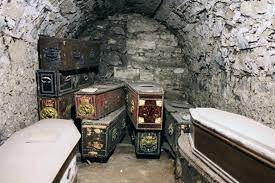
 However they trusted others without caution and were led into revealing details of the conspiracy to overthrow the Ascendancy. A Spy, one Captain John Armstrong who had befriended them in order to betray them, revealed their intentions to Dublin Castle. They were arrested on 21 May 1798. Found guilty of treason, they were publicly hung, drawn & quartered outside Newgate Prison [Green Street] in Dublin. Both were buried in the vaults of St. Michan's Church in Dublin City where their perfectly preserved coffins [above] are still on display.

 At midday on Saturday, July 14th, the hapless men were removed to the room adjoining the place of execution, where they exchanged a last embrace. They were then pinioned, the black caps put over their brows, and holding each other by the hand, they tottered out on the platform. The elder brother was somewhat moved by the terrors of his situation, but the younger bore his fate with unflinching firmness. They were launched together into eternity--the same moment saw them dangling lifeless corpses before the prison walls. They had lived in affectionate unity, inspired by the same motives, labouring for the same cause, and death did not dissolve the tie. "They died hand in hand, like true brothers."

`Speeches from the Dock'

By D. S. Sullivan


Saturday, 13 July 2024


13 July 1866: The Great Eastern steamship [above], the largest vessel afloat at that time, departed Valentia Island Co Kerry for Newfoundland on this day. Its task was to attempt once again to try and lay a working telegraph cable from Europe to the Americas.

 ‘It was the brainchild of American entrepreneur Cyrus Field, who made two unsuccessful attempts before finally succeeding. The first officer on the Great Eastern - the biggest vessel in the world at the time - was Wicklow native Captain Robert Halpin. While Belfast born scientist and engineer, Lord Kelvin, worked on the technical aspects of the cable. Prior to the laying of the Transatlantic Cable it took approximately two weeks for message from Europe to reach North America … weather permitting as all communications were sent via boat.

 The idea of a transatlantic cable was first proposed in 1845, but the distances and depths presented formidable problems. In 1856 the Atlantic Telegraph Company was registered with a capital of £350,000 (then about $1,400,000). On the American side Cyrus W. Field was the driving force; on the British side it was Charles Bright and brothers John and Jacob Brett.

 After so many failed attempts, the final, successful, cable was laid with virtually no problems. On 27 July 1866, the cable was pulled ashore at a tiny fishing village in Newfoundland known by the charming name of Heart’s Content. The distance was 1686 nautical miles from Valentia Island. The Great Eastern had averaged 120 miles a day while laying out the cable.

 The first message sent on this, finally successful, cable was: “A treaty of peace has been signed between Austria and Prussia”. Queen Victoria, then at Osborne, in the Isle of Wight, sent a message to the President of the United States. “The Queen congratulates the President on the successful completion of an undertaking which she hopes may serve as an additional bond of Union between the United States and England.'' *

 Almost immediately, the cable opened for business but only the very wealthy could afford it – the initial rates were a startling $1 a letter, payable in gold – at a time that a monthly wage for a labourer might be $20.''

 http://www.valentiaisland.ie/explore-valentia/valentia-transatlantic-cable-station/

 Launched at the Isle of Dogs, Kent, 31 January 1858, The Great Eastern  was 693 feet in length (over 200 metres) 22,500 tons dead weight and had passenger accommodation for over 3,000 passengers. Five times larger than any other ship then built, she had six masts, five funnels, 6,500 yards of sail, two 58 ft paddle wheels, a 24 ft screw (which remains the biggest ever built) and a coal carrying capacity of 15,000 tons.

 The ship’s Captain was Robert Charles Halpin of Co Wicklow who led the successful attempt to repair the line and also layed thousands of miles of vital cables to link together various far flung locations across the Globe. This helped usher in the Age of Telegraphy which enabled men and nations to communicate together at faster levels than ever before.

 For the next 100 years Valentia Island was a major portal for the dispatch and reception of messages between the distant continents in what was for its time an 'Information Superhighway' in itself. The station finally ceased being a conduit for transatlantic communication in 1966 when air mail & satellites made it un-economic to maintain it any longer. It was an end of an Era.

 * No mention of Ireland!


Friday, 12 July 2024


12 July [O.S. 1 July] 1690: The Battle of the Boyne/Cath na Bóinne was fought on this day. The mainly Protestant Army of King William of Orange defeated the mainly Catholic Army of King James II. With around 36,000 Williamites against 25,000 Jacobites this battle, in terms of the numbers of men on the battlefield was the largest clash of arms ever fought in Ireland.

 Both kings commanded their armies in person assisted by a number of men of high rank and status. King William had under his orders English, Scottish, Dutch, Danish, French Huguenots and Protestants from Ireland. King James Army mainly consisted of Catholic Irishmen, and a scattering of Englishmen loyal to the Stuarts. The King was also backed by around 6,500 regular French troops sent by King Louis XIV. William sent 10,000 men towards Slane with the advance guard under Count Meinhard, which drew the bulk of the Jacobites upstream in response. With some 1,300 Jacobites posted in downstream in Drogheda, only 6,000 were left at Oldbridge to confront 26,000 Williamites. Duke Frederick Marshal Schomberg (William’s top General) then led the Dutch Blue Guards and other regiments into the waters of the Boyne and across to the other side.

 Opposing them were just seven regiments of the Catholics who shot their attackers down in great numbers as they attempted the passage of the Boyne at Oldbridge. A want of sufficient cavalry and artillery to block the crossing of so formidable a host eventually told against the Irishmen. They were pushed back from the riverbank as their enemies gained a toehold and then flowed across. William himself eventually crossed at Drybridge slightly downstream with about 3,500 mounted troops.

 Marshal Schomberg brought down to the ford of Ouldbridge the gross of his cavalry, with orders to push on and suffer no check. At this, the seven regiments aforesaid of Irish foot, observing they would be soon overpowered, they cried to their own for horse to sustain them. In the meanwhile, they made a smart fire at the enemies, and laid them in heaps, as they were entering the waters. But their crying for horse was in vain; for they received but one troop, which was as good as nothing.

 By the time reinforcements arrived it was too late and the enemy was across in strength. The seven regiments of Irish foot, which guarded the great ford of Ouldbridge, not being supported by horse, were also forced to retreat, but were in danger to be intercepted by such of the enemy as had traversed first the river before they joined their main army, which the duke of Tyrconnell, from the right, perceiving, flew with his regiment of horse to their rescue, as did the duke of Berwick with the two troops of guards, as did colonel Parker with his regiment of horse, and colonel Sutherland with his. It was Tyrconnell's fortune to charge first the blue regiment of foot-guards to the prince of Orange, and he pierced through.

 Further upstream Count Meinhard had by then crossed the Boyne by the ford at Rosnaree and though blocked by O’Neills cavalry regiment he was soon reinforced. With King James left flank now turned his position was a precarious one. Most of his army was at this critical moment of the battle betwixt and between these two vital points and unable to render assistance to either in enough strength to turn the days events.

The King himself with a considerable portion of his Irish and French troops did however block Lord Douglas in the Williamite service from crossing the Boyne at Donore - which is situated between the fords of Rosnaree and Oldbridge. But this was a stalemate while the outcome of the battle was decided to the left and the right of the King’s position at Donore.

 Eventually as the Williamites got across the river in strength on both the left and right flanks the order was given to fall back on Duleek to the south and stop that village been taken by the enemy. If King Williams’s men had taken the vital bridge there then the whole of the Jacobite army would have been cut off from retreat and in all likelihood captured in its entirety.

 As it turned out the retreat was carried out in good order by the Jacobite Army and despite further clashes Lord Tyrconnel, who was given command of the rear-guard, it was able to effect an orderly withdrawal. The enemy were content to follow in their footsteps and not risk a reverse.

 However in these follow up operations the Williamites lost their best military leader – Marshal Schomberg.

 Twas during these encounters that one master Bryen O'Tool, of the guards, discovering his former acquaintance, marshal Schomberg, near the village of Ouldbridge, resolved to sacrifice his life to the making him away, upon which he, with a few of the guards, and a few of Tyrconnell's horse, made up to him, and O'Tool with his pistol shot the marshal dead. But, soon after, fighting like a lion, he was slain.

 King James's army retreated across the river Nanny at Duleek and evaded capture. It had been a ‘close run thing’ and though the battle had been lost the Army was intact and still a cohesive fighting force.

 Bad tactics rather than bad fighting had cost King James and his Irish followers the chance of victory against a more numerous enemy. The line of the Boyne might well have been held but King James had been outmanoeuvred by Marshal Schomberg’s plan - even though this crusty old Huguenot did not live to savour the Victory he had so materially helped to achieve.

 Though there was some hot fighting in the course of the battle overall the casualties were light on both sides with perhaps 1,500 soldiers lying dead or wounded along the banks of the Boyne. Considering the strategic consequences of this clash of arms it was a very low number for a battle that determined the political and religious balance of power in Ireland for centuries to come and this clash of arms on the banks of the river Boyne still resonates down to our own day.


Thursday, 11 July 2024


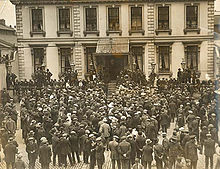
11 July 1921: ‘The Truce’ began at 12 noon on this day. This brought to an end organised military operations between the Irish Republican Army and the British Crown Forces during the Irish War of Independence. The negotiations leading up to the cessation of hostilities had been concluded some days previously at the Mansion House [above] in Dublin between representatives of the Irish President Eamon de Valera and the British Prime Minister Lloyd George. The British CIC in Ireland General Macready assented that his troops would obey what orders they were given from London.

On July 8th at the close of discussions at the Mansion House, de Valera telegraphed to to Lloyd George that he was ready to meet and discuss with him ‘on what basis such a conference as that proposed can reasonably hope to achieve the object desired’. Lloyd George telegraphed that he would be happy to see de Valera, and any colleagues he would wish to bring with him, at Downing Street. De Valera replied that he would be in London on the following Thursday, July 14th.

 General Macready was now invited to the Mansion House ; the general principles governing the Truce was agreed upon and liaison officers were appointed to conduct discussions between the two armies on matters of detail, Robert Barton and Eammon Duggan for the IRA, and truce terms were discussed. ...It was not until 3pm on the 9th that terms were finally agreed to.

 The Irish Republic by Dorothy Macardle

 The terms agreed were that no British reinforcements would enter Ireland, raids and arrests would cease and secret operations end. The Irish in turn agreed to cease attacking the British, not to interfere with private or British owned property and not to disturb the peace that would necessitate military interference. Both sides agreed not to engage in provocative displays of their respective forces, armed or unarmed.

 The following day an Irish Delegation consisting of Eamon de Valera, Arthur Griffith, Austin Stack and Robert Barton departed for London to open negotiations with the British Government. The Lord Mayor of Dublin Laurence O'Neill, Count Plunkett and Erskine Childers also accompanied the delegation. It looked like the violence that had wracked Ireland for the last two and a half years was coming to an end.