Wednesday, 8 May 2013


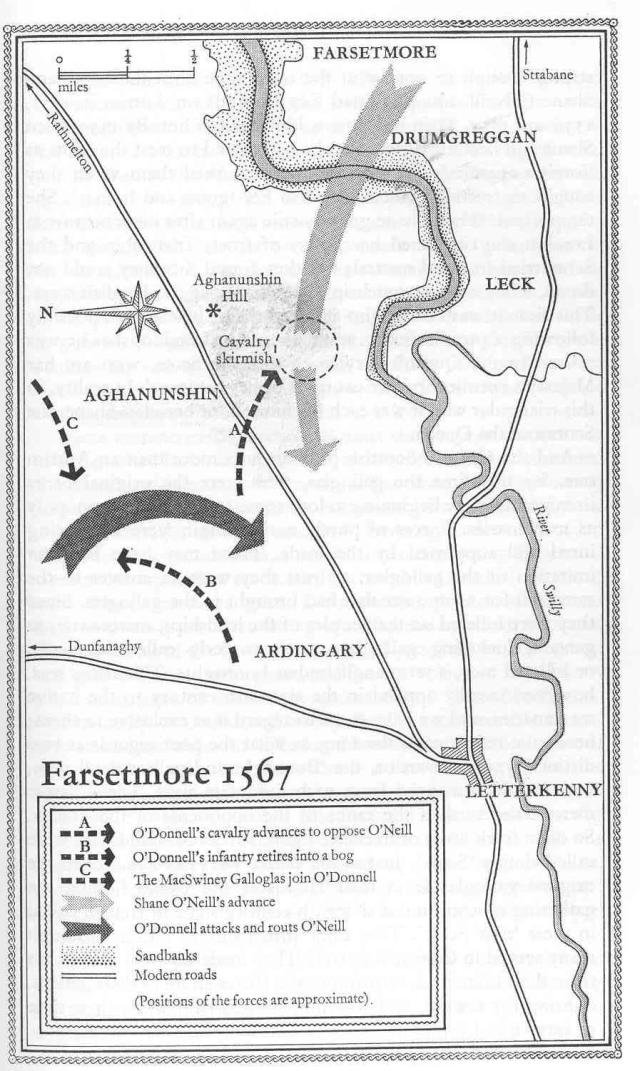
8 May 1567: The Battle of Farsetmore was fought near Letterkenny in County Donegal on this day. The battle was fought between the rival armies of Shane O’Neill of Tir Eoghan (Tyrone) and Aodh O'Donnell of Tir Connell (Donegal). Each side probably had about 2,000 men apiece. The battle began when O'Neill's cavalry crossed the ford at Fearsad-Suilighe at low tide.

Aodh O'Donnell, gathered with his band of loyal followers around the little hill fort of Ard-an-ghaire, dispatched his son, also called Aodh, to hold them as long as he could. The father was expecting reinforcements that very day and if he could just hold back O'Neill's army until he could assemble a force to near match the invaders he would be in with a chance. With his son locked in combat with the van of O'Neill's force he took the opportunity to fall back behind the shelter of a bog across which O'Neill's men could not advance but at a disadvantage.

After a vicious fight in which a number of leading men on both sides fell, young Aodh could hold his position no longer and pulled back to join his father behind the bog. But by then relief was at hand as three war bands of Gallowglass mercenaries drawn from the McSweenys came up to support Aodh O'Donnell in his hour of need.


O'Donnell saw his opportunity and without further ado launched his whole force upon O'Neill's men, who were possibly still forming up into a line of battle.

Fierce and desperate were the grim and terrible looks that each cast at the other from their starlike eyes; they raised the battle cry aloud, and their united shouting, when rushing together, was sufficient to strike with dismay and turn to flight the feeble and the unwarlike. They proceeded and continued to strike, mangle, slaughter, and cut down one another for a long time, so that men were soon laid low, heroes wounded, youths slain, and robust heroes mangled in the slaughter.
Annals of the Four Masters - 1567


How long this brutal melee lasted we do not know but eventually O'Neill's army was forced back onto the riverline and there it buckeled and disintegrated into fragments. Then O'Neills men fled for their lives. However the sandy tidal ford they had crossed that morning in the expectation of Victory was now filled with the waters of the swiftly advancing tide. There was no way out but to try their luck in the treacherous waters, encumbered as they were by their weaponry and armour. Hundreds were cut down or drowned as they sought the safety of the other bank.

As light faded Aodh O'Donnell had won a great victory over the men of Tir Eoghan with perhaps as many as 1300 of his enemies either drowned or dead on the field of battle.*


Shane O'Neill was turned within the course of a single day from being the most powerful Chieftain in the North into a desperate fugitive fleeing for his life. He had lost some of those dearest to him in this catastrophe: two of his grandsons, plus MacDonald, the leader of his Gallowglasses, and Dubhaltach, his foster brother and 'the person most faithful and dear to him in existence'

As fortune would have it Shane had recruited some of the O'Gallagers of Tir Connell onto his side and with their local knowledge he was able to evade his pursuers by turning upstream to Scarrifhollis and then ride for home.

When he got back he found his support base collapsing around him and turned in desperation to the Mac Donald's of Cantire in Scotland under Alexander to support him. The Mac Donald's were old enemies so it was a strange place to seek Allies but they came anyway to see if they could cut a deal. They met up at Cushendun in Antrim. Whatever happened when they initially met things soon turned sour and a fight broke out. Shane was cut down and put to the sword. His body was flung in a pit and his head dispatched to Dublin for display on the Castle Walls.

So ended the colourful and dramatic career of Shane O'Neill, a man who was a thorn in the side of the English for many years and was both respected and feared by all, Irish or Foreign, whom he clashed with.

Queen Elizabeth I of England stated:

'that we give thanks to Almighty God by whom we hold and rule all that we enjoy, for his goodness and favour shown in the punishment and extinguishing of such a rebellion so long continued'

Sidney State Papers 1565-70
T.OLaidhin


* A report to Lord Deputy Sidney stated that 613 men were counted dead on the battlefield. Many others must have drowned in the waters and been swept away


Tuesday, 7 May 2013


7 May 1915: The liner Lusitania (New York to Liverpool) was torpedoed off the Old head of Kinsale by the German submarine U20 on this day. She sank within 18 minutes. (Two explosions rocked the ship. The first was clearly caused by a torpedo from U-20. The cause of the second explosion has never been definitively determined and remains the source of much controversy.) Of those on board, 761 were rescued, while 1,198 perished, including 115 US Citizens.

On the 7th September 1907 under the command of Captain James B. Watt, the RMS Lusitania sailed on her maiden voyage to New York. She carried over 3,000 passengers and crew. Her passengers were delighted with the new ship. The standards of accommodation and services were well documented. Most third class passengers enjoyed the voyage. Dinning on her was like eating in the best restaurants or hotel anywhere.

In August 1914 World War One broke out. The day of anticipation finally arrived when the British Navy needed the ship for wartime service.The Lusitania had to be refitted for the purpose. Her four funnels were fully painted black to conceal her identity from enemy ships.

On May 1, 1915, the ship departed New York City bound for Liverpool. Unknown to her passengers but probably no secret to the Germans, almost all her hidden cargo consisted of munitions and contraband destined for the British war effort. As the fastest ship afloat, the luxurious liner felt secure in the belief she could easily outdistance any submarine. Nonetheless, the menace of submarine attack reduced her passenger list to only half her capacity.

Following the loss of the Titanic, the Lusitania was fitted with 48 boats (22 wooden and 26 collapsible). Every boat was fitted with 2 chains to anchor them to the deck. This would prove disastrous when the ship sank because the chains would have to be released before the boats could be swung clear of the ship. When the Lusitania was sinking many of the chains were not released and thus preventing the boats from being launched successfully. Many boats went down with the ship.

On Friday 7th May 1915 she had reached the War Zone. The usual precautions of blackening out the portholes and doubling the watch were obeyed.

The lookouts were tentatively at their posts. At about 1.30 p.m. Leslie Morton saw the torpedo heading towards the Starboard side travelling at about 22 knots. He gave the alarm stating "Torpedo coming in the Starboard side". The Bridge was slow in reacting to his warnings.

Another lookout, Thomas Quinn also said that the torpedo and sounded the alarm. It was too late. The torpedo struck the ship and detonated before Turner could do anything. Power was suddenly lost. The watertight door could not be closed. Radio distress signals had to be sent using battery power.

At 2.10 p.m. after lunch the passengers were eagerly waiting for their desserts when they heard:

"the sound of an arrow entering the canvas and straw of a target magnified a thousand times" or and "a pearl of thunder" and "the slamming of a door".

A second explosion came within seconds. Suddenly the ship took a 15º list to Starboard, which began to sharpen to 16º then 17º etc until the list reached 25º - a point at which the ship could not survive. The list had become so severe that the Officers could not swing the lifeboats clear of the ship.

Panic had set in amongst the passengers. Some jumped into the water trying to flee for their lives. Captain Turner jumped into the water when the Bridge was flooding. He swam for three hours before finding a lifeboat to climb into.

Within 18 minutes the ship had rolled over and sunk with 1,195 passengers. Only 289 bodies were recovered. 764 people survived.

The survivors were landed at Cobh (Queenstown) in Co Cork. It was here too that the bodies were brought ashore or washed up in the days after the sinking. The corpses, men, women and children, were placed in coffins and lined up along the Cunard Line’s dock. A huge funeral procession made its way through the streets of Cobh to the cemetery. Many of the dead were buried in mass graves, marked by two crudely hewn stones. Others victims, likely the more affluent, were buried in individual graves with headstones noting their death on the Lusitania.

The loss of the Lusitania was to reverbate on the World stage as the USA was shocked and stunned by the actions of the German Navy in sinking what was to all appearences a civilian Liner engaged in peaceful commerce. It pushed US public opinion firmly in the direction of the Allies and helped to bring the USA into the War against Germany in April 1917.

RMS LUSITANIA

Monday, 6 May 2013


6 May 1882: The Assassination of Cavendish & Burke aka The ‘Phoenix Park Murders’ on this day.

The Under Secretary for Ireland Thomas Henry Burke, and the newly arrived Chief Secretary Lord Frederick Cavendish, were both stabbed to death in the Phoenix Park by members of a secret organisation known as ‘The Invincibles’. Five of the assassins were later executed in Kilmainham Jail and a number of others were sentenced to long terms of imprisonment. This event rocked Anglo-Irish relations to the core and was the most shocking and audacious attack on members of the British Political Establishment in Ireland during the course of the 19th Century.

The Phoenix Park tragedy, as it may well be called, occurred on the evening of Saturday, May 6, 1882. Its victims were Mr. Thomas H. Burke, the under-secretary, and Lord Frederick Cavendish, the new chief-secretary. Undersecretary Burke, on that evening, was walking from the Castle to his lodge or official residence in the Phoenix Park, when he accidentally met Lord Cavendish, who accompanied him in the direction he was going.


When near the Phoenix Monument, they were surrounded by five or six men, armed with knives, who attacked them instantly. Surprised and unarmed the secretaries made scarcely any resistance, and were stabbed;and hurled to the ground where they expired in a few minutes.

Cavendish – who was married to Lucy Cavendish the niece of British Prime Minister William Ewart Gladstone, and had worked as Gladstone's personal secretary – had only arrived in Ireland the day he assassinated  He was not the main target but Burke. He had just met by chance with as they walked towards the vice regal Lodge and was a man of whom it could be truly said he was in the wrong place at the wrong time.

The hunt for the perpetrators was led by Superintendent John Mallon, a Catholic who came from Armagh. He suspected a number of former Fenian activists. A large number of suspects were arrested and kept in prison by claiming they were connected with other crimes. By playing off one suspect against another Mallon got several of them to reveal what they knew.


The Invincibles' leader James Carey, Michael Kavanagh and Joe Hanlon agreed to testify against the others. Joe Brady, Michael Fagan, Thomas Caffrey, Dan Curley and Tim Kelly were convicted of the murder and were hanged by William Marwood in Kilmainham Gaol in Dublin between 14 May and 4 June 1883. Others were sentenced to serve long prison terms.

The chief Traitor James Carey was No 1 of the Invincibles and a Dublin City Councillor. His turning Queens evidence brought him freedom but put his life in mortal danger. He was spirited off to London and with his family was dispatched by ship bound for Australia. As fortune would have it he was recognised on board by another member of the Irish Republican fraternity and from then on, unbeknownest to himself, was a marked man.


His life being in great danger, he was secretly, with his wife and family, put on board the Kinfauns Castle, bound for the Cape, and sailed on July 6 under the name of Power. On board the same ship was Patrick O'Donnell, a bricklayer. He became friendly with Carey, without knowing who he was. After stopping off in Cape Town, he was informed by chance of the real identity of Carey. He went with his victim on board the Melrose in the voyage from Cape Town to Natal, and when the vessel was 12 miles off Cape Vaccas, on July 29, 1883, using a pistol he had in his luggage, shot Carey dead.[

O'Donnell was brought to England and tried for murder, and being found guilty, was executed at Newgate on December 17.

James Carey - Wikipedia, the free encyclopedia


Sunday, 5 May 2013


5‭ ‬May‭ ‬1916:‭ ‬Major John McBride was executed by firing squad in Kilmainham Jail on this day.‭ ‬He was shot for his part in the Easter Rising.‭ ‬He had fought the British in the Boer War and only joined the Rising as it begun and while still in mufti.‭

In the second Boer War he was instrumental in the raising of the‭ ‬Irish Transvaal Brigade and led it in action against the British.‭ ‬When organised resistance collapsed he and the surviving members crossed the border into Mozambique.‭ ‬After the War he married the famous beauty Maud Gonne and they had a son called Sean McBride‭ ‬-‭ ‬who was also to make a name for himself in Irish Politics.‭ ‬However the marriage was not a success and they went their separate ways.‭ ‬McBride kept up his associations with Republican activists but did not become personally involved other than making the odd speech in support of Ireland’s Cause.

By chance he found himself in Dublin’s City Centre on Easter Monday‭ ‬1916.‭ ‬He had arranged to meet his brother at the Wicklow Hotel to discuss his role as Best Man at his sibling’s wedding a few days hence.‭ ‬With time to kill he wandered up Grafton St and onto St Stephens Green where he encountered members of the Irish Volunteers assembling to launch the Rising.‭ ‬He promptly offered to join in the enterprise and was gladly accepted.‭ ‬He walked with Thomas McDonagh to Jacobs Biscuit Factory which was occupied and held through Easter Week until the order to surrender was received.‭ ‬He became‭ ‬2nd in Command of the garrison.‭ ‬As he was in Mufti throughout the whole time he was there he could have made good his exit without too much difficulty but decided to go with the others into captivity.

Tried by Court Martial he was found guilty and sentenced to death.‭ ‬Two days before his‭ ‬51st Birthday he was led out to be executed.‭ ‬Facing the British firing squad,‭ ‬he refused to be blindfolded,‭ ‬saying:

‭ ‬I have looked down the muzzles of too many guns in the South African war to fear death and now please carry out your sentence.

He is buried in Arbour Hill Cemetery,‭ ‬Dublin.

Saturday, 4 May 2013


4‭ ‬May‭ ‬519‭ ‬AD:‭ ‬Saint Connlaedh,‭ ‬Bishop of Kildare,‭ ‬Bridget's brazier,‭ ‬died on this day.‭ ‬He was‭ ‬a metalworker of some note and a hermit before he began his pastoral mission.‭ ‬He is better known today as Saint Conleth.‭ ‬A copyist and skilled illuminator of manuscripts,‭ ‬he is noted for the Crosier that he fashioned for St.‭ ‬Finbar of Termon Barry,‭ ‬Co Roscommon.

Where Conleth was born or who his parents were is unknown.‭ ‬His birth is traditionally given as about‭ ‬450‭ ‬AD.‭ ‬However in Cogitosus’s‭ ‬Life of Brigid‭ (‬c.‭ ‬650‭) ‬it is related that he was a skilled metalworker in gold and‭ ‬silver that lived as a hermit at Old Connell on the Liffey near Newbridge.‭ ‬He had the reputation of being a very holy man who had the gift of prophecy.

Brigid invited him not only to make sacred vessels for her foundation but also to be pastor of the people nearby.‭ ‬Cogitosus says that they governed the church at Kildare‭ ‬"by means of a mutually happy alliance‭"‬.‭ ‬And so Conleth is regarded as the first bishop of Kildare,‭ ‬being appointed about the year‭ ‬490.‭
‬ ‭
‬After about twenty years as Bishop Conleth set out on a pilgrimage to Rome.‭ ‬His pilgrimage was undertaken against the wishes of Brigid.‭ ‬Because he was now an old man Saint Brigid feared for him going on this journey.‭ ‬Somewhere on the journey in Ireland Conleth was attacked and killed by wolves.‭ ‬Some accounts say that he was buried on the left side of the altar in the Church of Ireland cathedral in Kildare town and Saint Brigid on the right.‭ ‬Another relates that he was buried in the Old Connell graveyard.‭ ‬An alternative version is that his relics were transferred there in‭ ‬835‭ ‬to protect the inhabitants from Danish invaders.‭ ‬He is the patron saint of the parish of Droichead Nua‭ (‬Newbridge‭)‬,‭ ‬Co Kildare.

Friday, 3 May 2013


3‭ ‬May‭ ‬1274:‭ ‬The death of the King of Connacht,‭ ‬Aedh‭ ‬O Conchobair,‭ ‬on this day.‭ 

Aed son of Fedlimid son of Cathal Crobderg O Conchobair,‭ ‬king of Connacht for nine years,‭ ‬died on the third day of May this year,‭ ‬a Thursday and the feast of the Invention of the Holy Cross‭;
a king who wasted and desolated Connacht in fighting the Galls and Gaels who opposed him‭;
a king who inflicted great defeats on the Galls and pulled down their palaces and castles‭;
a king who took the hostages of the Ui Briuin and the Cenel Conaill‭;
the destroyer and healer of Ireland was he‭; 
the king most dreaded and triumphant of all the kings of Ireland in his day,‭ ‬as the poet says:‭ ‘‬For nine years did this Aed Engach defend the Family of Tara—no feeble forrayer was he—against Gall and Gael.‭’

While King Aedh was a formidable opponent for both his internal and external enemies,‭ ‬both Irish and English,‭ ‬his son who succeeded him was not able to hold his kingdom together:

Eogan son of Ruaidri son of Aed mac Cathail Chrobdeirg was instated in his stead by the men of Connacht.‭ ‬However,‭ ‬this kingship which was bestowed upon him was a short one,‭ ‬for he had been but three months in the lordship of Connacht when his own close kindred,‭ ‬led by Ruaidri son of Toirrdelbach son of Aed O Conchobair,‭ ‬killed him in the church of the friars at Roscommon,‭ ‬as the poet says:‭ ‘‬Ruaidri's son reigned for three months—short was the thread for the nursling of Bregia—the men of untilled Ailech wrought Eogan's sudden death.

Annála Connacht


Thursday, 2 May 2013


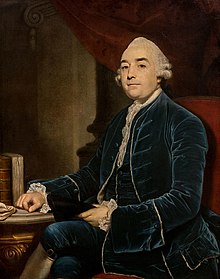
2 May 1737: William (Petty) FitzMaurice was born in Dublin on this day. 1st Marquess of Lansdowne aka The Earl of Shelburne between 1761 and 1784. He spent his childhood "in the remotest parts of the south of Ireland," and, according to his own account, when he entered Oxford in 1755, he had "both everything to learn and everything to unlearn".

He left Oxford in 1757 without taking a Degree. Served in British Army during Seven Years War. He fought in the expedition to Rochefort and  saw action at the battles of Minden and Kloster Kamp. He was a senoir Whig who was the Home Secretary in 1782 and then Prime Minister from July 1782 to April 1783. It was Shelburne's ministry that concluded the peace treaty with the American states, after Rockingham's acknowledgement of the colonies' independence. Shelburne faced opposition from Charles James Fox and Lord North and in March 1783 tendered his resignation, which was accepted. 

He retired to his estates and never held office again. He continued to hold a seat in the House of Lords until his death in 1805.