Thursday, 15 March 2018


15 March 1852: Lady Gregory was born on this day. Isabella Augusta Persse was an Irish dramatist, folklorist and theatre manager. With William Butler Yeats and Edward Martyn she co-founded the Irish Literary Theatre and the Abbey Theatre, and wrote numerous short works for both companies. Lady Gregory produced a number of books of retellings of stories taken from Irish Mythology.

On 4 March 1880 she married Sir William Henry Gregory at St Matthias church in Dublin .As the wife of a knight, she became entitled to be called "Lady Gregory". Their home at Coole Park, County Galway served as an important meeting place for leading Revival figures, and her early work as a member of the board of the Abbey was at least as important for the theatre's development as her creative writings. Sir William, who was 35 years her elder, had just retired from his position as Governor of Ceylon (now Sri Lanka), having previously served several terms as Member of Parliament for County Galway.

He was a well-educated man with many literary and artistic interests, and the house at Coole Park housed a large library and extensive art collection, both of which Lady Gregory was eager to explore. He also had a house in London, where the couple spent a considerable amount of time, holding weekly salons frequented by many leading literary and artistic figures of the day. However Sir William died in 1892 and she never remarried. Their only child, Robert Gregory was born in 1881. He was killed in World War One.

During her time on the board of the Abbey Theatre before and after the War, Coole Park remained her home and she spent her time in Dublin staying in a number of hotels. At the time of the 1911 national census for example, she was staying in a hotel at 16 South Frederick Street. In these, she ate frugally, often on food she brought with her from home. She frequently used her hotel rooms to interview would-be Abbey dramatists and to entertain the company after opening nights of new plays. However in that same year she led a very successful Tour of the Abbey to the USA. She spent many of her days working on her translations in the National Library of Ireland. She gained a reputation as being a somewhat conservative figure and was universally known as ‘the Old Lady’.

She is best remembered today for her work in reviving the idea of Celtic Literature as expressed in the old tales and sagas and for her collaboration with William Butler Yeats in making the Abbey Theatre in Dublin the focal point of the ‘Celtic Revival’. They were close companions for years and Yeats came to rely on her a lot to get things done.

She died at home in Coole Park aged 80 from breast cancer and is buried in the New Cemetery in Bohermore, Co Galway. The entire contents of Coole Park were auctioned three months after her death and the house demolished in 1941.

Her plays fell out of favour after her death and are now rarely performed. Many of the diaries and journals she kept for most of her adult life have been published, providing a rich source of information on Irish literary history during the first three decades of the 20th century. Though her book Gods and Fighting Men: The Story of the Tuatha De Danaan and of the Fianna of Ireland are still in print.

Lady Gregory's motto was taken from Aristotle: "To think like a wise man, but to express oneself like the common people.''



Wednesday, 14 March 2018


14‭ ‬March‭ 1921: Six members of the IRA were executed in Dublin on this day. The men were hanged in Mountjoy Jail.

Paddy Moran and Thomas Whelan were hanged for actions they were said to have been involved in on Bloody Sunday in November‭ 1920.

Paddy Moran‭ ‬had previously fought in Jacobs Garrison in Easter Week 1916, under Thomas Mac Donagh.‭ ‬He had also been imprisoned in England. He was rounded up after Bloody Sunday in November‭ ‬1920‭ ‬and charged with involvement in shooting a British Officer dead. He strongly denied this but was sentenced to death by a British Court Martial.

Thomas Whelan was arrested in November‭ 1920 ‬and brought to Kilmainham Jail.‭ ‬He was then transferred to Mountjoy to await sentence. He was charged with the shooting of another British Officer on Bloody Sunday. He too strongly denied the charge. His mother went to Dublin during the trial which lasted several days, and was present outside Mountjoy on the morning of the execution. He sang ‘The Shawl of Galway Grey’ for her the night before he went to the gallows.

The four other men were hung for taking part in an ambush in the Dublin suburb of Drumcondra. Their names were Patrick Doyle,‭ ‬Bernard Ryan, Frank Flood and Thomas Bryan. As no British soldiers were killed in the ambush it was decided to charge the men with ‘with high treason and levying war against the King’ which obviously was no act of treason in their eyes.‭

Patrick Doyle‭ ‬was a carpenter, married with four children and an active member of the Dublin Brigade. His brother Seán was fatally wounded at the Custom House 6 weeks later. One of Doyle’s infant twins died 2 days before his own execution.

Bernard Ryan was an apprentice tailor,‭ ‬and the only son of an elderly widow,‭ ‬with whom he lived with in Phibsborough. He was born and bred in Dublin, went to St. Gabriel’s N.S. in Cowper Street.‭ ‬He became a clerk in a city firm,‭ ‬and was the breadwinner for his family.‭ ‬Described as quiet and practical, he was renowned for his love of the Irish language.

Frank Flood was a very close friend of Kevin Barry’s,‭ ‬and was a student in UCD,‭ ‬which he attended under a scholarship. Prior to that he had been a student in O’Connell’s School, Dublin. He asked to be buried as close as possible to Kevin. He was a lieutenant in H Coy, First Battalion. He was the leader of the ambush. His brother Alfred J. Flood became a Deputy Commissioner in An Garda Síochána.

Thomas Bryan was an electrician and married just four months before his arrest.‭ ‬In 1917, he took part in the hunger strike in Mountjoy in which Thomas Ashe died. After that he spent time in Dundalk Prison. He was active in the War for Independence before he was captured.

A fifth prisoner charged,‭ Dermot O’Sullivan, had his sentence commuted to Life Imprisonment, as he was just 17 years old.

March‭ 14 ‬was a day of public mourning in Dublin; all business was suspended until 11 am. Before dawn crowds began to assemble outside Mountjoy Jail; sacred pictures and candles were set up in the streets and around these about twenty thousand people stood, praying and singing hymns. When the bells tolled at six o’clock for two executions, again at seven o’clock and again at eight, the people fell on their knees to pray for the dying; their emotions of grief and anger were overpowering. An impression remained which nothing could efface.  
The Irish Republic
By Dorothy Macardle


Tuesday, 13 March 2018


13‭ ‬March‭ ‬1846: The Ballinglass Evictions took place on this day. The local landlords, Mr. and Mrs. Gerrard, had the population of this village in Co Galway evicted in order to turn over the land to grazing. Hundreds of men, many with their rent money still in their hands, along with their women and children were left on the side of the road.

‘The village of Ballinglass consisted of‭ ‬61,‭ solidly built and well-kept houses, with thick plastered walls. None of the inhabitants were in arrears with their rent, and had by industry reclaimed about four hundred acres from a neighbouring bog. On the morning of the eviction a large detachment of the 49th infantry commanded by Captain Brown and numerous police appeared with the sheriff and his men…. the people were officially called on to give up possession, and the houses were then demolished - roofs torn off, walls thrown down. The scene was frightful; women running, wailing with pieces of their property, clinging to door-posts from which they had been forcibly removed; men cursing, children screaming with fright…
That night the people slept in the ruins‭; ‬next day they were driven out, the foundations of the houses were torn up and razed, and no neighbour was allowed to take them in.’
The Great Hunger
By Cecil Woodham Smith

This outrageous action was widely reported and condemned.‭ ‬However not all were of the opinion that the landlords had overstepped the mark.‭ ‬Lord Brougham,‭ ‬speaking in the House of Lords on 23 March was of the opinion that:      
 
The tenants must be taught by the strong arm of the law that they had no power to oppose or resist…it was the landlord’s undoubted,‭ ‬indefeasible and most sacred right to deal with his property as he wished.

However his fellow Lord,‭ ‬and one of the great landowners of Ireland, The Marquess of Londonderry, speaking in the House of Lords on 30 March that year stated that:

I am deeply grieved,‭ but there is no doubt concerning the truth of the evictions at Baltinglass. Seventy six families, comprising 300 individuals had not only been turned out of their houses, but had even – the unfortunate wretches – been mercilessly driven from the ditches to which they had betaken themselves for shelter.

Nevertheless despite widespread condemnation the evictions were never rescinded.


Monday, 12 March 2018


12 March 1689: King James II landed at Kinsale, Co Cork on this day. He brought with him some 6,000 French soldiers, attended by a French fleet of over forty warships and transports. On board were 13,000 seaman manning over 2,200 naval guns. King Louis XIV provided him with a purse of 500,000 crowns. His presence here was somewhat forced upon him as he was reluctant to start a Civil War but he was prevailed upon by his mentor, the King of France, to lead an Expedition to Ireland to attempt to regain the Crowns of England, Ireland and Scotland.

King James was an experienced Admiral & soldier and (he had fought with Turenne) and his valour was not in doubt. But the King had not fought in a land campaign since the Battle of the Dunes in 1658 – ironically enough against an Anglo-French Army. He had fought with distinction against the Dutch at sea but his last taste of a naval battle had been in 1672 after which King Charles (his older brother) forbade him to engage in action again.

During the years of the Restoration James Duke of York became increasingly drawn to the Catholic Religion and secretly converted. However such a momentous decision could not remain unknown forever and eventually his conversion became known at Court and within Parliament. The Test Act of 1673 meant he had to relinquish the position of Lord High Admiral and leave England for a while. He bided his time however and when his elder sibling suddenly died in 1685 he was crowned King James II in his place. The new King was accepted but not loved by the English Protestants. His rigid interception of Royal prerogatives and his promotion of Catholic favourites to positions of power and influence welled up into open discontent within the Protestant Oligarchy.

However the tipping point came in the Summer of 1688 when a male heir (the future ‘Old Pretender’ James III) was born. With a Catholic succession now guaranteed the Protestant nobles appealed to William of Orange for help. He landed with a Dutch Army at Torbay in November and some weeks later James was forced to flee to France to seek the protection his most Christian Majesty Louis XIV. Within weeks a force was assembled to be dispatched to Ireland in order to deflect William IIIs attention away from the Low Countries and to give the exiled King James at least a fighting chance of success.

And so it happened that the king landed at Kinsale on the twelfth of March, 1688, old style, that is 1689, new style; with whom came count D'Avaux, ambassador from Louis XIV., the most Christian king, general de Rosen, lieutenant-general Pusignan, lieutenant-general Momont, monsieur Boisselau; James Fitzjames, the duke of Berwick; William Herbert, the duke of Powis; Thomas Cartwright, the Protestant bishop of Chester, in England; the earl of Melfort, Henry FitzJames, lord grand prior, and several others, French, English, Irish, and Scots, lords, knights, gentlemen, officers, and chaplains. The king arrived that night at the city of Cork; from thence he took his journey straight to Dublin, the capital of the kingdom.
A light to the blind

When he landed at Kinsale that day King James’ chances of success looked reasonable. He had a well-trained and well-armed force with him and the promise of substantial aid from the Catholics of Ireland in his endeavour. If he could drive the Protestant armies out of Ireland then he could look forward to at least regaining one of the Kingdoms of his Realm that he considered his own by right of Succession. Alas for this Stuart Monarch the fates were against him and his cause. The following year after his defeat at the Battle of the Boyne he fled Ireland never to return and died an exile in France.


Sunday, 11 March 2018


11 March 1597:A Huge explosion rocked the quays of Dublin on this day. On a dry and breezy Friday afternoon over 400 years ago the city of Dublin was rocked by the greatest and most deadly explosion ever recorded in its history. At least 126 people were killed and many hundreds more injured by this devastating eruption on the Quays.
The source of the explosion was the many barrels of gunpowder that had been unloaded at the Wood Quay on the south side of the River Liffey. Stored in the open they were awaiting transportation to Dublin Castle where they were to be distributed to the English Army in Ireland. A dangerous situation had arisen due to a labour dispute with the carters and porters whose job it was to move them off the docks. Basically they instituted as 'go slow' that week and with such an accumulation of barrels of powder the potential for a devastating outcome was greatly increased.
The barrels had to be landed by a lighter making its way up the Liffey as the shallow draught of the river back then made it difficult for merchant ships to sail up it. The lighter moored itself adjacent to the City Crane mounted on the Crane House. This was situated more or less where Winetavern St meets the Liffey Quays at Wood Quay.
On that fateful day the craneman was one Stephan Sedgarve. Just as the clock over the Bridge Gate struck the hour of one in the afternoon and as Sedgarve was manoeuvring the very last four barrels on to the Quay the whole thing went up and blew asunder the hapless craneman, the Crane House and some 20 other dwellings in the vicinity of the eruption. At least 126 people were killed and many hundreds more injured - a casualty list that would have been higher except for the hour of day when many of the Port's officials had departed for lunch and by the fact that most of the carters and porters were some distance off as they were reluctant to move the cargo until their dispute was resolved.
An Official Enquiry under the Lord Mayor Michael Chamberlain was set up to establish what exactly had caused the explosion but no satisfactory explanation was ever reached. There were reports of children rolling a barrel of gunpowder either in play or in theft or that a horse's hoof had let a spark amongst the deadly cargo. But with the immediate area a gaping crater in the ground and all that stood near dead or missing nothing could be said for sure:

Richard Toben, mr porter of Dublin, of the age of 55 yeares or thereabouts likewise sworne and duly examined deposeth, that he this depont being at the Crane, the daie and yeare aforesaid helping to put out the powder, and leaving eche barrell at the Crane dore readie to be carried awaie by suche as the Q. officers had apointed, the children of the streete and other persons there standing idle and not hired, fell a rowling of the powder; but who the children or persons were that so rowld them this depont. did not well note or knowe them.
He further deposeth that Thadie Carroll servant to John Allen, clarke of the Storehouse, was there put taking the note of the barrells, and Patrick Carroll the said Thadies brother was loading the same upon carrs, the owner of one of the carrs his name is Derbie Ferrall, and the owner of the other he knowetil not.

One hundred and forty-four barrels of powder were sent by the Queen to Dublin, to her people, in the month of March. When the powder was landed, it was drawn to Wine-street, and placed on both sides of the street, and a spark of fire got into the powder; but from whence that spark proceeded, whether from the heavens or from the earth beneath, is not known; howbeit, the barrels burst into one blazing flame and rapid conflagration which raised into the air, from their solid foundations and supporting posts, the stone mansions and wooden houses of the street, so that the long beam, the enormous stone, and the man in his corporal shape, were sent whirling into the air over the town by the explosion of this powerful powder; and it is impossible to enumerate, reckon, or describe the number of honourable persons, of tradesmen of every class, of women and maidens, and of the sons of gentlemen, who had come from all parts of Ireland to be educated in the city, that were destroyed. The quantity of gold, silver, or worldly property, that was destroyed, was no cause of lamentation, compared to the number of people who were injured and killed by that explosion. It was not Wine-street alone that was destroyed on this occasion, but the next quarter of the town to it.
Annals of the Four Masters
CELT: The online resource for Irish history, literature and politics

Saturday, 10 March 2018

Image result for sir phelim o'neill

10 March‭ ‬1653:‭ ‬Sir Phelim O'Neill was hanged,‭ ‬drawn and quartered at Dublin on this day.‭ ‬Sir Phelim was a wanted man from the day back in October‭ ‬1641‭ ‬when he led the Irish of Ulster out in revolt against the English Parliament.‭ ‬He was a most unlikely‭ ‘‬Rebel‭’ ‬for his family had sided with the English during the Nine Years War‭ (‬1594-1603‭) ‬and again during O’Doherty’s Rebellion in‭ ‬1608‭ ‬in which‭ ‬his own father was killed in the service of King James I.‭

O’Neill in turn had openly adapted to the new dispensation,‭ ‬studied Law in London and on return had settled down to the life of a powerful if spendthrift landlord in Tyrone.‭ ‬But by the early‭ ‬1640‭’‬s the situation both in Britain and Ireland was rapidly spinning out of control as King Charles personal rule fell apart and the Puritans rose in power.‭ ‬O’Neill amongst others recognised that these people sought to further colonise Ireland and suppress the Catholic Religion.‭ ‬On the night of‭ ‬22‭ ‬October‭ ‬1641‭ ‬he opened the Revolt by seizing Charlemont Fort in Tyrone.‭ ‬Two days later,‭ ‬O'Neill issued a proclamation declaring that he and his associates had taken up arms only for the defence and liberty of themselves and the native Irish‭; ‬the insurgency was not intended to harm either King Charles or any of his subjects in Ireland.‭ ‬In a brilliant move he had forged a commission early in November‭ ‬1641,‭ ‬purporting to bear the King’s Seal and which authorised the Irish to rise in defence of their liberties against the Westminster Parliament.

Sir Phelim had mixed success in the years that followed,‭ ‬never quite getting the better of his enemies,‭ ‬and never quite securing command of the Irish of Ulster.‭ ‬His initial success was marred by an outbreak of vicious massacres and‭ ‘‬ethnic cleansings‭’ ‬of Protestant settlers that was greatly exaggerated but widely believed in Scotland and England.‭ ‬While O’Neill stood aloof he was blamed nonetheless by the Puritans and they were determined to execute him if he was ever taken alive.‭

‬He commanded a Regiment at the great Irish Victory of Benburb in‭ ‬1646‭ ‬but had to flee the field at‭ ‬Scariffhollis in‭ ‬1650.‭ ‬He tried to defend Charlemont Fort against the English Parliamentary army in August‭ ‬1650‭ ‬but was forced to flee and go into hiding‭ ‬as the Cromwellians tightened their grip on Ireland.‭ ‬They put a price of‭ ‬£300‭ ‬on his head and in February‭ ‬1653‭ ‬his hiding place on an island in Lough‭ ‬Roughan in County Tyrone was betrayed and he was captured.‭ ‬Brought to Dublin he was imprisoned to await Trial but he must have known he was doomed to the gallows.

He was tried by the Cromwellian‭ ‘‬High Court‭’ ‬sitting in Dublin which was specifically charged with executing as many of the ringleaders of the‭ ‬1641‭ ‬Rising as they could.‭ ‬The trial was held at‭ ‬the Court of Chancery in Dublin.‭ ‬Here the Judges sat,‭ ‬and were directed what questions they should allow by a Committee,‭ ‬who placed themselves in an adjoining room,‭ ‬called the Chancery Chamber.‭ ‬A communication was kept up between this Committee and the Judges by means of a messenger,‭ ‬who went constantly between them,‭ ‬relating to the Committee all proceedings that passed in the Court,‭ ‬and bringing their instructions to the Judges on every occasion,‭ ‬speaking to them through a square hole in the wall.‭ ‬His examiners were most anxious to know whether his Great Seal from the King was genuine or a forgery.‭ ‬O’Neill would not pleasure them with an answer even though they insinuated that his life could be spared if he answered in the affirmative.‭ ‬After a trial of just five days Sir Phelim O'Neill was found guilty and sentenced to be hung drawn and quartered.‭ The execution was duly carried out and ‬his head was fixed on the bridge at Dublin, and his quarters were scattered throughout different parts of Ireland.

While not a commanding figure,‭ ‬fate had placed Sir Phelim in a pivotal position in the Autumn of‭ ‬1641‭ ‬where his actions triggered a series of events that were to have profound effects across the Three Kingdoms of these islands that still resonate down to the present day.

Thursday, 8 March 2018


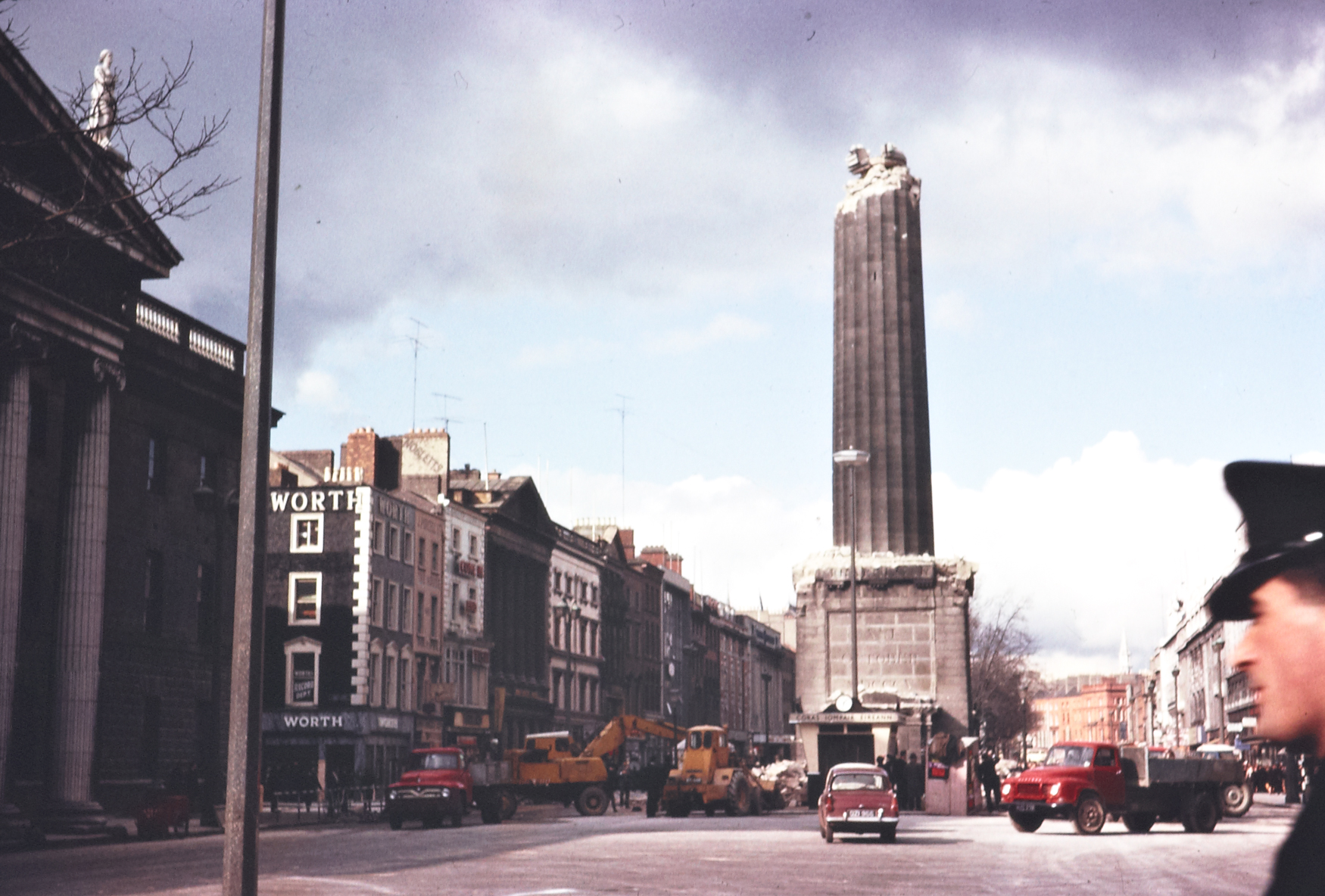
8‭ ‬March 1966: A group of Irish Republicans blew up Nelson’s Pillar in Dublin on this day. The 121 foot high column to England’s greatest Naval Hero, Admiral Lord Nelson, was erected in 1808 to commemorate his victories at sea and his death at the Battle of Trafalgar in 1805. A subscription was raised from amongst the Loyal citizens of Dublin to fund the design and construction of the column and also the 13 foot high statue of Nelson that was placed on top of this imposing edifice.  

A number of attempts over the years,‭ ‬some legal and others not so legal,‭ ‬were initiated to have it removed. Some were based on aesthetic and others on commercial grounds - that it was a block on traffic etc. But after 1922 a more political angle emerged as it was seen as an embarrassment that such an open symbol of British Imperial history dominated the main thoroughfare of Ireland’s Capital city. Notwithstanding this the open platform perched high above O’Connell Street remained a popular visit for both tourists and natives alike. It was also a well-known meeting place and landmark and the phrase ‘I’ll meet you at the Pillar’ was one that fell from many a Dubliners lips for generations. Many of the city' Trams and later the Buses had the simple words ‘The Pillar’ on their frontage as the name of their destination with no further explanation necessary to the passengers.

However with the approach of the Commemoration of the‭ ‬50th anniversary of the Easter Rising in‭ 1966 a small group of non-aligned republicans decided to remove the object by way of explosion. A plan, ‘Operation Humpty Dumpty’ was initiated to place within the pillar a device of such force that the structure would collapse. It was decided to plant a time-bomb on the stairs set to go off in the early hours of a weekday so as to avoid civilian casualties. No warning was to be issued and the perpetrators took a huge risk in this endeavour but Dublin was a far more deserted night time city back then than it is now and this played in their favour.‬

At around‭ ‬2 AM on the morning of 8th March a huge explosion rocked the City and awakened the more alert of the citizens situated near the city centre. The bomb destroyed the upper half of the pillar, throwing the statue of Nelson onto the street and causing large chunks of masonry to litter the surrounding area.  By sheer good Fortune no one was killed or injured.

So long had the Admiral cast his eye over the City that at first many people did not believe the news on being told.‭ But disbelief soon turned into undisguised amusement that this political eyesore was gone at last and in such bizarre circumstances. More mirth was had some days later when the Irish Army was ordered to remove the remains of the column by detonation. While this was accomplished the resultant official bombing destroyed many of the shop front windows in O’Connell St – none of which were subject to damage in the initial explosion!

Within days the event was commemorated in a ballad called‭ ‘Up went Nelson in O’Connell Street’ by a group from Belfast called ‘The Go Lucky Four’ that reached Number 1 in the Irish Charts and stayed there for eight weeks. While Lord Nelson’s head from the statue survived damaged but intact it suffered further indignities as it was stolen from storage in a Student Prank and used to raise funds. It appeared in a TV add and on stage with the Dubliners. After many years on view in the Civic Museum it is now on display in the Dublin City Library (Gilbert Library) in Pearse Street.

In September‭ 2000 Liam Sutcliffe, a resident of Dublin, claimed during a radio interview that he was one of the people responsible for the attack on the monument. On being questioned by the Gardaí he refused to substantiate his claim and the matter was let drop. No one was ever charged or convicted for this attack in what was probably the most popular bombing ever to occur in Ireland. Liam Sutcliffe died in 2017 but no one now doubts he was the man who pulled it off.

‭The Spire now occupies the spot where Nelson’s Column once stood - but no one so far has attempted to demolish it....yet.