Friday, 31 May 2024


31 May 1941 – The German bombing of the North Strand in Dublin by the Luftwaffe on this day. 28 were killed  & over 90 were injured, some 300 houses were destroyed or damaged in the attack. Smaller bombs damaged the American Embassy and Áras an Uachtarain the official home of President Douglas Hyde in the Phoenix Park. The bombing was in all probability accidental and the German Government apologised in June 1941 for the attack.

The first fifteen burials took place on 4 June  incl. the internment of the tragic Brown family in their native Drumcooley, outside Edenderry Co Offaly . Harry Brown, who lived on the North Strand was a member of the Local Defense Force and was amongst the dead, as was his 65-year-old mother, Mary, his wife Mary (or Mollie as she was known, 32) and their children Maureen (7), Ann (5), Edward (3) and Angela (2).  On the same day the burial of eight more people took place  in Glasnevin and in Dean's Grange cemeteries in Dublin. Twelve of those killed were buried by Dublin Corporation at a Public Funeral on 5 June, at which Government members including Eamon De Valera attended. The service took place in the Church of St. Laurence O'Toole, Seville Place and was presided over by Archbishop McQuaid.

 An Taoiseach Eamon De Valera made the following statement in the Dáil on 5 June:

 Members of the Dáil desired to be directly associated with the expression of sympathy already tendered by the Government on behalf of the nation to the great number of our citizens who have been so cruelly bereaved by the recent bombing. Although a complete survey has not yet been possible, the latest report which I have received is that 27 persons were killed outright or subsequently died; 45 were wounded or received other serious bodily injury and are still in hospital; 25 houses were completely destroyed and 300 so damaged as to be unfit for habitation, leaving many hundreds of our people homeless. It has been for all our citizens an occasion of profound sorrow in which the members of this House have fully shared.

 (Members rose in their places.)

 The Dáil will also desire to be associated with the expression of sincere thanks which has gone out from the Government and from our whole community to the several voluntary organisations the devoted exertions of whose members helped to confine the extent of the disaster and have mitigated the sufferings of those affected by it. As I have already informed the public, a protest has been made to the German Government. The Dáil will not expect me, at the moment, to say more on this head.

 https://www.oireachtas.ie/en/debates/debate/dail/1941-06-05/27/


Thursday, 30 May 2024


30 May 1951: A General Election was held in the Irish Republic. The 1st Inter-Party Government under John A. Costello was defeated and Eamon De Valera was elected once again as Taoiseach.


TDs returned:

Fianna Fáil (Eamon de Valera): 69

Fine Gael (Richard Mulcahy): 40

Labour (William Norton): 16

Clann na Talmhan (Michael Donnellan): 6

Clann na Poblachta (Seán MacBride): 2

Independents: 14

The general election of 1951 was caused by a number of crises within the First Inter-Party Government, most notably the Mother and Child Scheme. While the whole affair, which saw the resignation of the Minister for Health, Noël Browne, was not entirely to blame for the collapse of the government it added to the pressure between the various political parties. There were other problems facing the country such as rising prices, balance of payments problems and two farmer TDs withdrew their support for the government because of rising milk prices.

 The election result was inconclusive. Fianna Fáil's support increased by 61,000 votes, however, the party only gained one extra seat. The coalition parties had mixed fortunes. Fine Gael were the big winners increasing to forty seats. The Labour Party patched up its differences with the National Labour Party and fought the election together but in spite of this the party lost seats. Clann na Poblachta were the big losers of the election. Three years earlier the party was a big political threat, but now the party was shattered.

 Fianna Fáil had not won enough seats to govern alone. However, the party was able to form a government with the support of Noël Browne, the sacked Minister for Health, and other Independent deputies.

 De Valera was to stay in power for another 3 years until he lost to another Coalition headed by Fine Gael and Labour


Wednesday, 29 May 2024


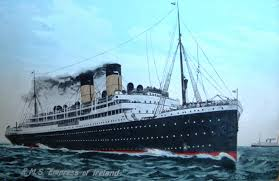
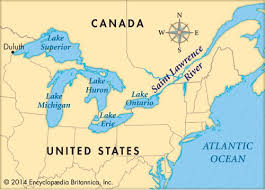
29 May 1914: The loss of the passenger liner Empress of Ireland on this day. The ship sank within minutes of being involved in a collision with a Norwegian SS Storstad in the St Lawrence river, Canada. The vessel had only left port in Quebec a few hours previously, but it was under a new Captain and sailed into a bank of fog where after spotting the approaching Storstad it tried to avoid contact but was unable to do so. Both skippers blamed the other but a subsequent Court of Inquiry blamed the Norwegian for the impact. A verdict that the Norwegians never accepted.

 Of the 1,477 persons on board the ship, 1,012 (840 passengers, 172 crew) died. The number of those who were killed is the largest of any Canadian maritime accident in peacetime.

Empress of Ireland was built by at Govan on the Clyde in Scotland and was launched in 1906.The liner had just begun her 96th sailing when she sank.

 There were only 465 survivors, 4 of whom were children (the other 134 children were lost) and 41 of whom were women (the other 269 women were lost). The fact that most passengers were asleep at the time of the sinking (most not even awakened by the collision) also contributed to the loss of life when they were drowned in their cabins, most of them from the starboard side where the collision happened.

 One of the survivors was Captain Kendall, who was on the bridge at the time, and quickly ordered the lifeboats to be launched. When Empress of Ireland lurched onto her side, he was thrown from the bridge into the water, and was taken down with her as she began to go under. Swimming to the surface, he clung to a wooden grate long enough for crew members aboard a nearby lifeboat to row over and pull him in. Immediately, he took command of the small boat, and began rescue operations.

The lifeboat's crew successfully pulled in many people from the water, and when the boat was full, Kendall ordered the crew to row to the lights of the mysterious vessel that had rammed them, so that the survivors could be dropped off. Kendall and the crew made a few more trips between the nearby Storstad and the wreckage to search for more survivors. After an hour or two, Kendall gave up, since any survivors who were still in the water would have either succumbed to the freezing cold or had drowned by then.

 While the ship had an Irish name there was no specific Irish connection other than she was based in Liverpool and sailed weekly back and forth across the Atlantic. However outside of Ireland it was the case that Liverpool was the most ‘Irish’ city on Earth, and at that time one, if not the greatest Shipping Port in the World. Many of the crew would undoubtedly have had Irish links.

 Sadly this terrible disaster has been almost forgotten, wedged as it is between the far more well know maritime disasters of the Titanic [1912] and the Lusitania [1915] which resonated with the public mind down the years.

 The wreck lies in 40 metres (130 ft) of water, making it accessible to divers. Many artifacts from the wreckage have been retrieved. Some are on display in the Empress of Ireland Pavilion at the Site historique maritime de la Pointe-au-Père in Rimouski, Quebec. The Canadian government has passed legislation to protect the site. http://en.wikipedia.org/wiki/RMS_Empress_of_Ireland#Passengers_and_crew

Tuesday, 28 May 2024


28 May 1929: The death of the Irish Historian Alice Stopford Green on this day. Her father was the Rector of Kells  Co Meath where she was born in 1847. Despite the terrible conditions in the Country at the time Alice was raised in some comfort and educated herself through the use of her fathers extensive Library in Greek, German and metaphysics. At about the age of sixteen she was attacked by an eye ailment, rendering her temporarily blind. In 1873 her family moved to Dublin and there, hungry for knowledge, she started to attend lectures in physics at the College of Sciences.

 After her father’s death she moved with her mother and sisters to London, where she was noticed by an emerging Oxford historian, John Richard Green. In 1877 they were married. He made his name through the publication of a work called A short history of the English people which sold well. She acted as his secretary and assistant and things seemed to be going well. However in 1883 her husband suddenly died and she was on her own. Undeterred she set out to make a name for herself as an Historian in her own right and as a Woman of Letters. She had a formidable list of correspondents in the English speaking World. Her early works—a life of Henry II and a long two-volume study of Town life in the fifteenth century—confirmed her abilities as someone capable of producing serious works of History.

 Though mildly interested in Irish affairs she resided in London and took a keen interest in Africa. Green found her niche editing the ‘Journal of the African Society’, which she did until 1906 and was of the opinion that Black Africans had their own cultures and traditions that should be highlighted and respected. The Boer War was something of a catalyst in how she viewed the Empire and she visited the prison camp on the island of St Helena where Boer prisoners-of-war were being held. In October 1900, returning to England aboard a steamship, she wrote to John Holt: I am certain if this Empire is to be held together at all that Englishmen will have to think more of knowledge v intelligence, & trust less to the argument.

 With the growth of the Irish Revival at home and a renewed interest in Old Irish History she set about the study of it. Much influenced by her late husband’s focus on social and economic aspects of historical change she came out in 1908 with her seminal work The Making of Ireland and its Undoing 1200-1600. This was a bit of a shocker in the stuffy world of Irish Historiography and it seems ruffled quite a few feathers! But it did establish her as a prominent Irish historian as opposed to a British one.

 With the growth of the Home Rule Crises in 1912 and the arming of the Northern Loyalists she became convinced that Nationalist Ireland had to reciprocate and helped along with Sir Roger Casement and others to land guns in Ireland to counter any attempt to Partition the Country. However it was only in 1918 that she moved to Dublin where she took up residence at 30 St Stephen’s Green where her house became a hub of social and political interaction. While she was an Irish historian and patriot she was not one of violent persuasion.

 When the Treaty was signed in 1921 she fully supported it. In 1922 she won a seat in Seanad Éireann  as a Senator of the new Irish Free State. She remained as a member until her death. Her final major work was History of the Irish State to 1014. Again in this volume she attempted to lay out the cultural, social and legal framework of Ireland and the National character and culture of the People up until that date and steered away from a political history of the period.

 Alice Stopford Green died on this day in 1929 - just two days short of her 82nd birthday. She is buried in Deans Grange cemetery Co Dublin.


Monday, 27 May 2024


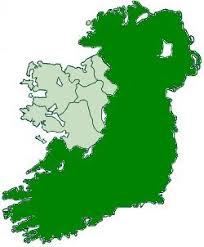
27 May 1224: Cathal Crovderg [‘Redhand’] O'Conor, king of Connacht, son of Turlough and brother of Rory O'Conor (the last 'High King' of Ireland), died at the age of 72. He was the last of the great Irish Kings. His death opened the way for the Norman takeover of Connacht.

 King Cathal had to play what might be described in today's terms as a masterly game of 'Realpolitik' in his time as King. He was faced with a range of enemies both internal and external who wished to bring him down. Depending on circumstances he was prepared to 'switch sides' and play one off against another. He built alliances with Thomond (north Munster), Tir Owen and Fermanagh in the North and sometimes with the Anglo-Norman invaders. But he was not averse to throwing himself at the mercy of the Justicar in Dublin when he was forced to flee his own kingdom. From his base west of the river Shannon he was forced to deal with the Norman invaders. He was a competent leader despite problems, avoiding major conflicts and winning battles. Ua Conchobair attempted to make the best of the new situation with Ireland divided between Norman and Gaelic rulers.

 He succeeded as head of the O'Conors on his brother Rory's death in 1198. The early part of his reign was passed in contests with the Anglo-Normans and with his nephew Cathal Carrach, who at one time succeeded in expelling him from his territories. In 1201, however, Cathal Crovderg, with the assistance of the Anglo Norman De Burghs, defeated and slew his nephew in battle near Boyle.

 On his nephews death Cathal was finally in a position to have himself inaugurated as King of Connacht in the traditional way, surrounded by his close family and retainers along with the heads of the important monasteries and with the vassal families of the O’Conors in attendance. This ancient ceremony took place at Carn Fraoich near Ráth Cruachan [above] in County Roscommon. But in some ways it was an empty title too as Cathal was also a vassal of the King of England. He certainly did not have free sway over the whole province, just a portion thereof on sufferance really.

 On King John's arrival in Ireland in 1210, he paid him homage, and by the surrender of a portion of his territories, secured to himself a tolerably peaceful old age. He died in the abbey of Knockmoy (having assumed the habit of a Grey Friar) in 1224. The principal abode of the heads of the O'Connor family at this period was around Rathcroghan, near Tulsk, in the County of Roscommon.

 He founded Ballintubber Abbey in 1216, and was succeeded by his son, Aedh mac Cathal Crobdearg Ua Conchobair. His wife, Mor Ní Briain, was a daughter of King Domnall Mór Ua Briain of Thomond, died in 1218. By the end of his Life he had come to accept the primacy of the King of England as also 'Lord of Ireland' as a political necessity and only wished to have his son recognised by King Henry III of England as his successor.

 He wrote to King Henry in 1224 shortly before his death:

 'To his dear Lord Henry,by the grace of God King of England, Lord of Ireland, Duke of Normandy and Aquitaine, Count of Anjou, from his faithful King of Connacht, greeting, and bond of sincere affection with faithful obedience.'

'We feel sure that you have heard, through the trusty men and counsellors of your father and your own, how that we did not fail to give faithful and devoted service to the Lord John, your father of happy memory ; and since his death, as your trusty servants stationed in Ireland know and have learned, we are not failing to give devoted obedience to you, nor do we wish ever as long as we live to fail you. Wherefore, although we possess a charter for the land of Connacht from the Lord your father given to ourselves and our heirs, and by name to Od [Aedh] our son and heir...'

LETTER FROM CATHAL "CROVDEARG" O'CONOR, KING OF CONNACHT, TO HENRY III, circa 1224

Taken from A History of Ireland by Eleanor Hull

 His eulogy in the Annals of Connacht relates the attributes that a true King was expected to portray to his People:

'A great affliction befell the country then, the loss of Cathal Crobderg son of Toirrdelbach O Conchobair, king of Connacht;

the king most feared and dreaded on every hand in Ireland;

the king who carried out most plunderings and burnings against Galls and Gaels who opposed him;

the king who was the fiercest and harshest towards his enemies that ever lived;

the king who most blinded, killed and mutilated rebellious and disaffected subjects;

the king who best established peace and tranquillity of all the kings of Ireland;

the king who built most monasteries and houses for religious communities;

the king who most comforted clerks and poor men with food and fire on the floor of his own habitation;

the king whom of all the kings in Ireland God made most perfect in every good quality;

the king on whom God most bestowed fruit and increase and crops;

the king who was most chaste of all the kings of Ireland;

the king who kept himself to one consort and practised continence before God from her death till his own;

the king whose wealth was partaken by laymen and clerics, infirm men, women and helpless folk, as had been prophesied in the writings and the visions of saints and righteous men of old;

the king who suffered most mischances in his reign, but God raised him up from each in turn;

the king who with manly valour and by the strength of his hand preserved his kingship and rule.

And it is in the time of this king that tithes were first levied for God in Ireland. This righteous and upright king, this prudent, pious, just champion, died in the robe of a Grey Monk, after a victory over the world and the devil, in the monastery of Knockmoy, which with the land belonging to it he had himself offered to God and the monks, on the twenty-seventh day of May as regards the solar month and on a Monday as regards the week-day, and was nobly and honourably buried, having been for six and thirty years sole monarch of the province of Connacht.

So says Donnchad Baccach O Maelchonaire in his poem on the Succession of the Kings:

‘The reign of Red-hand was a pleasant reign, after the fall of Cathal Carrach; he ruled for sixteen and twenty prosperous calm years.’

And he was in the seventy-second year of his age, as the poet Nede O Maelchonaire says: ‘Three years and a half-year, I say, was the life of Red-hand in Cruachu till the time that his father died in wide-stretching Ireland.’

He was born at Port Locha Mesca and fostered by Tadc O Con Chennainn in Ui Diarmata, and it was sixty-eight years from the death of Toirrdelbach to the death of Cathal Crobderg, as the chronicle shows.'

The Annals of Connacht


Sunday, 26 May 2024


26 May 1315: Edward de Bruce the Earl of Carrick (the younger brother of Robert de Bruce of Scotland) and his fleet landed on the Irish coast on points at and between Olderfleet Castle at Larne and Glendrum on the north east coast of Ireland. The Earl's army contained a force estimated at in excess of 6,000 men, many of them veterans of the campaign of the previous year in Scotland in which the Earl Edward led the vanguard at the Battle of Bannockburn where he and his brother decisively defeated the King of England Edward II.

 His descent on the north-west coast of Ireland was the start of his ultimately futile bid to seize Ireland from the English – an attempt that was to cause much bloodshed and suffering here for three long years. Edward knew there was much dissatisfaction with English Rule in Ireland. He had helped his brother fight the Sassenach in Scotland and defeat their attempts to secure that Kingdom. But he was also a man of ambition and pride. He did not want to spend his life in his brother's shadow. King Robert in turn did not want his ambitious sibling as a thorn in his side either. He steered his brothers’ focus onto freeing the Gaels of Ireland from English Rule. If Edward could achieve that then Robert would be shot of him and would have also diverted the attentions of King Edward II of England away from Scotland and onto Ireland.

 Edward the Bruce intended from the start to rely on the Gaels of Ireland to provide support, both in men and material, to the Scots. In this the Scotsman met with a measure of success but as he moved south the number of Irish Chieftains ready to throw in their lot with the newcomers diminished considerably. At first the Irish/Scottish alliance seemed unstoppable as they won battle after battle, in less than a year they had most of Ireland in their control. However by the beginning of 1317 famine had stricken the country making it difficult for either side to undertake military operations. The Famine was of unusual intensity and struck right across Europe, killing countless numbers as crops failed and the weather turned much colder.

 Then in the late summer of 1318, Sir John de Bermingham with his army began a march against Edward de Brus. On 14 October 1318, the Scots-Irish army was badly defeated at the Battle of Faughart by de Bermingham's forces. Edward was killed, his body being quartered and sent to various towns in Ireland, and his head being delivered to King Edward II. The Annals of Ulster summed up the hostile feeling held by many among the Anglo-Irish and Irish alike of Edward de Brus:

 Edward de Brus, the destroyer of Ireland in general, both Foreigners and Gaels, was killed by the Foreigners of Ireland by dint of fighting at Dun-Delgan. And there were killed in his company Mac Ruaidhri, king of Insi-Gall Hebrides [i.e. Ailean mac Ruaidhri] and Mac Domhnaill, king of Argyll, together with slaughter of the Men of Scotland around him. And there was not done from the beginning of the world a deed that was better for the Men of Ireland than that deed. For there came death and loss of people during his time in all Ireland in general for the space of three years and a half and people undoubtedly used to eat each other throughout Ireland."

The Annals of Ulster


Saturday, 25 May 2024


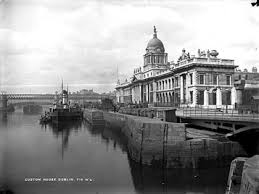
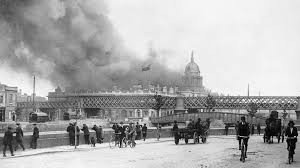
25 May 1921- The Custom House in Dublin was burnt out by members of the Dublin Brigade IRA. In an audacious and well planned operation some 200 IRA members seized control of the Custom House building on Dublin’s North Quay and set it alight. The purpose of the raid was to destroy the Local Government records of the British Administration in Ireland in order to further undermine their ability to rule the Country.

The Operation had been decided upon by the senior members of the Republican Movement at the time incl. Michael Collins and Eamon De Valera. It was hoped that such a devastating blow would undermine British rule to such a degree that it would never recover it ability to collect taxation at local level.

 The 2nd battalion Dublin IRA was tasked with carrying out the Operation. Vinny Byrne - a member of Collins hit men unit - ‘the Squad’ - recalled:

'However a 25 May IRA attack on the Customs House in Dublin made it clear that the advocates of continued force within the Irish Independence movement were more than content to keep the fight going. The attack, waged largely by the Dublin Brigade's 2nd Battalion, marked the largest armed deployment by the rebel forces since the Easter Rising. With some 200 men involved in all, the attack in retrospect might be judged to have been as foolhardy for the IRA as it was dramatic in scale. While the objective of damaging the Customs House and destroying thousands of tax records was achieved, in all the attack resulted in the loss of some seventy-five members of the Dublin Brigade due to arrests at the scene and the deaths of six others...

 The objective for attacking the Customs House in fact dated back to the end of 1918, when the Irish Volunteers devised a plan for the building's destruction if and when the British Government imposed conscription on Ireland. Vincent Byrne, a member of the execution gang attached to Michael Collins Intelligence Department, recalled his role in the attack and subsequent escape.


I got a tin of petrol and proceeded to the second floor. I opened the door and sitting inside there were a lady and a gentleman, civil servants having tea. I requested them to leave, stating that I was going to set fire to the office. The gentleman stood up and said 'Oh, you can't do that.' I showed him my gun and told him I was serious. . . The lady then asked me if she could get her coat, and I replied: 'Miss, you'll be lucky if you get out with your life.'

The Irish Revolution and its Aftermath 1916-1923 - Years of Revolt by Francis Costello


So while the immediate objective was achieved the operation was a costly one for the IRA as many of its top operatives were captured. The building was quickly surrounded by the Auxiliaries of the RIC who while ruthless were all combat experienced men. Many of the Volunteers were unable to effect their escape in time and were captured. So it was something of a Pyrrhic Victory for the men of the Dublin Brigade to burn out such an important edifice (both symbolic and real) of the British presence in Ireland that day.