Saturday, 23 May 2020

Bad Moon Rising | Full Moon rising above the hilltops east o… | Flickr

May 23-4 1798: The outbreak of the United Irishmen Rising on this day. Overnight mail coaches were attacked on the roads to Dublin to signal the start of revolutionary action. In order to give some degree of co ordination it was agreed that the ‘Rising of the Moon’ would be the hour to strike the coaches.

In the City itself attempts to trigger an outbreak were thwarted as the British Army moved to seize strategic assembly points and thus nip things in the bud. Small crowds of men had set out from the poor districts of the city of Dublin to seize the Castle and other key public buildings. Agents of the Crown had infiltrated their revolutionary organization, the United Irishmen, and had already arrested several of their key leaders, Lord Edward FitzGerald being the most important of them. The Militia mobilized before the insurgents could assemble in large groups and what their leaders had hoped would be an almost bloodless coup turned into a debacle.

Outside the City though the insurgents fared better and many gathered in rural areas of County Dublin as well as southern County Meath, northern County Kildare and northern and western County Wicklow. These groups attacked towns and villages in their respective localities and stopped and destroyed some of the mail coaches that were making their way out to the provinces.

On the 23rd of May, Dublin was placed under martial law; the citizens were armed, the guard was trebled, the barristers pleaded with regimentals and swords, and several of the lamplighters were hung from their own lamp-posts for neglecting to light the lamps. The country people were prepared to march on the city, but Lord Roden and his Foxhunters soon put down their attempt. The next morning the dead were exhibited in the Castle-yard, and the prisoners were hanged at Carlisle-bridge.[now O’Connell Bridge] Sir Watkins Wynn and his Ancient Britons distinguished themselves by their cruelties.
http://www.libraryireland.com


Friday, 22 May 2020


22 May 1849: Maria Edgeworth died on this day. She was born in England in 1767 and spent her early years there. Her mother died while she was quite young and she was raised by a series of step mothers. (Her father married four times and sired 22 children!). Unusual for the Age for a female she was sent to school where she excelled at her studies. However in 1782 she accompanied her father, his third wife and a number of children to Edgeworthstown, Co. Longford. It was here that she made her home for the rest of her Life.

An intelligent and curious woman she corresponded with famous and learned people across these islands, though in her heart she wanted to be a writer and with her material needs provided by her father and her social isolation on his Estate she began to pour out a succession of publications. She served as her father's secretary as well, and collaborated with him on several nonfiction works. She also helped to raise many of the numerous brood of his offspring.

Her first work was Letters for Literary Ladies (1795), and this owed much her fathers’ ideas on women's education. It was followed by The Parent's Assistant (1796), a collection of children's stories, and their jointly written Practical Education (1798). More children's stories were published in 1801 as Early Lessons and Moral Tales. Her first and best novel, Castle Rackrent (1800), was published anonymously. It achieved immediate success, and her name appeared on subsequent editions. Indeed her reputation today more less rests on this work and its portrayal of Irish life at that time. 

Castle Rackrent is also recognized as the first regional novel, depicting the speech, mannerisms, and activities of a specific Irish region and social class. This technique influenced subsequent novelists, including William Thackeray, James Fenimore Cooper, and Sir Walter Scott, who commended "the rich humour, pathetic tenderness, and admirable tact" of Edgeworth's novel and expressed the hope that his own novels would accomplish for Scotland "something . . . of the same kind with that which Miss Edgeworth so fortunately achieved for Ireland".

In 1802 the Edgeworths toured the English midlands. They then travelled to the continent, first to Brussels and then to France when a brief Peace operated  between Britain and Napoleonic France.  They met all the notables, and Maria received a marriage proposal from a Swedish courtier, Count Edelcrantz- but it appears she wasn’t very interested in him.

On a visit to London in 1813, where she was received as a literary lion, Maria met Lord Byron (whom she disliked). She entered into a long correspondence with the ultra-Tory Sir Walter Scott and they formed a lasting friendship. She visited him at his home in Scotland at in 1823 where he took her on a tour of the area.

After her father's death in 1817 she edited his memoirs, and extended them with her biographical comments. She was an active writer to the last. She was might be perhaps described as a mild unionist who believed in fair treatment for all but not in the separation of England and Ireland. She was a strong believer in Woman’s Rights and Children's’ Rights.

After a visit to see her relations in Trim, Maria, now in her eighties, began to feel heart pains and died suddenly of a heart attack in Edgeworthstown on 22 May 1849. She was buried in the family vault there alongside her father.
* Portrait of Maria Edgeworth by John Downman 1807


Thursday, 21 May 2020


21 May 1981: The Third and Fourth Irish Hunger Strikers Died in Long Kesh Prison on this day.
Raymond McCreesh (24), an Irish Republican Army (IRA) prisoner, and Patsy O'Hara (23), an Irish National Liberation Army (INLA) prisoner, both died having spent 61 days on hunger strike. Tomás Ó Fiaich, then Catholic Primate of Ireland, criticised the British government's attitude to the hunger strike.
The two men were preceded by Bobby Sands (5 May) and Frankie Hughes (12 May) in their struggle for political status.

Their 5 demands were:
The right not to wear a prison uniform;
The right not to do prison work;
The right of free association with other prisoners, and to organise educational and recreational pursuits;
The right to one visit, one letter and one parcel per week;
Full restoration of remission lost through the protest.

But perhaps what they felt is best summed up in these lines from this H Block Ballad:

But I'll wear no convict's uniform
Nor meekly serve my time
That Britain may call Ireland's fight
Eight hundred years of crime.

The strike was to last until 3 October 1981 and was to see 10 Republican prisoners starve themselves to death in support of their protest. The strike led to a heightening of political tensions in the region. It was also to pave the way for the emergence of Sinn Féin (SF) as a major political force in Ireland.


Wednesday, 20 May 2020


20 May 1311: The Battle of Bunratty/Bun Raite on this day.
Civil War raged in north Thomond (today's Co Clare) in the year 1311, a war that had been going on and off for decades as the O'Briens of that part of Ireland fought with one another to control their own territory. The chief antagonists at the time of this battle were King Dermot O'Brien[Clan Brien] and King Donough O'Brien [Clan Turlough].

The King of England's Justicar in Dublin was worried about the situation in Thomond and in May 1311 issued instructions that:

The war in the parts of Thomond between Richard Clare and Donatus Obreen, who calls himself prince of the Irish of Thomond, disturbs the peace throughout Ire. by its continuation. ORDER to prohibit Richard and Donatus from continuing that war and cause them to keep the peace for life.
Patent Roll 4 Edward II | CIRCLE
Which both sides ignored!

Donough O'Brien had the support of the Anglo-Norman DeBurghs of Connacht while Dermot O'Brien had the support of Anglo-Norman Richard de Clare based in Bunratty Castle.
The DeBurghs, led by William DeBurgh himself, invaded Clare to support their protégé and clashed with Richard de Clare's men near Bunratty Castle. While the DeBurghs won the tactical battle disaster befell them when William was taken prisoner and Donough O'Brien fled the field of battle as a result.

Lord William de Burgh was captured. On the day of the Ascension of the Lord lord john de Crok* was killed with many others in the battle of Bunratty with a great deal of booty given up in battle.
Annals of Ireland by Friar John Clyn
*He was deBurgh’s Standard bearer.

However the hapless Lord was most unfortunate as another account of this Battle relates:

A great hosting by William Burk into Mumha, against the Clarach;
and they gave battle to each other,
and the Clarach was worsted, and a great defeat was inflicted on him there.
William Burk was himself taken prisoner in the rere of his people, whilst he was following up the rout;
and although he was there taken prisoner,
it was he that had the triumph of that battle.

Annals of Loch Cé

None of this ended the War and even though King Donough was treacherously killed later that year and Dermot died in 1313 the dispute lingered on for many more years.


Tuesday, 19 May 2020


Image result for lord edward fitzgerald

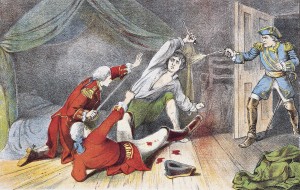
19 May 1798: Lord Edward Fitzgerald was shot and arrested at the home of the Merchant NicholasMurphy at whose house (now 151 Thomas Street, Dublin) he was taking refuge in.
Lord Edward Fitzgerald was a most unlikely 'Rebel'. He was born on 15 October 1763 at Carton House, Co Kildare, one of the most prestigious stately homes in the Country. He was the son of the Duke of Leinster, the most senior Aristocrat in Ireland. He was later brought up at Frascati House, Blackrock, Co Dublin.
He received a Commission in the British Army at an early age and served with the distinction in the American Revolutionary War with the 19th Regiment of Foot in South Carolina, taking part in the Battle of Eutaw Springs (1781) where he was wounded.
In 1783 FitzGerald returned to Ireland, where his brother, the 2nd Duke of Leinster, had procured his election to the Irish Parliament as a Member for Athy, a seat he held until 1790. He represented then Kildare County from 1790 to 1798. He continued his Army career and served in Canada and then travelled extensively across eastern Canada and down the Mississippi before sailing for home through New Orleans.
However it was the events of the French Revolution that proved the turning point in his life. In 1792 he went to Paris and stayed with Thomas Paine. He sat in the observers gallery to listen to the debates of the French Convention and was impressed with what he heard. While there he married Pamela, who was the love child of Madame de Genlis herself by Louis Philippe II, Duke of Orléans. The future King of the French, Louis Phillipe, was among the witnesses.
At a convivial gathering on the 18 November, after the French victory at Jemappes, he offered at a public dinner a toast to: ''The armies of France: may the example of its citizen soldiers be followed by all enslaved countries, till tyrants and tyrannies be extinct.'' He also proposed a toast to “the speedy abolition of all hereditary titles and feudal distinctions”, and gave proof of his zeal by expressly repudiating his own title. For his actions in Paris he was cashiered from the British Army.
On his return to Ireland his views both private and public became more Radical. However he did not join the revolutionary United Irishman until 1796 when he quickly immersed himself in the military plans for a Rising. He travelled as far as Hamburg to secure funds and military assistance from the French. Some of the United Irishmen wanted to wait until this was guaranteed but Lord Edward was of the opinion that it was better to strike sooner rather than later.
By early 1798 it was obvious that further delay would prove fatal and a Rising must come soon. The British Government was using forceful methods to disarm people of any weapons they might have that could used against them. However Martial Law had not yet been declared. The forces of the State also ran a very effective network of spies and informers that had infiltrated the United Irishmen or those who were on familiar terms with them.
On 23 March the military swept on the Dublin Committee of the revolutionaries and captured nearly all of them. Forewarned Lord Edward escaped the net but was now a hunted man.
In the aftermath the British declared Martial Law and it could be only a matter of time till things exploded. In response the date for the Rising was brought forward to be launched on 23 May 1798.
However on 9 May, with Lord Edward till at large, a bounty of £1,000 was put on his head for information leading to his capture - a huge sum in those days.Lord Edward was hiding in Thomas Street, Dublin but had just been involved in a skirmish with his pursuers and it was decided that his original place of refuge must have been compromised. He then moved on the night of the 18th to the home of the Feather Merchant Nicholas Murphy at what is now 151 Thomas Street. He was ill and under the weather but at breakfast the next morning was seen to recover. Murphy was apprehensive of having such a well known fugitive under his roof and (rightly) feared that his betrayal and arrest was only a matter of time.
That evening, at around 7pm Murphy went to Lord Edward's room to call him down for tea and remembered:
He was in bed. It was, at this time, about seven o’clock. I asked him to come down to tea. I was not in the room three minutes when in came Major Swan and a person following him with a soldier’s jacket, and a sword in his hand; he wore a round cap. When I saw Major Swan, I was thunderstruck. I put myself before him, and asked his business. He looked over me and saw Lord E. in the bed. He pushed by me quickly, and Lord E., seeing him, sprang up instantly and drew a dagger which he carried about him, and wounded Major Swan slightly, I believe. Major Swan had a pistol which he fired without effect; he immediately turned to me and gave me a severe thrust of the pistol under the left eye, at the same time desiring the person that came in with him to take me into custody. I was immediately taken away to the yard ; there I saw Major Sirr and about six soldiers of the Dumbarton Fencibles.
 Major Swan thought proper to run as fast as he could to the street, and I think he never looked behind him till he got out of danger, and he was the parading the flags, exhibiting his linen, which was stained with blood. Mr. Ryan supplied Major Swan’s place and came in contact with Lord E., and was wounded seriously. Major Sirr at that time came upstairs and keeping a respectful distance, fired a pistol shot at Lord E., in a very deliberate manner, and wounded him in the upper part of the shoulder. Reinforcements coming in, Lord E., surrendered after a very hard struggle. Lord Edward was imprisoned in Newgate....
Lord Edward had fought like a lion against those sent to lead him into captivity, killing Capitan Ryan and wounding Major Swan. However with him badly outnumbered by men in arms his heroic defense could only last but a short time. Desperately wounded in the struggle he was taken in a closed sedan chair first to Dublin Castle and then to prison. There he lingered for a number of days in agony as septicaemia took its toll. He died on the 4th of June 1798 as the Rising he had so long planned for was well underway.
Thus died one of the bravest of men, from a conviction, I believe, that he wished to ameliorate the condition of his country.
Lord Edward’s remains were placed in a vault under the East end of St. Werburgh’s Church in Dublin, near to the house he was taken in.
Years later the outcome that Murphy had feared was finally revealed - Betrayal!
The two informers implicated in the betrayal of Lord Edward were Francis Higgins (proprietor of ‘The Freeman’s Journal’), at that time a paper in the interest of Dublin Castle, the seat of British rule in Ireland, and Francis Magan, M.A., Barrister at Law. On the 20th of June 1798, Francis Higgins was paid his reward of £1,000 for Lord Edward’s capture.


Monday, 18 May 2020


18 May 1613: The opening of Parliament in Dublin Castle on this day. This parliament had been called by King James I [above] in London in order to strengthen his rule in Ireland and to ensure that the Protestant Religion was the dominant one in that body. By doing this he would be able to get legislation passed for the raising of taxes and the enforcement of anti Catholic laws.

 King James created some 40 micro boroughs (mostly in Ulster) in order to be able to ‘pack’ the Houses with Protestant supporters. In 1612 six of the major Catholic Lords of the Pale had written to him to complain about this:

the project of erecting so many corporations in places that constantly rank as the poorest villages in Christendom, do tend naught else but by the voices of a few selected for the purpose…extreme penal laws should be imposed on your subjects [i.e. Catholics]

But their protest was to no avail as James (a devout Protestant) was determined to see the measure through. He had once described the Catholics of Ireland as 'half subjects' and he did not trust their loyalty to his Throne at all.

When the members of parliament met that day they consisted of 132 Protestants and 100 Catholics - even though over 85% of the population of the Country were Catholics! Of the Catholics, 80 were Old English and only 20 Gaelic Irish. In the House of Lords, the block vote of 20 Protestant Bishops gave the British Crown control of the Upper House in which also sat 12 Catholic and 4 other protestant peers.

In the event on the day mayhem ensued as clashes erupted inside the Castle as the supporters of both religions exchanged blows as to who should have the Speakers Chair. The Catholics peremptorily installed their own nominee Sir John Everard literally into the Chair while the other side had left the Chamber to be counted. On return they then sat their champion Sir John Davies on top of him! After a scuffle Everard was rejected and the opposition withdrew.

 ‘Those within the house are no house and Sir John Everard is our Speaker, and therefore we will not join with you, but we will complain to my Lord Deputy and the King, and the King shall hear of this’ exclaimed Sir William Talbot.

The whole proceedings had turned into a Fiasco,& after a series of adjournments the parliament was prorogued on 17 June to await the results of an appeal to England.

Primary Source: Chapter VII of Early Modern Ireland Volume III: Pacification, plantation and the catholic question 1603-23 by Aiden Clarke with R. Dudley Edwards

Sunday, 17 May 2020


17 May 1974: The Dublin and Monaghan Bombings on this day. Three car bombs exploded in Dublin, immediately killing 23 people and injuring more than 100 others during the rush hour. Five more people died and another 20 were hurt in a blast, which hit the town of Monaghan an hour later. The final death toll was 34 people. The bombings were the work of a UVF gang that had links to elements within the British Army Intelligence services. No one has ever been charged with these attacks.
It was a hot day in early summer when the terrorists launched their attacks. The City centre of Dublin was full of shoppers and workers heading home that Friday afternoon, little suspecting that such a murderous deed was about to be inflicted upon them.
In the North a huge Loyalist Strike was underway with the aim of bringing down the Power Sharing Executive that had been formed in January that year. Its aim was to allow both sides a share in the Government of the North so that no side would feel excluded. It also had as one of its terms the formation of an All Ireland Council. To many Unionists this was a step too far and a possible 'foot in the door' to a United Ireland without their consent.
The perpetrators of these bombings knew that the Executive at Stormont was in grave danger of collapse. It was clear the British Government under Harold Wilson was dithering with indecision as to what to do in the face of such a massive level of civil disobedience by most of the Unionist Community in Ulster. This was backed by widespread intimidation of those who tried to go about their business regardless.
Only the Dublin Government under the Taoiseach Liam Cosgrave stood firm against any collapse of what they had tried so hard in negotiations to have set up and running. While the Troubles had claimed hundreds of lives north of the Border the south had escaped relatively unscathed up until then - but not entirely free of atrocities either.
Clearly the aim of the attackers was to jolt the people of the South, and the Dublin Government in particular, out of any sense of complacency that they could escape the consequences (as they saw it) of unwarranted interference in Ulster.
At approximately 17:30 on Friday 17 May 1974, without prior warning, three car bombs exploded almost simultaneously in Dublin's city centre at Parnell Street, Talbot Street, and South Leinster Street during rush-hour. According to one of the Irish Army's top bomb disposal officers, Commandant Patrick Trears, the bombs were constructed so well that one hundred per cent of each bomb exploded upon detonation.
The explosives used in the attacks were of the type used by the Provisional IRA and were probably from a haul that members of the Crown Forces had captured and that rogue elements had got their hands on to launch these attacks.
The first of the three Dublin car bombs went off at approximately 17:28, in a parking bay outside the Welcome Inn pub and Barry's Supermarket and close to a petrol station, in Parnell Street near its southwestern intersection with Marlborough Street. Ten people were killed in this explosion, including two infant girls and their parents, and a World War I veteran.
The second of the Dublin car bombs went off at approximately 17:30 at number 18 Talbot Street near the northwestern Lower Gardiner Street intersection, outside O'Neill's shoe shop opposite Guineys department store. At least four bodies were found on the pavement just outside Guineys.
The third bomb went off at approximately 17:32 in South Leinster Street near the railings of Trinity College, Dublin. Two women were killed instantly in that explosion; they had been very close to the epicentre of the blast.
Ninety minutes later, at approximately 18:58, a fourth bomb (weighing 150 pounds) exploded outside Greacen's pub in North Road, Monaghan. This bomb killed five people initially, and another two died in the following weeks.
On the evening of the bombings, the Taoiseach, Liam Cosgrave, said in a TV and radio broadcast that he wanted to express 'the revulsion and condemnation felt by every decent person in this island at these unforgivable acts.' He said it would help 'to bring home to us here what the people of NI have been suffering for five long years.' He added 'everyone who has practised violence, or preached violence or condoned violence must bear a share of responsibility for today's outrage'.
In Belfast, the UDA and the UVF denied responsibility for the explosions and in Dublin a statement issued by the Provisional IRA called the explosions 'vile murder'. Mr. Brian Faulkner, NI Chief Executive, sent a message to Mr. Cosgrave expressing 'deepest regret' from himself and his colleagues. The UDA Press Officer, Mr. Samuel Smyth, said: 'I am very happy about the bombings in Dublin. There is a war with the Free State and now we are laughing at them'.
But within days the official attitude had changed and the feeling in Government ranks was to play down this huge atrocity to avoid heightening tensions and giving credibility to the Provisional IRA. As the weeks rolled by the Garda investigations were wound down and then effectively stopped. It has been rumoured that names of the killers were known to the police forces in both parts of Ireland even if it could never be proved. The event was buried by the forces of Officialdom over the years and forgotten about. No one has ever been charged with these crimes on that terrible day.
LOST LIVES
Dublin and Monaghan Bombings - 17th May 1974:
Patrick Askin (44) Co. Monaghan
Josie Bradley (21) Co. Offaly
Marie Butler (21) Co. Waterford
Anne Byrne (35) Dublin
Thomas Campbell (52) Co. Monaghan
Simone Chetrit (30) France
Thomas Croarkin (36) Co. Monaghan
John Dargle (80) Dublin
Concepta Dempsey (65) Co. Louth
Colette Doherty (20) Dublin
Baby Doherty (full term unborn) Dublin*
Patrick Fay (47), Dublin & Co. Louth
Elizabeth Fitzgerald (59) Dublin
Breda Bernadette Grace (34) Dublin and Co. Kerry
Archie Harper (73) Co. Monaghan
Antonio Magliocco, (37) Dublin & Italy
May McKenna (55) Co. Tyrone
Anne Marren (20) Co. Sligo
Anna Massey (21) Dublin
Dorothy Morris (57) Dublin
John (24), Anna (22), Jacqueline (17 months) & Anne-Marie (5 months) O'Brien, Dublin
Christina O'Loughlin (51), Dublin
Edward John O'Neill (39), Dublin
Marie Phelan (20), Co. Waterford
Siobhán Roice (19), Wexford Town
Maureen Shields (46), Dublin
Jack Travers (28), Monaghan Town
Breda Turner (21), Co. Tipperary
John Walsh (27), Dublin
Peggy White (44), Monaghan Town
George Williamson (72), Co. Monaghan
*Baby Doherty was recognised as the 34th victim of the Bombings by the Coroner for the City of Dublin during the course of the Inquests held in April and May 2004
http://www.dublinmonaghanbombings.org/index2.html