Thursday, 7 January 2016


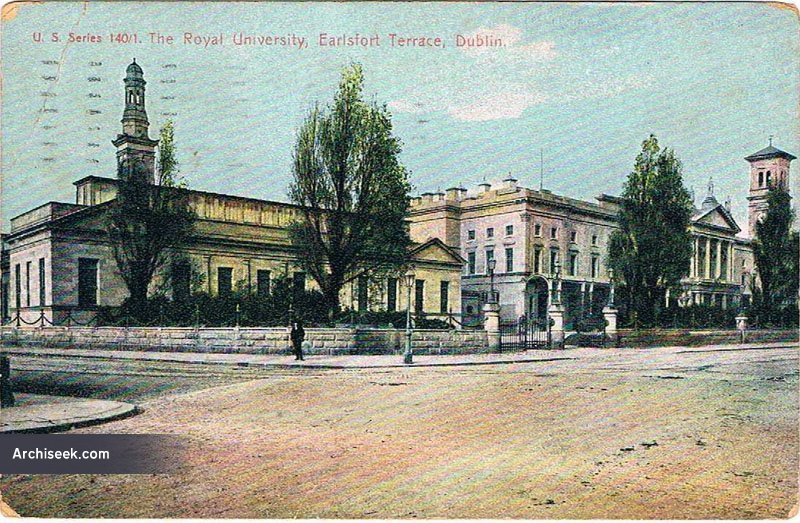
7‭ ‬January‭ ‬1922:‭ ‬The Treaty was passed by members of‭ ‬Dáil Eireann‭ ‬assembled at Earlsfort Terrace,‭ ‬Dublin [above] on a vote of‭ ‬64‭ ‬in favour and‭ ‬57‭ ‬against.‭ ‬President De Valera,‭ ‬after the vote was taken,‭ ‬indicated his intention of resigning his position.‭ ‬He said that:


There is one thing I want to say---I want it to go to the country and to the world,‭ ‬and it is this:‭ ‬the Irish people established a Republic.‭ ‬This is simply approval of a certain resolution.‭ ‬The Republic can only be disestablished by the Irish people.‭ ‬Therefore,‭ ‬until such time as the Irish people in regular manner disestablish it,‭ ‬this Republic goes on.‭ ‬Whatever arrangements are made this is the supreme sovereign body in the nation‭; ‬this is the body to which the nation looks for its supreme Government,‭ ‬and it must remain that---no matter who is the Executive---it must remain that until the Irish people have disestablished it.

Michael Collins,‭ ‬who voted to accept the terms replied that:‭

I ask your permission to make a statement.‭ ‬I do not regard the passing of this thing as being any kind of triumph over the other side.‭ ‬I will do my best in the future,‭ ‬as I have done in the past,‭ ‬for the nation.‭ ‬What I have to say now is,‭ ‬whether there is something contentious about the Republic---about the Government in being---or not,‭ ‬that we should unite on this:‭ ‬that we will all do our best to preserve the public safety.

Soon after the meeting broke up but it was clear that after this things would never be the same again and an unbridgeable rift had opened between those who supported the Treaty and those who were against it.‭ The division of opinion that day was to have one outcome: Civil War.


Wednesday, 6 January 2016


6/7‭ ‬January‭ ‬1839:‭ ‬The Night of the Big Wind/‭ ‬Oiche na Gaoithe Mire.‭ ‬A storm of Hurricane Force swept across Ireland on this night.‭ ‬A Depression of unusual severity it caused much structural damage and considerable fright and distress,‭ ‬especially to those less well off inhabitants of this island whose dwellings were just plain thatched cabins of loose construction.‭ ‬However even more solidly built structures did not escape unscathed and in some ways were even more dangerous to those within as chimneys came crashing down upon at least some of the unfortunates inside.‭ ‬Overall though the numbers of deaths caused by this violent tempest were few and the loss of life was limited to just a few dozen at most.‭ ‬However there is no doubt that for a considerable proportion of the Irish population the events of this visitation remained in the popular imagination as a night never to be forgotten.‭

The sequence of events had begun the previous evening,‭ ‬Saturday‭ ‬5th January‭ ‬1839,‭ ‬when heavy snow fell throughout Ireland.‭ ‬The next morning,‭ ‬Sunday the‭ ‬6th,‭ ‬it was completely calm and the sky was covered with motionless,‭ ‬dense cloud.‭ ‬As the morning progressed,‭ ‬the temperature rose well above the January average.‭ ‬While children played in the snow outdoors,‭ ‬mothers and fathers were inside their homes preparing for the festivities of Little Christmas‭ ‬-‭ ‬the feast of the Epiphany.‭ ‬It became unnaturally still.‭ ‬So calm that voices floated between farmhouses more than a mile apart.‭ ‬Something strange was happening,‭ ‬but no one knew exactly what.‭

 Then the snow started to melt as the temperature rose to an unnatural degree for that time of year.‭ ‬However as the warm front which covered the country gradually moved eastwards,‭ ‬and rose in the atmosphere,‭ ‬it was replaced by a cold front which brought with it high winds and heavy rain.‭ ‬The rain commenced before noon in the west and spread very slowly eastwards.‭ ‬In Mayo,‭ ‬the late afternoon turned chilly while the east of the country still enjoyed the unseasonably high temperatures experienced in Mayo earlier that day.‭ ‬At dusk,‭ ‬wind speeds increased,‭ ‬conditions got colder and alternate showers of rain and hail began to fall.‭ ‬By nine o'clock at night the wind had reached gale force and continued to increase.‭ ‬By midnight it had reached hurricane force and remained at that level until five o'clock in the morning when it reduced again to gale force.‭ ‬During the hurricane the wind blew variously from the southwest,‭ ‬west and northwest.‭ ‬Gales continued until six o'clock on Monday evening.‭ ‬At nine o'clock on Monday morning air pressure was at‭ ‬972.6‭ ‬Millibars and the temperature was then‭ ‬4.4.‭ ‬Degrees Celsius in Dublin.

In Dublin the‭ ‬Freeman’s Journal afterwards reported that:
The storm with which this city was visited on Sunday night was one of the most violent which has blown from the face of Heaven within the memory of the oldest inhabitants.‭ ‬At an early hour on Sunday evening the wind freshened to a degree that seemed to promise a rough night,‭ ‬and about half-past ten it rose into a high gale,‭ ‬which continued to increase in fury until shortly after midnight,‭ ‬when it blew a most fearful and destructive tempest.‭ ‬Not a soul dare venture into the streets‭; ‬the lamps were,‭ ‬without almost any exception,‭ ‬extinguished‭; ‬and amidst the roaring of the hurricane,‭ ‬which threatened to sweep every obstacle before it from the surface of the earth,‭ ‬the pealing of fire-bells‭ ‬--‭ ‬the sounds of falling chimneys‭ ‬--‭ ‬windows breaking,‭ ‬and slates and tiles flying through the streets,‭ ‬were fearfully audible‭; ‬and sometimes the still more dreadful rocking walls and falling roofs threatened them momentarily with destruction.‭
In the streets,‭ ‬however,‭ ‬it was impossible to tell in what direction the storm was,‭ ‬for it came in sudden gusts,‭ ‬sweeping sometimes up,‭ ‬and sometimes down,‭ ‬the street,‭ ‬and occasionally two contrary blasts meeting and forming a whirlwind,‭ ‬which made the strongest houses tremble and rock to their foundations.‭ ‬At intervals dense clouds obscured the sky,‭ ‬and added to the horror of the scene by the gloomy darkness which they produced‭; ‬but when they were driven by,‭ ‬the heavens did not appear less ominous,‭ ‬for the Aurora Borealis burned brightly a great portion of the night,‭ ‬mantling the hemisphere with sheets of red,‭ ‬and corresponding well with the lurid gleams which ascended to the zenith from the flames of burning houses that the tempest threatened to fan into a general conflagration.‭
After four o'clock the storm sensibly diminished,‭ ‬but continued to rage with considerable fury until daybreak,‭ ‬when it sank back into a steady and heavy gale from the S.W.‭ ‬that continued throughout the remainder of the day.
THE FREEMAN'S JOURNAL Dublin:‭ ‬Tuesday,‭ ‬January‭ ‬8,1839

For decades afterwards the‭ ‘‬Night of the Big Wind‭’ ‬was used as a marker in the Irish People’s memories to recall events that happened before or after that date.‭ ‬Indeed as late as‭ ‬1909‭ ‬when Old age Pensions were introduced many claimed entitlement based on their ability to remember this most unusual and terrible Storm from the days of their youth.

Tuesday, 5 January 2016


5 January 1976: The ‘Kingsmills Massacre’ happened on this day. Ten Protestant workmen were shot dead by the IRA in a revenge attack following a series of murders of Catholics in County Armagh by Loyalist Terrorists. Gunmen near Whitecross Co Armagh stopped a local firms minibus at a bogus checkpoint. The sole Catholic passenger was told to run off fast. The gunmen then opened fire on the remaining eleven passengers, all of whom were Protestant workmen from Bessbrook. Ten died and one survived. A group calling itself the ‘Republican Action Force’ claimed responsibility - but everybody knew who was behind it.

The previous night Loyalist gunmen had entered the home of the Reavey family in Whitecross, South Armagh. Two brothers were shot dead while a third was seriously injured. He died later that month. The gunmen searched every room in the house looking for further victims. Less than thirty minutes later a second group of gunmen burst into the O’Dowd household, some 20 miles away, and entered the sitting room where a large group of family members were gathered listening to one brother who was playing the piano. The gunmen opened fire and three members of the O’Dowd family were killed and a number were injured.


Following the massacre, the British government declared County Armagh to be a "Special Emergency Area" and hundreds of extra troops and police were deployed in the area. It also announced that the (SAS) was being moved into South Armagh. This was the first time that SAS presence in Ulster was officially acknowledged.


The whole of Ireland was shocked by these turn of events as the threat of outright Civil War in the North loomed in the air. But even though 1976 brought yet more atrocities the situation never quite spiralled out of control into a complete collapse of civil order.

Monday, 4 January 2016


4‭ ‬January‭ ‬1969:‭ ‬The‭ ‘‬Peoples Democracy‭’ ‬March from Belfast to Derry was attacked at Burntollet Bridge outside Derry City by Loyalists on this day.‭ ‬The RUC flanking the procession failed to offer any meaningful protection to the marchers as they were assaulted and beaten.‭ ‬The original march had begun from Queens University in Belfast on‭ ‬1‭ ‬January and was undertaken to highlight the lack of Civil Rights in the North of Ireland.‭ ‬Along the way to Derry the marchers had been continually heckled and occasionally attacked.‭ ‬However when they reached the narrow defile at Burntollet outside Derry City they were the victims of an organised ambush and viciously attacked by a Loyalist mob.‭ ‬The RUC who were in attendance made no serious attempt to intervene and thus encouraged the attackers that kept up their assault as the marchers ran the gauntlet through to the other side.

One eyewitness described what he saw:

‭"‬The major portion of the C.R.‭ ‬procession was cut off and left at the mercy of the attackers.‭ ‬A fusillade of stones and bottles was followed by the full weight of the attack against the young men and women who had pledged themselves to a policy of non-violence.‭
"The attackers showed no mercy.‭ ‬Men were beaten senseless.‭ ‬Girls tore their way through the hedges screaming:‭ '‬No‭! ‬No‭!' ‬Shouting,‭ ‬club-waving,‭ ‬men pursued them.‭"

Irish News

Eventually the marchers got through,‭ ‬but not before many of them,‭ ‬incl women and girls,‭ ‬had been attacked and beaten and some seriously injured.‭ ‬Those still able then made their went into Derry and the sanctuary of those of their own persuasion.

Burntollet was a rude shock to much of the Catholic Middle Class vote in the North. While not all marchers were Catholics most of them were, and while most were not Socialists some of the marchers were. But one thing they did all have in common was a belief that after Burntollet - there could be no going back...

Sunday, 3 January 2016


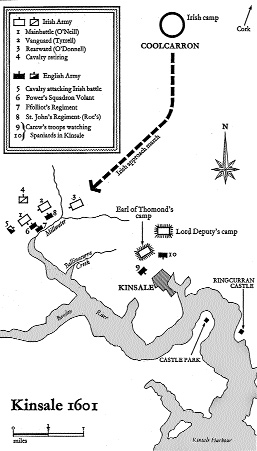
3 & 4 (N.S.) January 1602 - 23-24 December 1601 [O.S]: The Battle of Kinsale/Cath Chionn tSáile was fought on this day.

Probably the most decisive battle in Irish History took place on this day. The forces of the Irish under the Earl of Tyrone, Aodh (Hugh) O’Neill, and his ally Aodh ‘Red Hugh’ O’Donnell attacked the English lines surrounding the besieged town of Kinsale and were defeated. Inside was the Spanish garrison under Don John Aquila. The siege had begun two months before when the Spanish had landed at this small fishing port on Ireland’s south east coast. They had been sent by King Philip II of Spain to aid the Catholic Irish in their revolt against the Protestant Queen Elizabeth of England.

News quickly spread throughout the Country of their landing and both the Irish and the English made haste their forces to march south and meet Aquila either as friends or enemies. The English were under the command of Charles Blount, Lord Mountjoy. Mountjoy in Dublin was nearer to Kinsale than the northern leaders in Ulster and consequently got his forces to Kinsale first. He quickly laid siege to Kinsale. However he was not strong enough to risk taking it by storm. With the place blocked by land and by sea he intended to starve the garrison out and hope that the Irish would not be able to envelop him from the outside as well. In the event the Irish came south in sufficient numbers to make it very difficult to re-supply his forces. Both side’s forces suffered from want and lack of shelter but Mountjoy’s men felt it more and thousands of the besiegers of Kinsale died from cold and disease.

The Irish on the outside were not equipped to be so far from their base of operations in Ulster and could not remain indefinitely on the outside unless they had hope of Victory. Eventually they agreed with the Spanish commander to launch an assault if they could be guaranteed that a sally would be made by Aquila’s men to support them. But getting the timing right was crucial and with the English between them it was fright with difficulty.

There was some dispute amongst the Irish as to the best course of action to follow, with O’Donnell for making a determined attack while O’Neill counselled caution. In all probability the decisions of the Irish leaders to attack when they did was taken in light of their dwindling supplies and the desperation of their men to march North to their homes (where English pressure and intrigue was intense). It was a calculated gamble to meet the English in the open as their men were used to a different kind of warfare, one of the woods, the bogs and the rough terrain where English cannon and cavalry were of limited use.

The northern leaders chose to bring their forces up to the English lines under cover of night but such a night march is never an easy venture and in the dark columns became disorientated.

They spent much time in the early hours in dispute and contention, which arose between them. The two noble hosts and armies marched at last side by side and shoulder to shoulder together, until they happened to lose their way and go astray, so that their guides and pathfinders could not hit upon the right road, though the winter night was very long and though the camp which they were to attack was very near them, it was not until the time of sunrise on the next day, so that the sun was shining brightly on the face of the solid earth when O’Neills forces found their own flank at the lord Deputy’s camp, and they retired a short distance while their ranks and order would be reformed, for they had left the first order in which they had been drawn up through the straying and the darkness of the night….

Beatha Aodha Ruaidh Ui Domhnaill (The Life of Red Hugh O’Donnell) - Lughaidh O Cleirigh

Formed up in unwieldy copies of the Spanish ‘Tercios’ it would appear the Irish could not manoeuvre in front of Mountjoy’s fixed positions in a manner that could hope to inflict upon the enemy any significant casualties. In the event Mountjoy was on the ball and took the initiative, using his cannon and cavalry to good effect and scattering the Irish columns and riding down the survivors with his Horse.

They were not long considering them till they fired a thick shower of round balls [to welcome the Irish] from clean, beautiful big guns, with well oiled mechanisms and from finely ridged, costly muskets, and from sharp-aiming, quick firing matchlocks, and they threw upon them every other kind of shot and missile besides. Then burst out over the walls against them nimble troops, hard to resist, of active steady cavalry, who up to that were longing for the order to test the seed of their high galloping horses on the plain. They allowed their foot to follow after for they were certain that the hail of spherical bullets and the force attack of the troops would make destructive gaps in front of them among their enemies. Both armies were mingled together, maiming and wounding each other so that many were slain on both sides.

But in the end O’Neill’s forces were defeated, an unusual thing with them, and they fled swiftly away from the place, and they way the hurry urged them was to pour in on top of O’Donnell’s forces who happened to be east of them and had not yet come to the field of battle. When the routed army of O’Neill, and the troops of the Lord Deputy’s army following them, and swiftly smiting their rear, broke into the midst of O’Donnell’s people, wavering and unsteadiness seized on the soldiers, fright and terror on their horses and though it was their desire and their duty to remain on the field of battle, they could not.
O Cleirigh

Inside Kinsale nothing stirred and De Aquila claimed he was not aware what the Irish planned to do that day. He soon after surrendered and was allowed to depart for Spain with his men.

The morale of the Irish in revolt never recovered after this huge setback and the forced departure of the expeditionary force sent by the King of Spain to help them. O’Donnell almost immediately took ship for Spain to organise another expedition but was poisoned there by English agents. O’Neill returned North and fought on until 1603 when he surrendered to Mountjoy. Remarkably he got his personal Estates back and with a fair degree of local control again in his hands.

But his days were numbered as English Law was gradually extended into Ulster and his authority continually undermined. Fearing imprisonment and execution on trumped up accusations he fled to the Continent in 1607 in the famous ‘Flight of the Earls’. He ended his days in Rome as a charge on the Spanish Monarchy but under the immediate protection of the Pope. He died and was buried there in 1616 - still plotting to regain his lost lands.
Saturday, 2 January 2016


2‭ ‬January‭ ‬1417:‭ ‬The death of Art Mac Murrough Cavanagh‭ (‬King of Leinster‭) ‬on this day.‭

Art,‭ ‬the son of Art,‭ ‬son of Murtough,‭ ‬son of Maurice,‭ ‬Lord of Leinster,‭ ‬a man who had defended his own province against the English and Irish from his sixteenth to his sixtieth year‭; ‬a man full of hospitality,‭ ‬knowledge,‭ ‬and chivalry‭; ‬a man full of prosperity and royalty‭; ‬the enricher of churches and monasteries,‭ ‬by his alms and offerings,‭ ‬died‭ (‬after having been forty-two years in the lordship of Leinster‭) ‬a week after Christmas.‭

Some assert that it was of a poisonous drink which a woman gave to him,‭ ‬and to O'Doran,‭ ‬Chief Brehon of Leinster,‭ ‬at Ros-Mic-Triuin‭ [‬New Ross‭]‬,‭ ‬that both died.‭ ‬Donough,‭ ‬his son,‭ ‬assumed his place after him.

‭ ‬Annals of the Four Masters 1417 AD

Art McMurrough Cavanagh was a formidable character in his day.‭ ‬He‭ ‬was born in the year‭ ‬1357.‭ ‬From an early age he was distinguished by his great hospitality,‭ ‬intelligence and bravery,‭ ‬and I should imagine his contemporaries recognised a certain level of guile in the young Art that would serve him well in his dealings with rivals both internal and external.‭ ‬About the year‭ ‬1375 while he was still under age he was elected successor to his father,‭ ‬according to the annalists,‭ ‬who record his death in‭ ‬1417,‭ '‬after being forty-two years in the government of Leinster.‭' ‬A traditional Gaelic Leader he married a Lady from the Pale named Elizabeth and so through marriage,‭ ‬inheritance and conquest he dominated large tracts of Wexford,‭ ‬Wicklow,‭ ‬Kildare and Carlow.‭ ‬The Palesmen paid him tribute to keep him sweet and of course in the Gaelic areas he ruled in the old way.

However he did suffer a severe reverse in‭ ‬1392‭ ‬when the Earl of Ormond defeated him at Tiscoffin and killed‭ ‬600‭ ‬of his best warriors.‭ ‬But‭ ‬Art McMurrough pulled of a great coup when he captured the Colonial town of New Ross.‭ ‬In‭ ‬1395‭ ‬he had to contend with a descent on Ireland by the King of England,‭ ‬the hapless Richard II,‭ ‬who brought a huge army with him to overawe the Irish Kings and Chieftains.‭ ‬He could not however bring Art to‭ ‘‬come into his House‭’ ‬and submit.‭ ‬Instead he gave a promise of safe passage to the Leinsterman to come up to Dublin an treat with him.‭ ‬Though wary,‭ ‬Art accepted the invitation and was imprisoned and could only get his freedom by promising to agree to Richard’s terms.‭ ‬Once free though he resumed his independent way of life and soon fell to harrying the invaders once more.

In the summer of‭ ‬1398‭ ‬his allies the O’Byrnes defeated and slew Roger Mortimer,‭ ‬the Earl of March,‭ ‬and the heir to the Throne of England.‭ ‬This political earthquake brought Richard II back to Ireland in the following year,‭ ‬bent on revenge against all who defied him.‭ ‬But once again his campaign here was a fiasco,‭ ‬with not even a series of nominal submissions to flaunt at Court when he returned home.‭ ‬Indeed while he was bogged down here news reached him that Henry of Bolingbroke had landed in England to claim the throne for himself.‭ ‬This he did and when Richard went back he was taken prisoner and then starved to death by the now King of England  Henry IV.‭ ‬Thus Art McMurrough Cavanagh was the‭ ‬catalyst for one of the most momentous events in England’s history.


Friday, 1 January 2016


1 January 1926: 2RN, the predecessor of Radio Éireann , was established. The advent of Radio was to transform the nature of communication in Ireland, eventually bringing even the remotest country homes into instant receivers of news and entertainment from the new station’s broadcasting studios.

Séamus Clandillon [above] was appointed the 2RN first Director of Broadcasting

Clandillon was a civil servant, teacher, singer and fluent Irish speaker, he was appointed Director of Broadcasting following two selection processes.

Dáil Éireann decreed by the Wireless Telegraphy Act, 1926, that broadcasting should be a state service, organised by the Postal Ministry and financed by licence fees, advertising and import duties on wireless sets and components.

‘2RN began broadcasting from a studio and office at 36 Little Denmark Street, now the site of the ILAC Centre in Dublin. The transmitter was a 1.5 KW Marconi Q type, broadcasting on 390 meters from a hut in McKee Barracks beside the Phoenix Park.

The station call-sign was originated by the British Post Office, the authority responsible at that time, and the name 2RN was thought to be inspired by the last three syllables of the song title "Come Back To Erin".

With only one studio there was a silent, or not so silent, interlude between the programmes as music stands and other furniture were moved about.

Douglas Hyde, founder of the Gaelic League and later the first President of Ireland, officially opened 2RN.