Wednesday, 22 June 2016


22 June 1921: King George V opened the first session of the Northern Ireland Parliament in Belfast on this day, thus formally dividing Ireland into two political entities.

The genesis of the division lay in the Ulster Unionists opposition to the establishment of a Home Rule Parliament in Ireland. Their campaign against it dated back to 1886 when the British Prime Minister Gladstone had first brought a Bill before the British Parliament for its introduction. The bill was defeated and while it passed the House of Commons in 1893 it fell in the Lords.

However in 1909 the House of Lords had blocked the introduction of the Budget brought in by the Chancellor of the Exchequer David Lloyd George. The British Government then brought in legislation to limit the power of the House of Lords to block a Bill passed by the Lower House to two parliamentary sessions and no more. This momentous change meant that sooner or later a new Home Rule Bill was bound to be passed and implemented.


In 1912 the Ulster Unionists organised themselves in para-military formations under an organisation known as the Ulster Volunteer Force (UVF). Armed with weapons from Germany and Austria-Hungary they defied British Government attempts to introduce Home Rule for all of Ireland. The outbreak of the Great War stymied a looming Civil War situation and while Home Rule was passed in September 1914 it was suspended for the duration of the War.

With the ending of the Great War the issue of where Ulster stood in relation to the rest of Ireland once again came to the fore. By that stage the Ulster Unionist Council had accepted the concept of Home Rule if the six northern counties of Antrim, Armagh, Derry, Down, Fermanagh and Tyrone were at least temporally excluded from its terms.

With the outbreak of the War of Independence in 1919 and the decline of British power throughout much of the Country the likelihood of a deal being struck between Unionists and Nationalists became more remote.

On this basis the British Government decided to proceed with a plan to put before its Parliament a Bill to partition Ireland into two polities – Northern Ireland & Southern Ireland.

Consequently after the General Election of May 1921 in which unionist candidates won most of the seats in the Six Counties the formation of a northern State centred on Belfast was proceeded with.

It was on this basis that King George V was dispatched to the North to officiate at the opening of Northern Parliament on 22 June 1921 in Belfast’s City Hall

Addressing the members of the Senate and House of Commons from his throne he said:

"For all those who love Ireland, as I do with all my heart, this is a profoundly moving occasion in Irish history. My memories of the Irish people date back to the time when I spent many happy days in Ireland as midshipman. My affection for the Irish people has been deepened by the successive visits since that time, and I have watched with constant sympathy the course of their affairs.


"I could not have allowed myself to give Ireland by deputy alone my earnest prayers and good wishes in the new era which opens with this ceremony, and I have therefore come in person, as the Head of the Empire, to inaugurate this Parliament on Irish soil.


"I inaugurate it with deep-felt hope, and I feel assured that you will do your utmost to make it an instrument of happiness and good government for all parts of the community which you represent.


"This is a great and critical occasion in the history of the Six Counties, but not for the Six Counties alone for every thing which interest them touches Ireland, and everything which touches Ireland finds an echo in the remotest part of the Empire....




Tuesday, 21 June 2016

Image result for Midshipman Charles Davis Lucas

21 June 1854: Midshipman Charles Davis Lucas, by an act of outstanding bravery on board HMS Hecla was awarded the first Victoria Cross for his actions on this day. Midshipman Lucas was a native of  County Armagh.  He won the medal during a British Naval Expedition to the Baltic during the ‘Crimean War’. The fleet under Admiral Napier commenced a bombardment of the island fortress of Bomarsund. Three ships were sent forward to undertake the task, led by Captain Hall.

‘At the height of the bombardment, a live shell from an enemy battery landed on Hecla's upper-deck, with its fuse still hissing. All hands were ordered to fling themselves flat on the deck, but Lucas, with what Hall called in a letter to Napier next day 'great coolness and presence of mind', ran forward, picked up the shell and tossed it overboard. It exploded with a tremendous roar before it hit the water. Some minor damage was done to the ship's side and two men were slightly hurt but, thanks to Lucas, nobody was killed or seriously wounded. He was immediately promoted to Acting Lieutenant for his bravery, and the Admiralty later confirmed the promotion on Napier's strongest recommendation.’ 
'The VC at Sea' by John Winton. 

The 6-gun steam paddle sloop Hecla was under the direct command of Capitan Hall himself who reported to the Admiral that:

With regard to Mr. Lucas, I have the pleasure to report a remarkable instance of coolness and presence of mind in action, he having taken up, and thrown overboard, a live shell thrown on board the 'Hecla' by the enemy, while the fuse was burning.

Queen Victoria invested Charles Lucas with his Victoria Cross on the 26th June 1857 in Hyde Park, London. Lucas eventually reached the rank of Rear Admiral in the Royal Navy. He died on the 7th August 1914, aged 80, at his home in Great Culverden, Kent, and was buried in St. Lawrence's Churchyard, Mereworth.

Monday, 20 June 2016


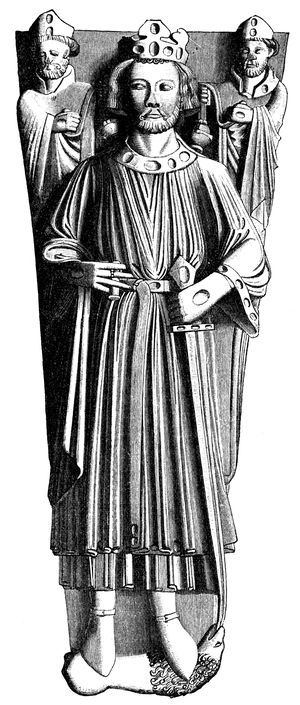
20 June 1210: King John of England landed at Crook, near Waterford on this day.

Johannes, grandson of the Empress [Matilda], king of the Saxons, came to Erinn, with a great fleet, in this year

After arriving he commanded a great hosting of the men of Erinn to Ulidia, to apprehend Hugo de Laci,

or to expel him from Erinn, and to capture Carraic-Fergusa.

Hugo left Erinn, and the persons who were defending the

Carraic abandoned it, and came to the king; and the

king put men of his own company into it.

Annals of Loch Cé 1210 AD


Sailing from south Wales he was to remain in Ireland throughout the rest of the summer.

His mission in Ireland was not so much to subdue the Irish Kings who still held power over large swathes of the Country, but instead to bring to heel the more powerful of the Anglo-Norman Lords who defied him. King John was a most unpopular Monarch in England and faced constant trouble with his Lords and Barons who resented his attempts to rule them. A ruthless and devious man he - probably with good reason-  trusted very few of his councillors who advised him.

The main objects of his attention were the De Lacy family, specifically Walter Earl of Meath and Hugh the Earl of Ulster. He believed they could act as a power base for malcontents back in England. Indeed they had backed the struggle of the once powerful Marcher Lord William de Braose against the King. It was to crush this family and punish the De Lacy's for their lack of loyalty that drove him to take a well armed military force to Ireland.

De Braose fled to England when he heard of the King's movements. There he endeavoured to make peace with his master, but failing to do so, he carefully avoided putting himself in his power, and took refuge in France.

John had been to Ireland before in 1185 when his father King Henry II had given him the title 'Lord of Ireland', but John had turned his journey into a Fiasco but upsetting the Irish kings with his youthful folly and the Gaels resented his attitude to them.

After arriving in Waterford he came to Dublin where he was well received and after leaving the capital he advanced into Meath from which Walter de Lacy then fled. King John then met up with King Cathal Crobhderg O'Conner of Connacht near Ardbraccan, Co Meath. King Cathal recognised him as his Lord in return for being re-assured as the recognised & rightful King of Connacht. The two kings then proceeded northwards where they besieged the powerful fortress of Carrigfergus in Ulster which was taken, though Hugh made good his escape.

While in the North he also parlayed with King Aedh O'Neil of Tir Eoghan (Tyrone), whom he wished to secure homage and take hostages from. Keeping his distance, O'Neill made a pretence of wanting to help with the siege and being prepared to offer some kind of agreement to subordinate himself to the English King, but he pleaded for time to consult his advisors. He donated a supply of cattle to feed John's troops. He was though really loath to submit and give over important hostages, incl. his own son, to such a volatile character as King John. The negotiations fizzled out and O'Neill backed off and went home.

Cathal Crovderg was in a weaker position as his kingdom was riven by rivalries which he had to return home to sort out. He had made a promise to hand over his eldest son, Aed O'Conner, to King John. He would then have him conveyed to England as a security against King Cathal remaining in submission. However Cathal's wife would have none of it and the Irish king had to return to King John empty handed. When they next met at Rathwire in County Westmeath, as arranged, but without his son, the King of England was anything but pleased and seems to have forcibly apprehended four of Cathal's sub-kings and royal officers, whom he brought back to England.

Soon after King John left Ireland, arriving back at Fishguard in Wales on 26 August. His Expedition here was overall a success. He had smashed the power of the De Lacy's, secured the city of Limerick, reformed the government of Dublin and the eastern counties and brought even as powerful figure as William Marshal of Leinster, the greatest Knight of the age, to heel.

But his attempts to bring the Kings of Connacht and Tir Eoghan under his thumb both failed, and while not the primary objective of his expedition John's ham fisted attempts only alienated these Irish Kings who rightly did not trust this ruthless man.

A final and horrible chapter to this attempt to punish his opponents was the fate of Maud De Braose and her infant son William de Braose. Captured in Scotland they were conveyed in chains to King John who had them imprisoned in Windsor Castle. They were locked up together but only given food and no water on the first day of their incarceration. Thereafter nothing. When the jailors yanked open the door to their cell 11 days later all that was left was their emaciated corpses.

John died in 1216, probably from dysentery, as he desperately tried to hold his Kingdom together from Revolt. His expedition here was the last by a serving King of England for 184 years until  Richard II, another unloved Monarch, arrived here in the year 1394.

Effigy of King John [above] from his tomb in Worcester Cathedral

Saturday, 18 June 2016


18 June 1815: The Battle of Waterloo took place on this day. This great battle was fought out some 10 kilometres south of the Belgic city of Brussels, along the Ridge of Mont St Jean and on the fields to the south and east of it. The French Emperor Napoleon Bonaparte was defeated by the combined armies of the Duke of Wellington of the British & Allied Armies and Marshal Blucher leading the forces of Prussia. It was a battle in which men of many nations participated. Men from England, Scotland, Wales, Ireland, the United Provinces (Holland + Belgium), Hanover, Wurttemberg, Prussia and other minor German states fought the forces of France to decide the fate of Europe.

Many soldiers in the British Army were recruited in Ireland though surprisingly few regiments with ‘Irish’ in their title played a part on the day. The Duke of Wellington was born in Dublin and spent much his early life in Ireland, his family hailing from Co Meath. At least three infantry or cavalry brigades were led by Anglo-Irish generals. Commanding the 9th British Infantry Brigade was Major General Sir Denis Pack, a native of County Kilkenny, Major General Sir William Ponsonby (KIA) led the 2nd British (Union) Cavalry Brigade, so-called because it included an English, a Scottish and an Irish regiment . Major General Sir John Ormsby Vandeleur led the 4th British Cavalry Brigade, a light cavalry formation. There were also some five battalion commanders with Irish connections who served in the Waterloo campaign. However it was in the the lower ranks of the British Army that the highest number of men who were either from Ireland or of Irish origin served.

While the British Army had 10 infantry regiments and 4 cavalry ones with ‘Irish’ in their description only three actually saw service in this campaign: 1st Battalion, 27th (Inniskilling) Foot; 6th (Inniskilling) Dragoons and the 18th (King's Irish) Hussars. They all saw heavy action in actual battle, the 27th in particular taking huge casualties while in Square in the front line.

The British Army who fought that day fielded about 28,000 men drawn from England & Wales, Scotland and Ireland. At that time the Irish (Catholic, Protestant & Dissenter) comprised some 38% of the population of these islands. That ratio was well reflected in the ranks of the military force present at Waterloo with the Irish having a strong presence pretty well across the board in all arms Cavalry, Infantry and Artillery. Most of these were poor men, labourers and weavers who found in the Army a relatively secure measure of employment and shelter.

By all accounts the Irish were good fighters but rightly or wrongly were seen as undisciplined off the battlefield. Many were from Catholic households but the Protestant population were represented as best we can judge in numbers that matched their proportion of the Country’s population. The rank and file were seen as the ‘scum of the earth’ by Wellington and probably by most of the Officer Class too. In some respects he was right as many were there because they were outcasts and misfits from civil society or rough men who sought a fighting career. But they could fight and fight well - and that's what they were there to do.

When the battle ended that evening some 7,500 men of the British Army laid dead, dying or severely wounded on the battlefield - some 28% of the force engaged. On a per capita basis that would be around 3,000 or so men from Ireland who fell that day - a heavy enough toll. On the other hand the population of the island was some Six Million souls in 1815 so while a severe loss to those that had family in the Military it would not have been seen as a National cause for grief. Indeed many at home might well have wished for a French Victory that day - Daniel O’Connell being one of them.

There are a number of roads and landmarks in Ireland still that commemorate the battle that day. The most imposing being the Wellington Monument in the Phoenix Park [above] in Dublin that commemorates the Duke of Wellington’s Victories. The halfpenny footbridge over the river Liffey in Dublin City Centre is officially ‘Wellington’ bridge and in the suburbs south of the city are the Wellington and Waterloo roads. In Trim Co Meath where his family hailed from there is also a monument to honour him.

But while still a Hero in Britain his legacy in most of Ireland is less sure given his vehement opposition to Catholic emancipation and his eventual sour acceptance of its political necessity. If Waterloo is remembered at all here its for it marking the end of Napoleon Bonaparte’s career rather than any part that Ireland played in his Downfall.

Friday, 17 June 2016


17‭ ‬June‭ ‬1959:‭ ‬Éamon de Valera was elected President of Ireland on this day.‭ ‬The contest for the highest Office in the Republic was between him and General Sean Mc Eoin from the Fine Gael Party, who had previously ran for the Office in 1945 and had been defeated.‭ He like Dev had been active in the War of Independence but they had taken opposite sides in the Civil War of 1922 -23. ‬The number of people eligible to vote was‭ ‬1,678,450,‭ ‬of which‭ ‬979,628‭ ‬chose to exercise their Franchise.‭ ‬This represented a turnout of‭ ‬58.4‭ ‬%.‭ ‬Of the total numbers of votes cast‭ ‬538,003‭ ‬voted in favour of De Valera and‭ ‬417,536‭ ‬voted for Mc Eoin.‭

‘De Valera won a majority of the vote in every constituency bar the northern Dublin city constituencies, Longford-Westmeath, which Mac Eoin had represented for over ten years, and Cork West, a strong Fine Gael area. As in the previous election, Mac Eoin's best results were in the Longford and surrounding areas, with strong results also where de Valera didn't win majorities in Dublin. De Valera's vote was strongest in Clare, Galway and Donegal - his share reaching 69% in parts of the latter two counties.'
http://irishpoliticalmaps.blogspot.ie/2011/10/irish-presidential-election-1959.html

On the same day was also held a Referendum to abolish Proportional Representation‭ ‬-‭ ‬but here the tide of public opinion swung against Dev and it went down to defeat.‭

The following summary of the principal proposals in the Third Amendment of the Constitution Bill,‭ ‬1958,‭ ‬was circulated for the information of voters:

At present,‭ ‬members of Dáil Éireann are elected on a system of proportional representation for constituencies returning at least three members,‭ ‬each voter having a single transferable vote.
It is proposed in the Bill to abolish the system of proportional representation and to adopt,‭ ‬instead,‭ ‬a system of single-member constituencies,‭ ‬each voter having a single non-‭ ‬transferable vote.‭ ‬It is also proposed in the Bill to set up a Commission for the determination and revision of the constituencies,‭ ‬instead of having this done by the Oireachtas,‭ ‬as at present.

The total number of votes recorded in favour of the proposal contained in the Bill was‭ ‬453,322‭ ‬and the total number of votes recorded against the proposal was‭ ‬486,989.‭ ‬The people did not,‭ ‬therefore,‭ ‬approve the proposal.

Eamon De Valera thus became the third President of Ireland.‭ ‬He was again elected in‭ ‬1966‭ ‬and retired from the post and active politics in‭ ‬1973.‭ ‬He died in‭ ‬1975.


Thursday, 16 June 2016


16‭ ‬June‭ ‬1929:‭ ‬'Bloomsday' was first celebrated on this day. In one of the earliest Bloomsday celebrations,‭ ‬Sylvia Beach,‭ ‬publisher of James Joyce's classic novel Ulysses organised a Ulysses lunch with her partner Adrienne Monnier in France in June‭ ‬1929.‭

The first Bloomsday celebrated in Ireland was in‭ ‬1954,‭ ‬the fiftieth anniversary of the first Bloomsday.‭ ‬The eccentric writers Patrick Kavanagh and Flann O’Brien visited locations such as the Martello Tower at Sandycove,‭ ‬Davy Byrne’s pub,‭ ‬and‭ ‬7‭ ‬Eccles Street where the fictional Leopold Bloom lived with his wife Molly.‭ ‬They spent part of their tour reading extracts from Ulysses and drinking a great deal as they went along‭!

"It wasn't until‭ ‬1954,‭ ‬its‭ ‬50th anniversary,‭ ‬that John Ryan,‭ ‬restaurant owner and publisher of the literary periodical Envoy,‭ ‬and his literary friends,‭ ‬novelist Brian O'Nolan and poets Patrick Kavanagh and Anthony Cronin,‭ ‬resurrected Bloomsday in Ireland.‭ ‬There are photos at the National Library in Dublin…of their pilgrimage in two horse-cabs to various locations in Ulysses and several pubs.‭"

Fritzi Horstman

Bloomsday celebrates the day on which the narrative of James Joyce’s novel Ulysses takes place,‭ ‬16‭ ‬June‭ ‬1904,‭ ‬the day on which it is believed that Joyce first went out with his future wife,‭ ‬Nora Barnacle.‭ ‬The day is named after Leopold Bloom,‭ ‬the central character in Ulysses.‭ ‬The novel follows the life and thoughts of Leopold Bloom and Stephen Dedalus (his alter ego)along with a host of other characters‭ – ‬real and fictional‭ – ‬from‭ ‬8‭ ‬am on‭ ‬16‭ ‬June through to the early hours of the following morning. 


An Extract:

As he set foot on O'Connell bridge a puffball of smoke plumed up from the parapet.‭ ‬Brewery barge with export stout.‭ ‬England.‭ ‬Sea air sours it,‭ ‬I heard.‭ ‬Be interesting some day get a pass through Hancock to see the brewery.‭ ‬Regular world in itself.‭ ‬Vats of porter,‭ ‬wonderful.‭ ‬Rats get in too.‭ ‬Drink themselves bloated as big as a collie floating.‭ ‬Dead drunk on the porter.‭ ‬Drink till they puke again like christians.‭ ‬Imagine drinking that‭! ‬Rats:‭ ‬vats.‭ ‬Well of course if we knew all the things.

Episode‭ ‬8‭ – ‘‬Lestrygonians‭’

Wednesday, 15 June 2016


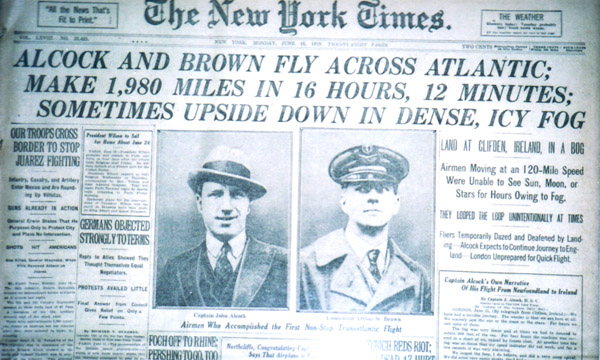
15 June 1919: The British aviators John Alcock and Arthur Whitten Brown made the first non-stop flight across the Atlantic on this day. They flew a modified Vickers Vimy bomber plane from St. John’s Newfoundland to Clifden, Co Galway thus winning the Daily Mail prize of £10,000. The lucrative prize had been up for grabs since 1913 when the Daily Mail first proposed the idea. Their offer ran as follows:

"the aviator who shall first cross the Atlantic in an aeroplane in flight from any point in the United States of America, Canada or Newfoundland and land at any point in Great Britain or Ireland" in 72 continuous hours".

Both men had served as Aviators in the Great War and both had been shot down and captured, Alcock by the Turks and Brown by the Germans. During his captivity Alcock determined that if he survived the War he would go for it. As Fortune had it both men were at a loose end after their release and return home. Alcock approached Vickers with the idea of backing the attempt and teamed up with Brown as his co pilot for the crossing.

Several teams had entered the competition and when Alcock and Brown arrived in St Johns Newfoundland the Handley Page aircraft team were in the final stages of testing their machine for the flight but their leader, Admiral Mark Kerr, was determined not to take off until the plane was in perfect condition. The Vickers team quickly assembled their plane and at around 1:45 p.m. on 14 June, whilst the Handley Page team were conducting yet another test, the Vickers plane took off from Lester's Field.

The flight nearly ended in disaster several times owing to engine trouble, fog, snow and ice. It was only saved by Brown's continual climbing out on the wings to remove ice from the engine air intakes and by Alcock's excellent piloting despite extremely poor visibility at times and even snow filling the open cockpit. The aircraft was badly damaged upon arrival due to the attempt to land in what appeared from the air to be a suitable green field but which turned out to be the bog on Derrygimlagh Moor, near Clifden Co Galway,  but neither of the airmen was hurt.

The news of the adventure spread like wildfire and the two men were received as heroes in London. For their accomplishment, they were presented with Lord Northcliffe's Daily Mail prize of £10,000 by Winston Churchill, who was then Britain's Secretary of State. A few days later, both men were knighted at Buckingham Palace by King George V, for recognition of their pioneering achievement.

Alcock was tragically killed some months later in December 1919 while flying to the Paris Air Show. Brown lived on until 1948.