Wednesday, 22 July 2020

Image result for aughrim battle


22 July N.S./12 July O.S. 1691. The Battle of Aughrim (Irish: Cath Eachroma) was fought on this day. The battle was fought near the little village of Aughrim in County Galway. The defeat of the Jacobite forces by those of the Williamite Army decided the War of the Two Kings in favour of King William of Orange. It is considered the bloodiest battle in recorded Irish History. 


Ever since the Battle of the Boyne in July of the previous year the Catholic Jacobite armies had been on the defensive. King James had fled back to France never to return. Dublin and all the major cities of Ireland bar Galway and Limerick had fallen to the armies of King William of Orange. In June 1691 the line of the Shannon had been breached at Athlone and the Jacobites were retreating towards the city of Galway. It was decided to make a last stand at Aughrim and hope that the fortunes of a pitched battle would go in their favour. That way they would at least have a chance of turning the tide of the War back in their direction.

The Commander of the Catholic forces of King James II was the Marquis de St. Ruth, a veteran General of the French King Louis XIV. He had only arrived in Ireland in March that year. Although he had fumbled the defense of Athlone and thus allowed the Williamites to get across the Shannon he was determined to stop them reaching Galway. It was he who decided to make a stand at the village of Aughrim and on the ridge to the south of that settlement.  A pitched battle is a risky business and not all his Generals agreed it was worth it. But St Ruth realised that further retreat would only see the slow disintegration of his formations into a rabble incapable of effective resistance.

 The position was a good one as to its front was an almost impassable bog that meant that any attackers would be forced to make their main efforts either along the causeway leading to Aughrim or else at the ford to the south of the ridge which was a difficult crossing point. The Irish deployed some 15,000 - 20,000 men of various quality in regiments and squadrons of Infantry, Cavalry and Dragoons [mounted musketeers]. They had some nine field pieces to play upon the Enemy. 

Their opponents under Dutch General Ginkel, an experienced soldier had advanced from Ballinasloe that morning and it was late in the afternoon before either side came in contact with the other. Ginkel’s Army was perhaps 20,000 strong and also made up of Infantry, Cavalry and Dragoons with some half its ranks made up of Continental Regulars and half from amongst the British population of both Britain & Ireland.

To Ginkel it was an unexpected battle but he handled his dispositions well sending the bulk of his force to push on the southern flank of the Irish and pin them there. After  heavy fighting his men slowly made it across Tristaun Bridge and into the right flank of the Irish but were finally halted at a dip in the landscape called ever after ‘Bloody Hollow’. But this could not be held by the Irish without pulling troops across from their left  flank - perhaps unavoidable but St Ruths decision to reinforce his right at the expense of the left was to have baleful consequences for his Army.

Further north the Protestants advanced into the bogs in order to cross over and engage the Catholic infantrymen drawn up behind hedgerows and prepared positions. Their initial attempts were partially successful but very costly, they were thrown back and some units were routed and senior officers captured. St Ruth was elated by the efforts of his Irishmen calling out ‘Le Jour est a nous mes enfants!' Again though more men were committed here by him who could not be used elsewhere. So far the Irish had fought very well and stopped all the enemy attacks from advancing to a critical point.

It was though to the north around Aughrim village and the ruins of Aughrim Castle the battle was decided. It was on this flank that the Scottish General Mackay held command. Here a narrow causeway had to be crossed to get behind the Irish left flank. Mackay could see that the battle was at a critical stage as elsewhere the attacks of his fellows had been checked. The momentum had been lost and in if you will a last throw of the dice he led his troopers forward to take the causeway and turn the battle. He fell from his horse and the Huguenot Marquis de Ruvigny[later Earl of Galway] led the attack in. Against the odds he made it through.

 Burke’s Regiment in the Castle ran out of ammunition and could not stop the advance of the enemy. The Irish Horse under Luttrel and Sheldon were strong and in position. Incredibly they did nothing but quit the field of battle! To this day we do not know why, Treachery is suspected but nothing proven. But with them gone the position was well and truly turned and the Williamite cavalry swept down into the rear of the Irish ranks.

St Ruth soon got wind of this and moved north to check the dangerous situation in his left rear. Then Fortune truly turned her gaze against the Irish that day as a cannonball took his head clean off! Nothing could stop the disintegration by then and the infantry broke and ran for the bogs. Night soon came on and a misty rain began to fall and that must have saved many. But many, very many, had fallen in the fighting and the pursuit that followed. 

The Jacobite defeat was complete. They lost eleven standards of cavalry and dragoons, the colours of thirty two infantry battalions, nine field guns, all their ammunition, tents and camp equipment, most of their small arms and about 4,000 men killed. The Williamites too suffered heavily. Their casualties are variously stated; they were probably as many as 2,000.
Aughrim 1691, Irish Battles G.A. Hayes-McCoy

It was all over - there was no way another Field Army could be put together after a defeat of this magnitude. Galway surrendered on 21 July [OS] and Limerick on 3 October [OS]. The Treaty of Limerick was the end of Catholic Ireland for over a Century. It was also to be over a hundred years before another pitched battle was fought on the soil of Ireland during the Risings of 1798.



See the source image


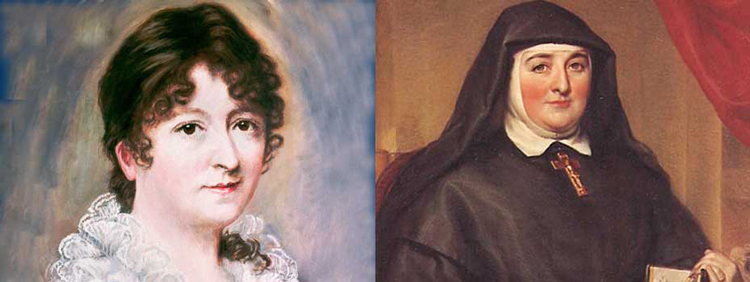
22 July 1858: Mother Mary Frances Aikenhead died on this day. She was a frail child and was adopted out in her native city of Cork to a woman called Mary Rourke. Though baptised into the Church of Ireland it is thought that Mary was secretly baptised a Catholic from this early age by Mary Rourke who was a devout Catholic. However she was not formally received into the Catholic Faith until she was 15 years old on 6 June 1802. From an early age she was a devout disposition and wished to pursue a religious Life.


In 1808, Mary went to stay with her friend Anne O’Brien in Dublin. Here she witnessed widespread unemployment and poverty and soon began to accompany her friend in visiting the poor and sick in their homes. From this experience she believed it would be her vocation to help the sick and the poor as a member of a religious Community. She trained for 3 years (1812-1815) in a convent in York, England in order to become a Nun. When she returned to Dublin she set up the Religious Sisters of Charity in Ireland.

On 1 September 1815, the first members of the new institute took their vows, Sister Mary Augustine being appointed Superior General. Added to the traditional three vows of poverty chastity & obedience, was a fourth vow: to devote their lives to the service of the poor. For the next 15 years Mother Mary worked very hard to alleviate the sufferings of the less well-off but it took a terrible toll on her own Health.

However she did not let her own personal misfortune get her down:

“Low spirits and dreads of evil to ourselves or Congregation, or even to the church, are actually the beginnings of despair. If all the rest of the world goes wrong, we should still persevere in trying to serve our God with faith and fervour.” (7 November 1834)

Confined to bed or a wheelchair she continued to direct her charges and set up new institutions both at home and abroad. Her Sisters were particularly active during the great Cholera outbreak in 1832. She died in Dublin, aged 71 in Our Lady’s Mount Harold’s Cross and was buried in in the cemetery attached to St. Mary Magdalen's, Donnybrook, Dublin 4.

Her cause for canonization as a saint has been progressing in Rome. On 18 March 2015, a decree was issued proclaiming her heroic virtues. This entitles her to be referred to as the Venerable Mary Aikenhead.


Tuesday, 21 July 2020


21 July 1914: The Buckingham Palace Conference began on this day. It ran between 21 and 24 July. Though the issue of Home Rule had been on the political agenda since the 1870s, the 1914 conference was the first time that a formal conference had been called involving both Nationalists and Unionists and the British Government of the day.


Those who attended were the British Prime Minister Herbert Asquith, Lloyd George as Chancellor of the Exchequer, the Irish Parliamentary leader John Redmond, his deputy, John Dillon, & across the table the leader of the Irish Unionists, Edward Carson together with Bonar Law, James Craig and Lord Landsdowne. The Speaker of the House of Commons presided.

Each delegation was met in person on arrival by King George V who was anxious for a peaceful settlement over whether Ulster should be in whole or part be included in an All Ireland Parliament under a form of ‘Home Rule’ for the Country.

By the second day Asquith saw that no solution as to which counties were to be temporarily excluded was going to emerge. He wrote to an associate:

"I have rarely felt more helpless in any particular affair, an impasse with unspeakable consequences, upon a matter which to English eyes seems inconceivably small and to Irish eyes immeasurably big. Isn't it a real tragedy?"

The conference broke up after three days without agreement. All sides, however, argued that it had been a useful engagement, with Unionists and Nationalists for the first time having meaningful discussions on how to allay each other's fears about the other. A limited understanding emerged between Carson and the Nationalists that if Ulster were to be excluded, in its entirety, the province should come in or out as a whole.

With hindsight it was seen as a failure as there was only so far each side was prepared to go on a compromise - and to the other side that was not far enough. Within a week Austria had declared War on Serbia & within a month the First World War was  well and truly underway. Any tenuous developments that might have come from this meeting of the main players was washed away by the momentous and bloody events unfolding in Europe.


Monday, 20 July 2020

Image result


20‭ July ‬1398: The Battle of Kellistown/ An Cath Cell Osnadha was fought on this day. The battle was fought between the forces of the O’Byrnes and O’Tooles, and the English of Leinster led by Roger Mortimer, the 4th Earl of March.

A battle was given to the English by O'Byrne and O'Toole, in which the Earl of March was slain, and the English were slaughtered.
Annals of the Four Masters

The O’Byrnes and O’Tooles were surrogates for Art Mac Murrough Cavanagh who was the most powerful Chieftain in Leinster and recognised as a King amongst his own people.‭ ‬He used them to fight a proxy war against the English and thus avoid a complete break with them. Kellistown is situated in County Carlow between the towns of Carlow and Tullow.

"Here fell the heir presumptive to the English crown, whose premature removal was one of the causes which contributed to the revolution in England a year or two later."  

Mortimer had been created the King of England’s Lieutenant in Ireland in‭ 1396 ‬and held this position until the Irish killed him. His body was cut to pieces during the battle but whether this as a result of combat or mutilation after his death is not recorded. Curiously enough he had decided to engage in the combat dressed in the Irish style - that is without body armour. There was at least enough of him remaining for his corpse to be brought back home to England where he was interred amongst his own people in Wigmore Abbey, Herefordshire.

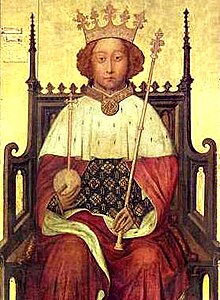
Mortimer was none other than an heir to the throne of England then held by the childless king Richard II [above].‭ He was also dignified with the titles ‘Earl of Ulster’ and ‘Lord Of Connaught’. Ironically he was a direct descendant of Aoife Murchada, whose father Diarmait had let the English way in back in 1169 AD. Thus he was a distant relation of his nemesis Art Mac Murrough Cavanagh! However the unstable & paranoid King Richard II  had ordered his arrest just after this engagement[27 July] but the news had not reached England before his death in battle. With him dead then the primary candidate to succeed the childless Richard became ‬Henry Bolingbroke whom the King had sent into exile.

Richard‭ was so concerned by the news from Ireland that his Authority had been so flouted and decided to settle matters once and for all by returning to Ireland with an Expedition to make Art Mac Murrough submit to English rule as he had  before when Richard had last campaigned here in 1394. But his departure from his own Country in the following year of 1399 cost him his Kingdom as his domestic enemies took the opportunity to topple him from his throne. On return in the month of August of that year he was compelled to give up his crown and submit to the advances of his cousin, Henry of Bolingbroke who had returned in Richard’s absence and risen in revolt. 

Henry was crowned King in Westminster Abbey on 13 October and Richard was now his prisoner. An embarrassment to the new King Henry IV he was allowed to wither away in captivity in Pontefract Castle in Yorkshire and ‘died’ (probably from deliberate starvation?] in early 1400.

An Cath‭ ‬Cell Osnadha was thus a battle of great importance in the history of two countries – England and Ireland - as it was a catalyst for a series of events that led to the Downfall of a Monarch who claimed to be both ‘King of England’ and ‘Lord of Ireland’ - claims that at the end of the day he found impossible to maintain.

Sunday, 19 July 2020


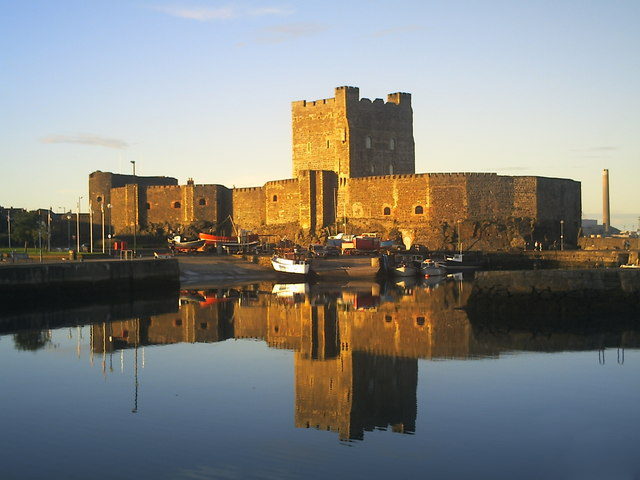
19 July 1210: King John of England arrived before the Castle of Carrickfergus in Ulster and besieged it on this day. It soon fell into his hands and in the days following he received a visit from the King of Tyrone/ Tir Eoghan, Aed Meith O Neill. His visitor brought a large contingent of troops with him, perhaps 2,000 warriors to impress the Anglo-Norman Monarch. The Ulster king agreed to render John service but the two kings drew different conclusions as to what that actually meant. 

The King of Connacht was also a somewhat reluctant part of King John’s host and actively helped him in suppressing the Anglo-Norman De lacy family that had upset the King of England’s temperament. King John had met up with King Cathal Crobhderg O’Conner of Connacht near Ardbraccan, Co Meath. King Cathal recognised him as his Lord in return for being re-assured as the recognised & rightful King of Connacht.

Johannes, grandson of the Empress, king of the Saxons, came to Erinn, with a great fleet, in this year.
After arriving he commanded a great hosting of the men of Erinn to Ulidia, to apprehend Hugo de Laci, or to expel him from Erinn, and to capture Carraic-Fergusa.
Hugo left Erinn, and the persons who were defending the Carraic abandoned it, and came to the king; and the king put men of his own company into it.
Annals of Loch Cé

For John this was quite a success as the strongest castle in the north east had fallen without a fight and 30 Knights had surrendered to him. However the primary targets of this expedition into Ulster - the Brothers Hugh & Walter - escaped to France.


Saturday, 18 July 2020


18 July 1938: Douglas Corrigan  -‘Wrong way Corrigan’ - landed at Baldonnel Aerodrome  Co Dublin after flying across the Atlantic solo in his aircraft Sunshine on this day. His arrival was totally unexpected and on being asked from whence he came he answered ‘New York’ - much the incredulity of those who had gathered around him.

Despite his assertion that he had simply lost his way on take off and instead of turning west for California he had  inadvertently headed east for Ireland no one really believed him. He had started his working life as a mechanic and had caught the Flying Bug when he took a ride up in a plane some years previously. He got his pilots license & took up stunt flying to earn a living. But he always hankered to do something out of the ordinary and settled on Ireland (the Homeland of his ancestors) as a place he would like to fly to.

He saved up his salary and spent $300 on buying a second hand 1929 Curtiss Robin OX-5 monoplane and flew it home, where he returned to work as an aircraft mechanic and began to modify the Robin for a transatlantic flight. Having installed an engine built from two old Wright Whirlwind J6-5 engines (affording 165 hp (123 kW) instead of the 90 hp (67 kW) of the original) and extra fuel tanks, Corrigan applied to the Bureau of Air Commerce in 1935, seeking permission to make a nonstop flight from New York to Ireland. The application was rejected; his plane was deemed unsound for a nonstop transatlantic trip, although it was certified to the lower standard for cross-country journeys.

But Corrigan was nothing if not a tryer and on 17 July 1938 he took off at 5:15 in the morning with 320 US gallons (1,200 L) of gasoline and 16 US gallons (61 L) of oil on board. Corrigan headed east from the 4,200-foot (1,300 m) runway of Floyd Bennet Field New York to begin his epic journey. He landed at Baldonnel Aerodrome  on July 18, after a 28-hour, 13-minute flight. His provisions had been just two chocolate bars & two boxes of fig bars, and 25 US gal (94.64 L) of water.

Corrigan's plane had fuel tanks mounted on the front, allowing him to see only out of the sides. He had no radio and his compass was 20 years old, but somehow he made it. His daring flight alone across the Atlantic Ocean made headlines across the World. Back in the USA he was nicknamed ‘Wrong Way Corrigan’ when he claimed to have flown East instead of West on take off. It was said that his tickertape parade through the streets of New York City outshone that of his great hero Charles Lindbergh - who curiously never acknowledged his achievement.

The journalist H.R. Knickerbocker who met Corrigan in Ireland after his arrival, wrote in 1941:

You may say that Corrigan's flight could not be compared to Lindbergh's in its sensational appeal as the first solo flight across the ocean. Yes, but in another way the obscure little Irishman's flight was the more audacious of the two. Lindbergh had a plane specially constructed, the finest money could buy. He had lavish financial backing, friends to help him at every turn. Corrigan had nothing but his own ambition, courage, and ability. His plane, a nine-year-old Curtiss Robin  was the most wretched-looking jalopy.

As I looked over it at the Dublin airdrome I really marvelled that anyone should have been rash enough even to go in the air with it, much less try to fly the Atlantic. He built it, or rebuilt it, practically as a boy would build a scooter out of a soapbox and a pair of old roller skates. It looked it. The nose of the engine hood was a mass of patches soldered by Corrigan himself into a crazy-quilt design. The door behind which Corrigan crouched for twenty eight hours was fastened together with a piece of baling wire. The reserve gasoline tanks put together by Corrigan, left him so little room that he had to sit hunched forward with his knees cramped, and not enough window space to see the ground when landing.

The following year, he starred as himself in The Flying Irishman, a movie biography. The $75,000 he earned was the equivalent of 30 years income at his airfield jobs! During the War he flew planes for the US Transport Command and then went back to California where he bought an Orange Farm. He died there in 1995. To the end he never admitted to anything other than flying ‘the wrong way’.


Friday, 17 July 2020

Related image


17 July 1579: James Fitzmaurice Fitzgerald, the cousin of the 15th Earl of Desmond arrived off Smerwick/ Ard na Caithne in County Kerry on this day. The Catholic adventurer had arrived back from Spain with high hopes of re launching the Catholic Cause in Ireland and in particular in Munster. He brought with him one Nicholas Sanders - an exiled priest and holding the position of Papal Nuncio to the Irish. Within days a few hundred men joined them in two Spanish galleys but this small force was only enough to garrison a little fort. Fitzmaurice knew that he would have to raise the flag of revolt and rely on the resentment of the Catholics of Munster against English Protestant encroachments to carry the day.

However many of the local chieftains had reached an uneasy peace with the English and did not want to risk all they had in a revolt in which the odds would be stacked against them. One such was Fitzmaurice’s own cousin Theobald Burke. Within days of the landing Fitzmaurice departed on a series of raids but his depredations turned many against him including his own cousin!

Mac-I-Brien sent a body of galloglasses and soldiers to Theobald. These then went in pursuit of those heroic bands, and overtook James, who had halted in a dense and solitary wood to await their approach. A battle was fought between both forces, in which James was shot with a ball in the hollow of the chest, which afterwards caused his death. Notwithstanding this, however, he defeated his lordly pursuers. In this conflict a lamentable death took place, namely, that of Theobald Burke, a young warrior, who was a worthy heir to an earldom for his valour and military skill, and his knowledge of the English language and the law. James, the son of Maurice, had not passed far from the scene of this battle when the languor of death came over him; upon which, in a few words, he made his will, and ordered his trusty friends to cut off his head after his death, in order that his enemies might not discover him, so as to recognise or mangle him.
ANNALS OF THE FOUR MASTERS

The killing of James Fitzmaurice Fitzgerald should have been the end of the matter. But while his return home to Ireland was cut short by his death in battle his actions had been enough to trigger off what became known as the 2nd Desmond War that proved to be a long and bloody affair.