Tuesday, 14 December 2021


Slaughter at Carrickshock


14 December 1831: The Carrickshock Incident on this day. A party of the Irish Constabulary was ambushed at Carrickshock [carriag-seabhac/‘the hawks rock] Co Kilkenny. Three of the attackers and 13 Constables were killed in the affray. It happened at the height of the ‘Tithe War’ as catholic farmers and tenants resisted having to pay a ‘tithe’ or tax to the local clergy of the Church of Ireland.

Dr Hans Hamilton, the Rector of Knocktopher in County Kilkenny insisted that it be collected from the locals. He appointed his Land agent James Bunbury to see it done. Bunbury in turn employed one Edmund Butler, a local butcher, to serve these processes to the tenants. The local R.M. (Resident Magistrate) Joseph Green, authorised a Constabulary escort for Butler as he went about his task. At first all went well as Butler made his way house to house serving notices but soon resentment grew and by the third day of his travels hundreds of men had gathered to follow him and impede his progress. Everywhere he went the alarm was raised and people mobilised to stop him.

Things came to head as the procession made its way through a Boreen (a narrow country pathway) that was flanked on both sides by walls. Butler was accompanied by 38 constables under the command of a sub-inspector, Captain James Gibbons but by this stage the crowd had swelled to some two thosuand men. The cry went up ‘We will have Butler or Blood!’ and one young fellow (James Treacy) ran forward and grabbed at Butler. He was brutally baynotted and fatally shot. At this the crowd erupted and a torrent of stones were flung upon the target and his escort, one of which brought down Butler. The Constabulary were then overwhelmed and attacked with mallets and hurleys and stab wounds from pikes and scythes. It was all over in minutes and at the end of it all James Treacy, Patrick Power & Thomas Phelan were dead from amongst the attackers as well as Butler, Gibbons, and 11 constables who had been killed or mortally wounded, with 14 constables severely injured. A curious note is that of the 38 constables, 24 were Protestants, of whom 9 were killed and 11 wounded, while of the 14 Catholics only 2 were killed and 4 wounded!

A number of men were brought to Trial the following year but at the end of it all no one was ever convicted. Daniel O’Connell defended some of the men and successfully argued that under the circumstances that they could not get a fair trial before packed juries and all the adverse publicity surrounded the events of that day. Dublin Castle realised that any convictions and executions would only inflame and excaberate the situation further and the whole matter was dropped with the collection of Tithes suspended. Eventually in 1838 a compromise was put into practise whereby Landlords would collect the amounts due from their tenants and pass them on in turn and the whole sorry saga stopped. There ended The Tithe War - a period of intense violence in Ireland akin to ‘The Troubles’ of latter years that is now almost forgotten by the general public.

Image: https://commons.wikimedia.org/wiki/User:Jnestorius


Monday, 13 December 2021


13 December 1955: The death of Grace Gifford on this day. She was born in 1888. Grace Evelyn Gifford Plunkett came from a solid middle class family background in Dublin whose parents were of different religions. Her father was a Catholic and her mother a Protestant. She attended the upper middle class girl’s school Alexandra College and seemed to have had a fairly conventual upbringing. She was the second youngest in a family of 12 children and they lived in the fashionable Dublin suburb of Rathmines.

She took an early interest in Art and attended  the National College of Art and Design and studied under Orpen who used her as one of his models and did a full portrait of her. At around this time, Gifford's talent for caricature was discovered and developed. In 1907 she attended the course in Fine Art at the Slade School of Art, London. However the World was changing fast around her and she was drawn into the movement of ‘The Celtic Revival’ which saw an upsurge of interest in Ireland’s National Identity through the mediums of Language, Culture and Art. After she returned to Ireland she attended Gaelic language lessons at St. Enda's School, or Scoil Éanna & it was here she met Joseph Mary Plunkett, a frail man but a poet with a passion for Ireland’s Right to be a free and independent Nation.

Her growing interest in the Catholic religion led to the deepening of Gifford and Plunkett's relationship as she began to discuss Catholic mystical ideas with him – he was from an arch-Catholic family, his father a Papal count. Plunkett proposed to her in 1915; Grace accepted and took formal instruction in Catholic doctrine. She was received into the Catholic Church in April 1916. They planned to get married at Easter that year. However their plans for matrimony were overturned as Joseph was deeply involved in plans to stage an uprising against British rule and luck would have it the day planned to undertake such an enterprise was Easter Sunday - their wedding day.

The Rising actually began one day later on Easter Monday and Joseph Mary Plunkett was in the thick of it from right from the start. He was too weak to fight himself but he took his stand inside the GPO along with the other leaders and was one of the signatories of the Proclamation. His signature on that document sealed his fate and he was sentenced to be executed by British Court Martial. On hearing the news Grace immediately set in plans to see her lover one last time and marry him. This was arranged through the offices of a Priest and Grace was taken into Kilmainham Jail to see Joseph and take their vows of Marriage to each other. On the 3rd May 1916 that night Grace Gifford entered Kilmainham Gaol. With a priest and two witnesses present she married Joseph. After a too brief encounter she had to leave him but was allowed to return later for just another 10 minutes with her husband. He was executed by firing squad a few hours later. She never married again.

She remained a convinced Republican and actively opposed the Treaty of 1921. For her troubles she was arrested and held in Kilmainham Jail - where her husband had met his end just over five years earlier. Her life after that was one that gave her some status in Republican circles & at one stage she was on the Executive Committee of Sinn Fein but it would seem an existence of genteel but reduced circumstances was her fate as a woman who struggled to make her way in this world as a female cartoonist. Her talent as an artist was her only real asset; her cartoons were published in various newspapers and magazines, including Dublin Opinion, the Irish Tattler, Sketch, and on one occasion in 1934, Punch! She illustrated W. B. Yeats' The Words upon the Window Pane in 1930. 

Her difficulties did not end on her release and she struggled along moving from one rented apartment to another in the City. Things also became slightly better for her when she was awarded a small pension in 1932 when De Valera came into Power and honoured her position as the widow of a Leader of the 1916 Rising. But her husband’s family had wanted nothing to do with her and she eventually sued them as Joseph had left everything to her on his death and she received nothing of his inheritance. She was given £700 in an out of court settlement. 

Life drifted on and by the late 1940s her health began to fail. She was moved to a Nursing Home and she died on this day in 1955. She was  buried with full military honours among the attendees at her funeral was President Seán T. O'Kelly. She was interned close to the republican plot in Glasnevin Cemetery, Dublin.

While a somewhat tragic figure and in some ways forgotten about outside of Republican circles her story and that of her sombre marriage had a new lease of life in the 1980s when the ballad ‘Grace’ was released by Frank and Seán O'Meara which is now a huge favourite at any location where ballads are sung by the Irish.

Oh, Grace, just hold me in your arms and let this moment linger

They'll take me out at dawn and I will die

With all my love, I place this wedding ring upon your finger

There won't be time to share our love for we must say goodbye


Saturday, 11 December 2021


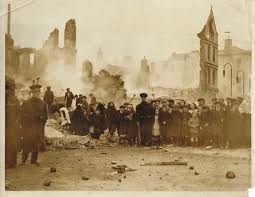
11 December 1920: The burning of Cork on this day. After an IRA attack on a lorry load of RIC Auxiliaries at Dillons Cross in which one of them was killed members of the Crown Forces went on a rampage in Cork City Centre. Buildings were set alight and many were gutted by fire. Two men who were members of the Cork IRA, Con and Jer Delaney were shot dead in their own home. British forces deliberately set fire to several blocks of buildings along the east and south sides of Saint Patrick’s Street during the hours of darkness and the following morning. The City Hall and the Carnegie Library were also completely destroyed by fire. The loss of the stock of the library and of the records in Cork City Hall was a huge blow to future historians.

Florrie O'Donoghue described the scene in Cork on the morning of the 12th:
Many familiar landmarks were gone forever – where whole buildings had collapsed here and there a solitary wall leaned at some crazy angle from its foundation. The streets ran with sooty water, the footpaths were strewn with broken glass and debris, ruins smoked and smouldered and over everything was the all- pervasive smell of burning.

The Chief Secretary for Ireland, Sir Hamar Greenwood, immediately denied that Crown forces were responsible for the conflagration:" I protest most vigorously," he said,  " against the suggestion, without any evidence, that these fires were started by the forces of the Crown."
Who burnt Cork City? - An Investigation on the Spot With Full Proofs [Dublin 1921]

However subsequent local inquiries carried out by reputable bodies established that members of the Crown Forces were indeed culpable for the widespread destruction.

Afterwards, some Auxiliaries took to wearing piece of half-burnt cork in their hats. But their black humour could not disguise the fact that these actions further undermined their already weakening authority and showed the World that the British Government could not control their own Forces on the streets of a City that it claimed was part of their Empire.


Friday, 10 December 2021


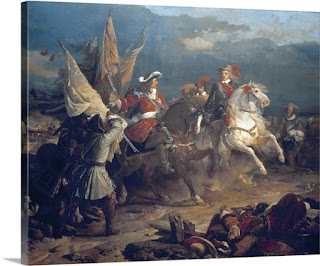
10 December 1710:  The battle of Villaviciosa in Spain on this day in which the Irish Brigades in the service of France and Spain played a distinguished part in the Victory. This was during the War of the Spanish Succession  between the two contenders for the Spanish Throne: Philip [Felipe] V backed by France and Charlesof Austria backed by Austria, England and Holland. During this see saw war the fortunes of both sides waxed and waned but after this campaign the Allies were never able to recover enough ground to regain their position. The battle took place about 70 miles north east of Madrid as Charles of Austria retreated towards Catalonia. Philip’s army hotly pursued him under the direct command of Marshal Vendome of France. 

Three Irish regiments fought with the Spanish army in this battle, commanded by respectively Col. Don Demetrio MacAuliffe, Col. Don John de Comerford and Col. Don Reynaldo Mac Donnell. They were collectively known as the Brigade of Castlelar. The Marshal’s army also included a force of Dragoons under the dashing cavalry commander General Count Daniel O’Mahony who was assisted by General Henry Crofton. To this ‘Arme Blance’ was attached a Lord Killmaloc’s Regiment of Dragoons. All of the Irish troops were to play a full part in the battle that materially affected the outcome of the War in Spain.

The engagement was fought on a bleak day in the midst of a Spanish Winter. The main action began in the early afternoon and after many hours of hard fighting it looked like that Charles had won. Marshal Vendome had even ordered the Retreat when his cavalry under the Marquis de Val-de-Canas and Count O’Mahony won the day by charging into the enemy’s rear and forced them to retreat. Only the onset of the darkness of a December night stopped them from destroying their opponents in detail. Though O’Mahony did manage to hamstring 700 mules that severely hampered the enemy from carrying away much of their material from the battlefield. 

Combined with the defeat and capture the previous day by Vendome of 5,000 English soldiers at the town of Brihuega the losses inflicted upon the enemy were such to render them unable to maintain the field and Charles had no option but to continue his sorry retreat to Barcelona and safety. His bid though for the Throne of Spain was effectively over.

Their brave and daring actions raised the status of the Irish troops and their leaders immeasurably during the Campaign of 1710. Though Lord Killmaloc was mortally wounded in the final battle the Count O’Mahony was awarded for his services.

The Comte de Mahoni acquired a great deal of glory on the battle-day of Villaviciosa, at the head of the dragoons. The King was so satisfied with him, that he conferred upon him a Commandership of the Order of St. Jacques (ie Jago) producing a rent of 15,000 Livres. …
History of the Irish Brigades in the Service of France
by John Cornelius O’Callaghan.

Painting: Jean Alaux (1840) - Marshal Vendome presenting the captured colours to King Philip V


Thursday, 9 December 2021


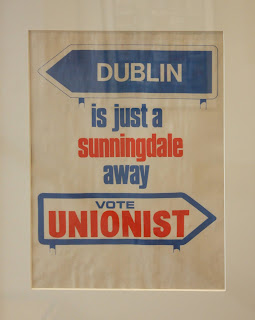
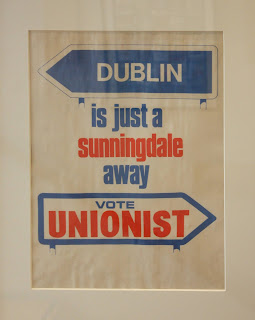
 9 December 1973: The Sunningdale Agreement was signed at Sunningdale in Berkshire, England on this day. Agreement was reached between the Irish Government & the SDLP representing the nationalists and the British Government and the Ulster Unionist Party representing the Unionists - with the Alliance Party taking more of a middle ground. It was agreed that a Power sharing Executive would be set up at Stormont. It was to include representatives from all the participant political parties that were elected to serve in the new parliament. 

However Article 7 of the Agreement stated that a 'Council of Ireland' would be set up that would enhance cross border co-operation. Its opening lines read:

The Conference agreed that a Council of Ireland would be set up. It would be confined to representatives of the two parts of Ireland, with appropriate safeguards for the British Government's financial and other interests. It would comprise a Council of Ministers with executive and harmonising functions and a consultative role, and a Consultative Assembly with advisory and review functions. The Council of Ministers would act by unanimity, and would comprise a core of seven members of the Irish Government and an equal number of members of the Northern Ireland Executive...

This was to prove its downfall. While there was initially a measured welcome for this settlement in many quarters it was greeted with deep suspicion especially by the more hard-line loyalist elements within the North. Also the IRA - who were engaged in a full scale campaign against the Crown Forces - were not interested as they saw it as irrelevant and if anything an impediment to a United Ireland. The ill-fated Executive only lasted a few months before the Loyalist Ulster Workers Council brought it down in May 1974.


Wednesday, 8 December 2021


8 December, 1856, Father Matthew, Apostle of Temperance, died at Cobh in County Cork after suffering a stroke on this day. He was born at Thomastown Castle, Co Tipperary in 1790. He was ordained a priest 1814 and spent 24 years in the Diocese of Cork before he began his great Crusade against Drink.

His striking personal appearance is thus described: "A finely-formed, middle-sized person, of exquisite symmetry; the head of admirable contour, and from which a finished model of the antique could be cast; the countenance intelligent, animated, and benevolent; its complexion rather sallow, inclining to paleness; eyes of dark lustre, beaming with internal peace, and rich in concentrated sensibility, rather than speaking or kindling with a super-abundant fire; the line of his mouth harmonizing so completely with his nose and chin, is of peculiar grace; the brow open, pale, broad, and polished, bears upon it the impress not merely of dignified thought, but of nobility itself."
www.libraryireland.com

In 1838 came the crisis of his life and after battling with his own Demons he founded the Cork Total Abstinence Society on 10 April 1838 in his own schoolhouse. He presided, delivered a modest address, and took the pledge himself. Then with the historic words, "Here goes in the Name of God", he entered his signature in a large book lying on the table. From then on night after night, Father Mathew addressed crowded assemblies. In three months he had enrolled 25,000 in Cork alone; in five months the number had increased to 130,000. 

The movement now assumed a new phase. Father Mathew decided to go forth and preach his crusade throughout the land. In the following years he gave the Pledge to multitudes throughout Ireland and in Scotland and England too. When the Famine struck he devoted his efforts to the relief of the poor and hungry in Cork and used his influence in England and America to obtain food and money. In the early part of 1849, in response to earnest invitations, he set sail for America. He visited New York, Boston, Washington and many other cities, and secured more than 500,000 disciples. After a stay of two and a half years he returned home in 1851. By then it was estimated he had secured the Pledge from some seven million people. He is buried at St. Joseph's Cemetery, Cork city which he had himself established.


Tuesday, 7 December 2021


7 December 1688 - The Apprentice Boys of Derry closed the gates against King James' troops on this day. With the advent of King James II to the throne in 1685 religious animosity had grown between the Protestants and Catholics of Ireland. The former resented the growing power of the latter and they in turn suspected their religious opponents of disloyalty to James who was of the Catholic Faith.

Events came to a head when a son was born to the King in June 1688. This meant that if the boy reached maturity he would succeed his father as a Catholic Monarch true to the Old Faith. But on 5 November of that year William of Orange landed in England and set himself in opposition to King James. A War between the Faiths looked inevitable and in Ireland this indeed proved the case. The King had many supporters here amongst the Catholics of Ireland who made up the bulk of the population. In Ulster however the situation was somewhat different as there were many Protestant settlers who would not support him at all and feared for their future under his rule.

So King James wished to secure his position in this Country as at least here he could rely on the most widespread support from the Catholic population. The Catholic Earl of Antrim was ordered to secure the City of Londonderry for King James. The said Earl, Alexander MacDonnell, advanced to Derry with some 1200 men. He sent an advanced party across the river Foyle to enter and take the main gate and hold it until he brought up the bulk of his force.

Just at this moment thirteen young apprentices, most of whom appear, from their names, to have been of Scottish birth or descent, flew to the guard room, armed themselves, seized the keys of the city, rushed to the Ferry Gate, closed it in the face of the King’s officers, and let down the portcullis.

‘History of England’ by Lord Macaulay.

This was a setback for the Royal cause as it galvanised opposition amongst the Protestant population there to resist and await relief from England should (as was most likely) William succeed in his daring enterprise. As it turned out the city was not taken and despite much suffering held out until relieved the following Summer. It was a turning point in Irish History & indeed of British History as this act of defiance has imbued within the Protestant population of the North ever since a notion that loyalty to the Crown was conditional upon the Monarch being not a Catholic but one of their own Faith.