Thursday, 13 January 2022
Wednesday, 12 January 2022
12 January 1729: Edmund Burke, one of the foremost political thinkers of 18th century, was born at 12 Arran Quay in Dublin on this day. He was also Anglo-Irish statesman, author, orator, political theorist and philosopher who, after relocating to England, served for many years in the British House of Commons as a member of the Whig party.
Burke was born in Dublin to a prosperous, professional solicitor father (Richard; d. 1761) who was a member of the Church of Ireland. His mother Mary (c. 1702–1770), whose maiden name was Nagle, belonged to the Catholic Church and came from an impoverished but genteel Cork family. Burke was raised in his father's faith and would remain throughout his life a practising Anglican, unlike his sister Juliana who was brought up as and remained a Roman Catholic.
His political enemies would later repeatedly accuse him of harbouring secret Catholic sympathies at a time when membership of the Catholic church would have disqualified him from public office. Once an MP, Burke was required to take the oath of allegiance and abjuration, the oath of supremacy, and declare against transubstantiation. Although never denying his Irishness, Burke often described himself as "an Englishman".
He spent the bulk of his life in England and became active on Politics, opposing Britain’s policy on the Revolt of the American Colonies and at the end of life British policy towards Ireland. He never totally adopted any political philosophy however but overall he could be said to represent a conservative liberalism that eschewed extremes. His most famous work was Reflections on the Revolution in France [1790] which was a best seller, and in it warned against the dangers of excess in political affairs especially as events unfolded in France in the wake of the start of the French Revolution. He basically wanted the role of the State to play but a limited role in the personal affairs of men and allow as much individual freedom of though and action that was commensurate with the Social Order.
‘That the State ought to confine itself to what regards the State, or the creatures of the State, namely, the exterior establishment of its religion; its magistracy; its revenue; its military force by sea and land; the corporations that owe their existence to its fiat; in a word, to every thing that is truly and properly public, to the public peace, to the public safety, to the public order, to the public prosperity.’
"All government, indeed every human benefit and enjoyment, every virtue, and every prudent act, is founded on compromise and barter."
'The only thing necessary for the triumph of evil is for good men to do nothing.'
Edmund Burke
While hard to sum up such an active career over many decades a pithy summary of what he stood for might well be:
His soul revolted against tyranny, whether it appeared in the aspect of a domineering Monarch and a corrupt Court and Parliamentary system, or whether, mouthing the watch-words of a non-existent liberty, it towered up against him in the dictation of a brutal mob and wicked sect.
Winston Churchill
Burke died in Beaconsfield, Buckinghamshire, on 9 July 1797, five days before the anniversary of the storming of the Bastille which marked the official start of the Revolution he so long predicted and fought against. He was buried in Beaconsfield alongside his son and brother. His wife survived him by nearly fifteen years.
Tuesday, 11 January 2022
11 January 1970: The foundation of ‘Provisional’ Sinn Fein on this day. The political organisation was activated after a formal split arose within Sinn Fein as to what was the best approach to take in regards to opposition to British Rule in the North and towards the 26 County Government. The more left wing members of the leadership like Cathal Goulding and Sean Garland wanted to operate a broad based ‘National Liberation Front’ [NLF] that would include both Sinn Fein and the likes of the Communist party within its ranks. They also wanted to recognise the parliaments in Leinster House, Westminster and Stormont as legitimate. Political Action within the current political framework was their chosen method of approach.
However to the more traditionally minded SF members these policies were anathema. They wanted to pursue a policy of active opposition to British rule in the North that would include support for armed struggle to bring about a British withdrawal from Ireland. They did not want any recognition of the Partitionist States here. In an acrimonious Ard Feis that took place in Dublin at the Intercontinental Hotel a split emerged into the open that had long been brewing.
Despite the best efforts of Sean MacStiofáin and Ruairí Ó Brádaigh, who eventually led the subsequent walkout, the changes were finally approved by the party membership but not, however, by the two thirds majority required for an alteration of the party’s constitution. In the wake of these decisions they organised a walkout by a minority of like minded delegates who reconvened a meeting at Kevin Barry Hall on Dublin’s Parnell Street and duly set up a ‘caretaker’ Sinn Féin Executive to liaise with the previously elected Army Council.
Some days later the new group made its intent clear in a freshly issued pamphlet:
We pledge our allegiance to the 32 county Irish Republic proclaimed at Easter 1916, overthrown by force of arms in 1922 and suppressed to this day by the existing British imposed Six County and Twenty-Six County partition states.
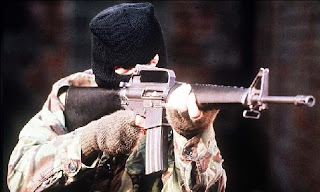
From then on the IRA split into two distinctive groups - one styled ‘Official IRA’ & the other ‘Provisional IRA’ with the latter being much more militant into how to bring about political change in Ireland especially North of the Border.
Thus were born the ‘Provos’!:
Monday, 10 January 2022
10 January 1868: Prisoners off the last convict ship from England to Australia came ashore at Freemantle Western Australia on this day. The ship set sail from Portsmouth (after picking up people along the way down the English coast) on 12 October 1867 with 280 convicts and 108 passengers on board. Amongst the convicts were 62 Irish political prisoners, convicted for their part in the Rising of 1867. About 17 of these were military Fenians. The transportation of political prisoners contravened the agreement between the U.K. and Western Australia, and news of their impending arrival caused panic there. The fact that military Fenians were transported was also highly unusual, given the United Kingdom Government's previous firm policy not to transport military prisoners.
The presence of Fenians amongst the convicts meant that there were many more literate convicts on board than was usual for a convict ship. Consequently, a number of journals of the voyage are extant: the journal of Denis Cashman has been known of for many years, and the journal of John Casey and the memoirs of Thomas McCarthy Fennell have recently been discovered and published. During the voyage a number of the Fenians entertained themselves by producing seven editions of a shipboard newspaper entitled The Wild Goose copies of which survive to this day.
While conditions on board would have been horrendous by todays standards the only death recorded on the convict shipping and description lists was for Thomas Cochrane (9689) and other sources say he died near Africa on the voyage out.
The Fenians were all convicted for treason and some of them were military men who were court martialled for failing to report or stop the treason and mutinous acts of others within the British Army. Some were not definitely identified as Fenians in other sources and they have been given a "Fenian???" notation in the passenger list below. The Fenians were members of a Secret Society the Irish Republican Brotherhood and the name came from the US branch of said society The Fenian Brotherhood. Military prisoners were not supposed to be shipped overseas but in this case the British Government made an exception. The transportation of prisoners of any type to the Antipodes was becoming increasingly controversial and this human shipment was the last of its kind.
* Headline from the Perth Gazette & Western Australian Times 17 January 1868
Sunday, 9 January 2022
Saturday, 8 January 2022
Friday, 7 January 2022
7 January 1922: The Treaty was passed by members of Dáil Éireann assembled at Earlsfort Terrace, Dublin [above] on a vote of 64 in favour and 57 against. President De Valera, after the vote was taken, indicated his intention of resigning his position. He said that:
There is one thing I want to say---I want it to go to the country and to the world, and it is this: the Irish people established a Republic. This is simply approval of a certain resolution. The Republic can only be disestablished by the Irish people. Therefore, until such time as the Irish people in regular manner disestablish it, this Republic goes on. Whatever arrangements are made this is the supreme sovereign body in the nation; this is the body to which the nation looks for its supreme Government, and it must remain that---no matter who is the Executive---it must remain that until the Irish people have disestablished it.
Michael Collins, who voted to accept the terms replied that:
I ask your permission to make a statement. I do not regard the passing of this thing as being any kind of triumph over the other side. I will do my best in the future, as I have done in the past, for the nation. What I have to say now is, whether there is something contentious about the Republic---about the Government in being---or not, that we should unite on this: that we will all do our best to preserve the public safety.
The Treaty negotiations had begun in London on 11 October 1921 and concluded in the early morning of 6 December 1921 with the signature, by British and Irish negotiators, of ‘Articles of Agreement’ – better known as the Anglo-Irish Treaty (or the Treaty). This led directly to the establishment of the Irish Free State on 6 December 1922, governing twenty-six of Ireland’s thirty-two counties. It was a milestone in the histories of Ireland, the United Kingdom (UK), and the British Empire and Commonwealth.
But it’s signing caused a huge rift at home as people divided on whether to accept it or not. An Dáil Éireann [Irish Parliament] debated the issue from 15 December on with cogent arguments being made for and against. They broke for Christmas & the New Year and resumed their deliberations in early January. Finally on the 7th of that month the matter was brought to a head and the TDs in attendance voted for or against on its terms.
The day began at 11.30 a.m. when the Speaker read a motion he had submitted in his own name as another attempt to avert a split, but it had virtually no support and was never put to a vote. In the evening, there were concluding remarks from senior Deputies on both sides. Then at 8.30 p.m. the vote was called with all assembled on tenterhooks as which side would carry the day. In the event the Pro Treaty side won it but by a margin that was narrow enough to not give them a decisive result over such a contentious issue as this one was.
Namely was the Irish State to include all the territory of Ireland and was the State to be a Republic or a Free State as demanded by the British Government? The most problematical issue was an Oath of Fidelity to King George V and his lawful successors to be taken by all TDs who were to take their seats in the new parliament of the State. Without that bone of contention there may well have been no Civil War.
In the event the Ceann Comhairle Eoin MacNeill [pro Treaty] absented himself from the vote in accordance with standing orders. It was ruled that the four other TDs, Michael Collins, Arthur Griffith, Éamon de Valera and Seán Milroy, who had been elected for two constituencies (for both the House of Commons of Southern Ireland and the House of Commons of Northern Ireland) would only cast one vote each. Of the 124 Teachtaí Dála (TDs) who were entitled to vote as a result of these rulings, 121 cast their vote in the Dáil, and three abstained. The result of the vote was: 64 in favour of the Treaty and 57 against. Of the three TDs eligible to vote who did not do so, one had resigned, one was abroad & one was ill.
All the female TDs voted against accepting the Treaty.
Soon after the meeting broke up but it was clear that after this things would never be the same again and an unbridgeable rift had opened between those who supported the Treaty and those who were against it. The division of opinion that day was to have one outcome: Civil War.