Monday, 7 August 2023
Sunday, 6 August 2023
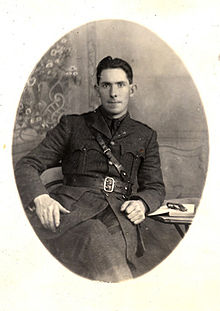
6 August 1921: Dublin Castle, the seat of the British Rule in Ireland, issued a statement to the effect that all TDs [elected members of Dáil Éireann ] would be released from captivity - with one exception! That man was Seán Mac Eoin who had been sentenced to death for the murder of an RIC District Inspector McGrath in January 1921. During an attempt to escape he was shot and wounded he was than transferred to Mountjoy Prison in Dublin.
The Irish Cabinet met the same day and rejected the terms imposed by the British re the release of prisoners who were TDs and specifically the intended further incarceration of Mac Eoin and the threat of execution should the current peace negotiations fail. There was an objection from one member of the cabinet who did not feel it worth risking the fate of the negotiations for Mac Eoin’s life!
However President De Valera immediately issued a public statement [fully supported by Michael Collins & Arthur Griffith] that read:
If the detention of Commandant is persisted in, I cannot accept responsibility for proceeding further with the negotiations ...
In British legal phraseology he is termed a murderer; but for us, and I believe, for the world, he is a heroic Irishman.
The Irish Republic, Chapter 50 by Dorothy Macardle
Within days he was released and he went on to support the Treaty of December of 1921. ‘The Blacksmith of Ballinalee’ then had a successful political career in the new Irish State.
‘Seán Mac Eoin was a soldier during the War of Independence and leader of an IRA (Irish Republican Army) flying column in north Longford during that conflict. He was first elected a Sinn Féin TD in 1921 for Longford Westmeath. He also served in different constituencies for Sinn Féin, Cumann na nGaedheal and Fine Gael until his defeat in 1965. He was also Minister for Justice (1948-1951) and Defence (1951 and 1954-1957).'
https://www.rte.ie/archives/2021/0722/1236667-survivor-sean-mac-eoin/
Saturday, 5 August 2023
5 August 1922 - the fall of Kilmallock Co Limerick on this day and the end of the most formalised series fighting in the field in the Irish Civil War. The town was the key to the taking of the south Limerick - north Cork area that the Free State National Army had to secure to open up the road south to the city of Cork that was still in the hands of the Anti Treaty forces aka ‘the Irregulars’.
‘The geography of Kilmallock lent itself to a stubborn defence. A series of small hills surround and dominate the approaches to the town, which sits in a hollow on the banks of the River Loobagh. If the anti-Treaty forces could maintain a hold on these heights, then driving them from Kilmallock would be extremely challenging.’
Conventional warfare: the Battle of Kilmallock by Dr John O'Callaghan
https://www.rte.ie/history/conventional-phase/2022/0630/1307775-the-battle-of-kilmallock/
In overall command of the immediate operations was Major General WRE Murphy [above] who had served in the British Army in the Great War and had seen extensive active service in France, Belgium and Italy. Facing him were some of the IRA’s most experienced commanders Liam Deasy, Officer Commanding 1st Southern Division, and Sean Moylan, Officer Commanding North Cork Brigade.
Both sides had problems within their own ranks. For the National Army it was primarily the rawness of the Officers and men who were not properly trained or led and were in many cases incapable of conducting basic military operations in the field. In the ranks of the IRA it was lack of supplies and the absence of artillery and heavy weapons to counter any attacks their opponents would launch against them. They also had a diminishing state of morale after the fall of Limerick city and the fear of being outflanked by naval landings in Kerry and Cork plus the rather obvious fact that most people did not want or support a Civil War to maintain an Irish Republic as opposed to an Irish Free State.
In the days preceding the attacks on Kilmallock the National Army had secured the villages of Bruff and Bruree after some brisk combats. For the attempt to take Kilmallock an elaborate plan was drawn up to stop the republicans from making good their escape without loss and orders for a semi encirclement of the town were issued. However the difficulties of getting men up to the front lines in any sort of formal order were continually frustrated the lack of experience of both officers and men and a lack of food supplies. Finally on the 4th August the attack was launched and made progress but by late afternoon it had stalled and Murphy called a halt as the men were exhausted.
That evening word reached the defenders that as feared the Free State had indeed landed at Fenit in Co Kerry and they decided to retreat back south to cover Cork more effectively. So on the following morning scouts reported that they could see no sign of enemy activity and General Murphy gave the order to advance. Thus ended the only set of engagements in the field that could be recognisably defined as active military manoeuvres in the Irish Civil War.
Friday, 4 August 2023
4 August 1914: Great Britain declared War on Germany. That afternoon the British Prime Minister Herbert Asquith [top above] addressed the House of Commons in London and set out the reasons for the decision to declare War. Basically it was the crossing of the Belgian border by German forces that morning after Belgium had rejected Berlin’s demand that her armies have free passage across that country in order to attack France.
The problem for Britain was that if France’s northern coast was left open to German Naval operations then it was considered doubtful that she could hold out for long against attack by both land and sea. A quick German Victory in the West would then give the Kaiser a free hand to deal with Russia and thus make Germany the Master of Europe.
Britain however had an ace card to play as a Causi Belli and that was an International Treaty signed in 1839 guaranteeing the Independence of Belgium - which had been signed by both Britain and Prussia! Clearly the German attack on Belgium was a violation of that Treaty and this opened the door for her entering the war against Germany. The stakes were believed to be just too high for Britain to risk staying out of it and having no influence on the outcome of the War.
That afternoon Asquith addressed a packed and silent House setting out the unfolding events and the continuing diplomatic communications with Brussels and Berlin. Assurances received from the German Capital that Germany had no territorial ambitions on Belgium and was only acting on their convinced belief that France would attack her through that country otherwise did not find any favour with Asquith and the British Cabinet.
Asquith concluded his speech with these fateful words:
I have to add this on behalf of His Majesty's Government: We cannot regard this as in any sense a satisfactory communication. We have, in reply to it, repeated the request we made last week to the German Government, that they should give us the same assurance in regard to Belgian neutrality as was given to us and to Belgium by France last week. We have asked that a reply to that request, and a satisfactory answer to the telegram of this morning—which I have read to the House—should be given before midnight.
The House adjourned at 7.15 pm to meet again the following day. The Cabinet then retired to await the reply from Germany.
However as the clock struck 11pm that night and as no reply had been received from Berlin the Cabinet had decided to wait no longer than that hour as it would be already midnight in that city. Apparently this was on a prompt from Winston Churchill - the First Lord of the Admiralty - who was eager for War. Time was now of the essence and the word went out to commence military operations with immediate effect.
"It was 11 o'clock at night -- 12 by German time -- when the ultimatum expired. Along the Mall from the direction of the Palace the sound of an immense concourse singing 'God Save The King' floated in.
"On this deep wave there broke the chimes of Big Ben; and, as the first stroke of the hour boomed out, a rustle of movement swept across the room. The war telegram, 'Commence hostilities against Germany', was flashed to the ships and establishments... all over the world."
Winston Churchill
The Foreign Office then issued the following official statement:-
Owing to the summary rejection by the German Government of the request made by his Majesty's Government for assurances that the neutrality of Belgium will be respected, his Majesty's Ambassador to Berlin has received his passports, and his Majesty's Government declared to the German Government that a state of war exists between Great Britain and Germany as from 11 p.m. on August 4, 1914.
No mention of Ireland! But the previous day John Redmond [bottom above] - the Leader of Nationalist Ireland - had spoken in the House and had stated that at least Ireland could be defended by Irishmen if the British Army was needed elsewhere.
Today there are in Ireland two large bodies of Volunteers. One of them sprang into existence in the North. Another has sprung into existence in the South. I say to the Government that they may to-morrow withdraw every one of their troops from Ireland. I say that the coast of Ireland will be defended from foreign invasion by her armed sons, and for this purpose armed Nationalist Catholics in the South will be only too glad to join arms with the armed Protestant Ulstermen in the North. Is it too much to hope that out of this situation there may spring a result which will be good not merely for the Empire, but good for the future welfare and integrity of the Irish nation? I ought to apologise for having intervened, but while Irishmen generally are in favour of peace, and would desire to save the democracy of this country from all the horrors of war, while we would make every possible sacrifice for that purpose, still if the dire necessity is forced upon this country we offer to the Government of the day that they may take their troops away, and that if it is allowed to us, in comradeship with our brethren in the North, we will ourselves defend the coasts of our country.
Redmond’s proposal was lost in the wash of unfolding events but his decision to support Britain and not oppose the War was a fateful one. Of course with Home Rule on the cards he had to play it careful and this position was one really of neither being in or out of the War. But it was a stance he could not maintain for long as the dramatic and bloody events of the next few weeks were to demonstrate.
Thursday, 3 August 2023
3 August 1916: Roger Casement was hanged at Pentonville Prison London on this day. He was tried by the British for Treason as he had endeavoured to enlist German help to free Ireland at a time when Britain and Germany were at War.
He was born in Dublin in 1864. His father was an Officer in the British Army. From 1895 onwards he worked for the British Foreign Office in a Consular capacity. He was sent to the Congo where he reported on the widespread abuses there against the Natives by the Belgian Colonialists. These reports earned Casement a CMG (Order of St Michael and St George) in 1905. He was then sent to Brazil and was commissioned to undertake an investigation on the reported abuse of workers in the rubber industry in the Putumayo basin in Peru. He once again found many instances of abuse and exploitation by the Rubber Barons there and was rewarded a Knighthood in 1911 for his services to Humanity.
But by 1912 Casement had become disillusioned with European Colonialism of which he found himself a reluctant part though albeit in a pacific role. At Home he had become a member of the Gaelic League and a strong Nationalist. He viewed with abhorrence the events in the North (his father was from Antrim) and was totally against Partition.
In August 1914 he was in the USA raising funds for the Irish Volunteers when the Great War broke out. He soon made contact with Clan na Gael and John Devoy put him in contact with German Diplomats in New York. He made his way to Germany to raise military and financial support for a Rising in Ireland but met with little success. In particular his attempt to raise an Irish Brigade from amongst the Irishmen held as Prisoners of War was meagre. By this time the British Intelligence Service had latched onto his activities and set about undermining him.
When in early 1916 Casement learnt of the high likelihood of a Rising in Ireland he requested to be sent home to be there. However by the time he sailed in a German Submarine he was of the opinion that it should not go ahead if the Germans could not offer considerable military assistance – and of that there was no real prospect given their huge commitments at that time. He felt that the German High Command were sending him to his Death otherwise. In the event Casement’s small party was put ashore at Banna Strand, Co Kerry in the early hours of Good Friday 21 April 1916. They were soon spotted by the locals who took them for German spies and they were arrested by the RIC. Casement was dispatched hastily to London and imprisoned to await his Fate.
His Trail for Treason was conducted at the Old Bailey. Despite the best efforts of his Legal Team the evidence against him was pretty clear cut and on the facts he could hardly expect to escape the Death Sentence. A campaign was underway to enlist support for an amelioration of the execution of any judgement past by the Court. Casement was a widely respected figure for his humanitarian work and it could possibly be argued that while he had erred in Judgement his past services to Humanity should be taken into account.
But during the Trial the British produced the infamous ‘Black Diaries’ that they claimed were written in Casement’s own hand and showed him to be a Homosexual with a marked predilection for young boys he picked up while engaged in his work abroad. These Revelations proved a Sensation and as intended destroyed Casement’s Character and Reputation in the circles where his cause was most likely to find support. He vehemently denied all the accusations against him.
He was found Guilty of Treason and sentenced to death. He was 51 years old and had been received into the Catholic Faith in the hours before he made his way to the Scaffold. He received the Last Sacraments and died as he said with the body of his God as his last meal.
His body was buried in quicklime in the grounds of the Prison. There it remained until 1965 when the Labour Government of Harold Wilson agreed to hand it over the Republic of Ireland on condition he was not buried in the North (Casements' wish). He was given a full State Funeral and interred in Glasnevin Cemetery Dublin. President Eamon de Valera himself gave the graveside oration.
Wednesday, 2 August 2023
2 August 1649: The Battle of Rathmines/Ráth Maonais on this day. The battle was fought in what was then open fields to the south of Dublin City over what is now long since suburbia. The city itself was under siege by James Butler, Marquis of Ormond, in command of the Royal Army that gave its allegiance to the uncrowned King Charles II, the son of the recently executed King Charles I.
Ormond hoped to force the city garrison of the English Parliament under Colonel Jones to capitulate before Oliver Cromwell could sail from Britain with a large relief army to retake Ireland from the Catholics. However it was Ormond himself who had handed the city over to the parliamentary forces some years beforehand when he realised he could no longer defend it from the Catholics. His logic was 'better English rebels than Irish ones’!
In the wake of the collapse of the Royal Army in England and the capture and execution of King Charles I the remnants of his forces in Ireland formed a reluctant alliance with the Catholic forces here to oppose the Parliamentarians. Thus the army besieging the city under Ormond was a disparate one of divided loyalties, their only point of unity was a hatred of the English Parliament and its armed forces. The Irish Catholics especially those drawn from the ranks of Gaelic Ireland did not trust Ormond and indeed his inept conduct on the day of the battle led to questions being asked - though nothing was ever proven.
The battle began when Ormond ordered an advance force to seize the partially demolished Baggotrath Castle, [ lower right side of map] situated roughly just south of where Baggot street bridge now is on the Grand Canal. However the force lost its way in the dark and Colonel Jones must have got wind of the venture and launched a counter attack that caught the would be attackers off guard. Disorder turned to rout and Jones seized his moment and called out his strike force to pursue and kill or capture as many of their opponents as they could. Ormond had already retired to his Camp at Rathmines when word reached him that Jones had come out to fight.
‘Meanwhile, Colonel Jones had observed the movement around Baggotrath and guessed Ormond's intention. He quickly deployed 4,000 foot and 1,200 horse from the Dublin garrison on the meadows between the city walls and Baggotrath, intending to dispute Ormond's occupation of the castle. Ormond gave orders that his whole army should stand to arms to support Purcell and Vaughan at Baggotrath in case of a Parliamentarian attack. Having been awake all night, Ormond then retired to his tent at Rathmines to rest while his army deployed, but he had underestimated Colonel Jones' determination.
At about nine o'clock in the morning, Jones' whole force advanced rapidly across the meadows towards Baggotrath. Sir William Vaughan's cavalry were routed in the first charge and Vaughan himself was killed. Major-General Purcell's infantry held the position for a short time but were soon overwhelmed; most were killed or taken prisoner, the rest fled. Having regained Baggotrath, Jones saw an opportunity to attack the main Royalist camp. He quickly regrouped and advanced towards Rathmines. Ormond was awakened by the sound of gunfire and rode to the battle, where he bravely tried to rally the troops that were streaming back from Baggotrath.
Any remaining Royalist troops fled as the Parliamentarians overran the camp at Rathmines. Ormond retreated south with his lifeguard and made his way to Kilkenny.
Estimates of the number of coalition soldiers killed at Rathmines vary between 600 and 4,000. More than 2,500 were taken prisoner, including many experienced officers. Ormond's artillery and baggage train were captured, as well as his private papers and correspondence.’
http://bcw-project.org/military/confederate-war/rathmines
Colonel Jones had won a great victory and when Cromwell arrived some weeks later with 14,000 men he was quickly able to seize the initiative without having to secure Dublin first.
The battle gave the names to several local landmarks. 'The Bleeding Horse' public house, which stands at the corner of modern Upper Camden street, was established in 1649, when, after the Battle of Rathmines, a wounded horse wandered into a tavern. This made such an impression on the owner that he named his premises 'The Bleeding Horse'.
In addition, an area in the townland of Milltown was formerly known as the "Bloody Fields", where it is believed that some of the fleeing Royalist soldiers were overtaken by the Parliamentarian cavalry, killed and subsequently buried
Ironic that Jones died of a fever some months later when on campaign in County Waterford, more or less a forgotten man while Ormond went on to be the Lord Lieutenant of Ireland under King Charles II and is buried in Westminster Abbey!
Tuesday, 1 August 2023
1 August 664 AD: A great Plague arrived in Ireland and swept the Country killing huge numbers of people. The ‘Great Mortality' was possibly a return of the Buide Conaill which had swept through Ireland in the 6th century. The 'Yellowness of Conaill' might perhaps refer to a prominent individual who had been amongst its first victims, as in the 20th century the 'Spanish Influenza' refers to King Alfonso XIII of Spain catching it - though he survived! A jaundice like fever was perhaps the root of the disease.
But it has been advanced that the Plague of 664 and the years following was actually a bubonic plague caused by rats - though the rat population in Ireland at that time is a matter of conjecture. Rats in large numbers are usually needed for that disease to take off and places of dense urbanity are their preferred locations - which Ireland did not possess at that time. However we cannot be sure that the plague that arrived in 664 was a new strain of bubonic plague or the same type as that of the earlier one - or indeed another disease altogether.
The plague of 664 broke out on or about the 1st August that year after a warm summer which was followed by a warm autumn (ideal for the spread of plague) and continued into 665, and broke out with renewed violence in 667-668. It then quietened down for about a decade and a half but flared up again in 683-684 when it was described as the mortalitas puerorum (death of boys). Children seem to have been more heavily affected then because they had no resistance to it.
A great mortality in Ireland came on the calends of August i.e. in Magh Itha in Leinster.
The Annals of Tigernach 664 AD
The plague reached Ireland on the Kalends of August.
Chronicum Scotorum
A great mortality prevailed in Ireland this year, which was called the Buidhe Connail, and the following number of the saints of Ireland died of it: St. Feichin, Abbot of Fobhar, on the 14th of February; St. Ronan, son of Bearach; St. Aileran the Wise; St. Cronan, son of Silne; St. Manchan, of Liath; St. Ultan Mac hUi Cunga, Abbot of Cluain Iraird Clonard; Colman Cas, Abbot of Cluain Mic Nois; and Cummine, Abbot of Cluain Mic Nois.
After Diarmaid and Blathmac, the two sons of Aedh Slaine, had been eight years in the sovereignty of Ireland, they died of the same plague.
There died also Maelbreasail, son of Maelduin, and Cu Gan Mathair, King of Munster; Aenghus Uladh. There died very many ecclesiastics and laics in Ireland of this mortality besides these.
Annals of the Four Masters 664 AD
This Plague also struck in Britain, first along the southern coast before spreading north into Northumbria. It is more than likely that it spread from Britain into Ireland along the same channels. Many men of the English Nation then resided here and studied or practised the religious Life in Irish Monasteries. This was all given free of charge! The Venerable Bede recorded this Plague and it is the first such one recorded in the history of that Country:
IN the same year of our Lord 664, there happened an eclipse of the sun, on the third day of May, about the tenth hour of the day. In the same year, a sudden pestilence depopulated first the southern parts of Britain, and afterwards attacking the province of the Northumbrians, ravaged the country far and near, and destroyed a great multitude of men.
Moreover, this plague prevailed no less disastrously in the island of Ireland. Many of the nobility, and of the lower ranks of the English nation, were there at that time, who, in the days of the Bishops Finan and Colman, forsaking their native island, retired thither, either for the sake of sacred studies, or of a more ascetic life; and some of them presently devoted themselves faithfully to a monastic life, others chose rather to apply themselves to study, going about from one master’s cell to another. The Scots willingly received them all, and took care to supply them with daily food without cost, as also to furnish them with books for their studies, and teaching free of charge.
Bede's Ecclesiastical History of England