Saturday, 19 August 2023


19‭ August 1504: The battle of Knockdoe/Cnoc Tuagh (the Hill of Axes) was fought on this day. This battle was the greatest clash of arms seen in Ireland in hundreds of years. It took place around Knockdoe, a hillock about eight miles north east of Galway city. The combatants were the forces under Gerald Fitzgerald, the Great Earl of Kildare and his rival Ulick Burke of Clanrickard.

Despite a somewhat uncertain relationship the Great Earl was King Henry VII’s man in Ireland.‭ He was charged with ensuring that no other than himself should dictate the state of the King's affairs in this Country. Something of a poacher turned gamekeeper the Great Earl would brook no rivals. Ulick Burke had thrown down the gauntlet however by seizing three castles belonging to the O’Kellys of south Galway and also taking under his control the Royal city of Galway. Ironically Ulick was also Gerald’s son in law! While not a certainty he seems to have fallen out with his wife Eustacia and she had returned to be under her fathers roof. The O’Kellys also appealed to him for the restitution of their fortresses. 

Gerald was, said the Irish, ‘a knight famous in deeds of arms, royal and just in word and judgement’. He was a descendent of the Maurice FitzGerald of Strongbow’s Invasion, the Head of the great house of Kildare, and the strongest man in Ireland. The King of England ...found him indispensable.

Irish Battles, G.A. Hayes-McCoy

He decided to lead an Army to the West and settle the issue through battle.‭ He led a formidable force with him, perhaps as many as 6,000 warriors and many of them the iron clad Gallowglass who dominated the battlefields of Ireland in the latter Middle Ages. To oppose him Ulick gathered a similar type of force but he could not match the Great Earls resources or network of connections. He had maybe about 4,000 men in the field on the day of battle. The Great Earl mustered forces from Leinster and Ulster with some Connacht allies too. Burkes’ own force was comprised of his retinue from south Galway, and his allies from northwest Munster. To the Gaels it seemed that the great wars between the provincial kings of old in the days before the English arrived had returned. But to Gerald it was more like a version of a suppression of a rebellion against Royal authority that the King of England might engage upon across the water. In truth there was a mixture of both these analogies in what happened.

In the event Gerald Fitzgerald beat his opponent decisively and retook Galway from Ulick Burke.‭ The battle though was bloody and hard fought – ‘a dour struggle’. Essentially an infantry battle both sides hacked and slashed at each other to bring the other down. It is also the first battle to record the use of a gun - a Palesman beat out his opponent’s brains with the butt of his piece! It was really a medieval battle of the old style and the last great one of its kind. Both sides clashed early in the morning and it was late in the day before the remnants of Burkes’ much depleted host broke and ran. The Geraldine force camped on the battlefield that night to collect booty and bring in the stragglers. The Great Earl proceeded the next day to enter the City of Galway in Triumph and received the keys of the metropolis from the grateful Mayor.

A fierce battle was fought between them,‭ such as had not been known of in latter times. Far away from the combating troops were heard the violent onset of the martial chiefs, the vehement efforts of the champions, the charge of the royal heroes, the noise of the lords, the clamour of the troops when endangered, the shouts and exultations of the youths, the sound made by the falling of the brave men, and the triumphing of the nobles over the plebeians.

 The battle was at length gained against Mac William, O'Brien, and the chiefs of Leath-Mhogha; and a great slaughter was made of them; and among the slain was Murrough Mac-I-Brien-Ara, together with many others of the nobles. And of the nine battalions which were in solid battle array, there survived only one broken battalion. A countless number of the Lord Justice's forces were also slain, though they routed the others before them. It would be impossible to enumerate or specify all the slain, both horse and foot, in that battle, for the plain on which they were was impassable, from the vast and prodigious numbers of mangled bodies stretched in gory litters; of broken spears, cloven shields, shattered battle-swords, mangled and disfigured bodies stretched dead, and beardless youths lying hideous, after expiring.

Annals of the Four Masters


Friday, 18 August 2023


18 August 670: The Feast of St. Fiacre the Abbot on this day. He was was born in Ireland about the end of the sixth century. He had a hermitage on the banks of the river Nore at Kilfera, County Kilkenny. Disciples flocked to him, but, desirous of greater solitude, he left his native land and arrived, in 628 AD, at Meaux in what is now France. 

St. Farowas the Bishop there generously received him. He gave him a solitary dwelling in a forest, which was his own patrimony, called Breuil, in the province of Brie. Here he founded a Monastery and a Hospice. He resided in a little cell and led a frugal existence surrounded by a small garden, which he worked himself. He was very strict on the rule that no women should be about the place. He was noted for his great ability to cure the sick and many flocked to him to be cured. 

After his death a Shrine to him became a place of Pilgrimage and in later centuries he had some very famous devotees. Anne of Austria attributed to the meditation of this saint to the recovery of Louis XIII at Lyons, where he had been dangerously ill; in thanksgiving for which she made, on foot, a pilgrimage to the shrine in 1641. She also sent to his shrine, a token in acknowledgement of his intervention in the birth of her son, Louis XIV.

 St. Fiacre is also a patron saint of gardeners and of the cab-drivers of Paris. French cabs are called fiacres because the first establishment to let coaches on hire, in the middle of the seventeenth century, was in the Rue Saint-Martin, near the hotel Saint-Fiacre in that City.


Thursday, 17 August 2023


17 August 1922: The transfer of Dublin Castle by the British to the Provisional Government of the Irish Free State was completed on this day.

The Castle loomed large in the consciousness of the Irish People as the source and origin of many of their troubles. It was from here that the Crown of England through its Justiciars, Viceroys, Lord Lieutenants & latterly its Chief Secretaries attempted with various degrees of success to administer the Country they claimed the Right to rule over.. ‘The Castle’ - as it was commonly referred to - was an imposing structure that dated back to the early 13th century when King John gave orders for its construction. It was completed by 1230 and the Great Courtyard (Upper Castle Yard) of today corresponds closely with the fortification.

Though its origins go deeper into the past as ‘The Castle’ stands on the high ridge, the highest ground in the locality, at the junction of the River Liffey and its tributary the (now underground) Poddle, which formed a natural boundary on two sides. It is very probable that the original fortification on this easily defended strategic site was a Gaelic ráth [ringfort], which guarded the hurdled ford across the river Liffey [Átha Cliath], the adjacent Dubhlinn [Blackpool] monastic settlement and the four long distant roads that converged nearby that made Dublin such an important site. In the 940's, a Viking fort stood on this site when they decided to 'over-winter’ here and make a permanent settlement and berth their longships in black pool to the south of where the Castle now is.

The structure built on the orders of King John  had large sturdy walls and four round towers to protect it from attack by the Irish. The south-east Record Tower is the last intact medieval tower, not only of Dublin Castle but also of Dublin itself. It functioned as a high security prison and held native Irish hostages and priests in Tudor times.

So strong and well-defended was it and so important to the Crown that it never fell to attack. It was besieged in 1537 during the Revolt of Silken Thomas, almost taken in the Rising of 1641 and later occupied by the soldiers of the English Parliament under Cromwell. In 1798 it again came under threat and at Easter 1916 the insurgents of the Irish Citizen Army attempted to seize it by coup de main but without success. 

But with the signing of the Treaty in December of 1921 the British had agreed to withdraw from most of Ireland and the days of the Castle as the centre of British Power in this Country started to draw to a close. While the British Army pulled out in January 1922 the transfer of administration took months to organise. 

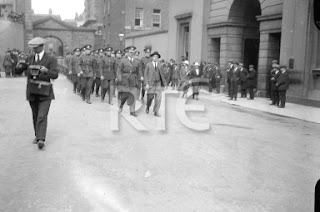
Thus the day came about in August 1922 when the last contingent of the members of the Royal Irish Constabulary (RIC) marched out and the first detachment of the Civic Guards (later An Garda Síochána) marched in, led by the first Garda Commissioner Michael Staines & Chief Superintendent McCarthy. At last ‘The Castle’ was fully in Irish hands.


Wednesday, 16 August 2023


16 August‭ 1927: The Alderman Jinks Affair. Mr Denis Johnstone, the leader of the Labour Party, proposed a motion of No Confidence in the Government of Mr W.T. Cosgrave. Johnstone opened the crucial debate with the following words:

The motion down in my name and which I move is:

‭“That the Executive Council has ceased to retain the support of the majority in Dáil Eireann.”

In effect,‭ it is clear that that motion is intended to test the views of the House as to whether the present Executive Council shall continue in office. It is based on Article 53 of the Constitution, which says: “The President and Ministers nominated by him shall retire from office when they cease to retain the support of the majority in Dáil Éireann.”


The result was a tie of‭ 71 votes each. As a result the vote of the Speaker Mr Michael Hayes decided the issue for the Government. The absence of Mr Jinks of the National League Party (who were in alliance with Fianna Fail) was crucial to Cosgrave’s survival.


It is widely believed that Jinks non-appearance was due to the intervention of Major Bryan Cooper and J.M.‭ Smyllie (editor of the Irish Times) who plied Jinks with liberal quantities of drink in the hours before the vote was taken. Their hospitality apparently rendered their hapless guest in no fit state to attend the House. The pair convinced their drinking companion that a ticket home was a better course of action than attendance upon the House when he was obviously the worse for wear. ‬They then put him on the Sligo train and thus unable to partake in the day’s parliamentary proceedings. This development thus saved Mr Cosgrave’s Government from almost certain defeat.


Jink’s, a National League Deputy, was the centre of wild speculation that he had been kidnapped to keep him from voting. Rumours swept the country and headlines such as, ‘The Mystery of Deputy Jinks, the missing deputy’ screamed from several newspapers not only in the U.K. and America.

The sensational affair began when Jinks walked out of the Dáil chambers before the vote was about to be called and he couldn’t be found despite a frantic search by colleagues.

There was consternation amongst the opposition who had been confident that the Government would fall. Jinks was later tracked to a hotel at Harcourt Street having spent the day strolling through the streets of Dublin. He told reporters he had gone to Dublin with instruction from two thirds of his supporters to vote for the Government.

“I was neither kidnapped nor spirited away. I simply walked out of the Dáil when I formed my own opinion after listening to a good many speeches.

“I cannot understand the sensation nor can I understand the meaning or object of the many reports circulated. What I did was done after careful consideration of the entire situation.

“I have nothing to regret for my action. I am glad I was the single individual who saved the situation for the Government, and perhaps, incidentally, for the country. I believe I acted for its good,” said Deputy Jinks.

The Sligo deputy arrived home on Wednesday night by the midnight mail train. A large crowd greeted his arrival. He spent the following morning receiving callers including one proclaiming him  “ The Ruler of Ireland.”!!!

Jinks had only been elected a TD in June of that year and subsequently lost his seat in the General Election of September that same year. He returned to local politics where he served once again as Mayor of Sligo. He died in 1934.

To this day the bizarre actions of Mr Jinks have been the subject of much speculation. The common accepted story is that he was inveigled into doing the rounds of various establishments in Dublin City centre by Smylie and Cooper, men with Sligo connections and who were from a Unionist background. They did not want to see Mr De Valera in power!

By the time the vote was called he was nowhere to be seen and his somewhat ignominious place in modern Irish political history was assured - Legend has it that Mr Cosgrave then purchased or had purchased on behalf of the Government a horse called Mr Jinks [above]. This horse went on to win the Two Thousand Guineas at Newmarket, England in 1929!


Tuesday, 15 August 2023


15 August 1998: The Omagh Bombing. On a Saturday afternoon the quite town centre of Omagh Co Tyrone was ripped apart by a single bomb that killed 29 innocent people and injured hundreds more. The atrocity was carried out by a small splinter group of the 'Real IRA' [RIRA].

The group was being monitored by the British Secret Service who knew something was up but failed to pass on any information they may have had to the local RUC. It is an open question though whether this would have made much material difference. Warnings were phoned in but the location for the car bomb were vague. It referred to a bomb in 'Main St' near the Courthouse - but there is no street by that name in Omagh. The RUC started to clear the area where they thought the bomb was but in actual fact they sent people towards its location.

The car bomb detonated at about 3.10pm in the crowded shopping area. It tore the car into deadly shrapnel and created a fireball and shockwave. People were caught in "a storm" of glass, masonry and metal as the blast destroyed shop fronts and blew the roofs off buildings. A thick cloud of dust and smoke filled the street. Twenty-one people who were standing near the bomb were killed outright. Eight more people would die on the way to or in hospital. The people who died included a pregnant woman, six children, and six teenagers.

A 500lb bomb packed in the Cavalier is detonated with a remote trigger. The explosion tears through Market Street. Shop fronts on both sides are blown back on top of customers still inside. Glass, masonry and metal tears through the crowd on the street as a fireball sweeps out from the epicentre. Twenty-one people are killed instantly - some of their bodies were never found, such was the force of the blast. A water main under the road ruptures. Gallons of water gushes out. Some of the dead and badly injured are washed down the hill.

https://www.irishtimes.com/news/crime-and-law/timeline-of-the-omagh-bombing-1.1525134

Injured survivor Marion Radford described hearing an "unearthly bang", followed by "an eeriness, a darkness that had just come over the place", then the screams as she saw "bits of bodies, limbs" on the ground while she searched for her 16-year-old son, Alan. She later discovered he had been killed only yards away from her, the two having become separated minutes before the blast.

In the aftermath there was widespread condemnation across the board from all sides. The Good Friday Agreement had been signed only months before and people throughout Ireland were genuinely hopeful that 'The Troubles’ were at an end. Some days later the RIRA admitted that they did it and apologised. But their words fell on deaf ears. 'Enough was Enough' as far as most people were concerned. The bombing campaign was suspended and never reactivated. While there have been deaths and murders in the North since then nothing like this [the worst single bombing atrocity in the Northern Troubles 1968-1998] has happened since.

Photo above: Two Spanish tourists stopped beside the car, and were photographed. The photographer died in the bombing, but the man and child in the photograph survived.


Monday, 14 August 2023


14 August 1598 O.S./24 August 1598 N.S.- the Battle of the Yellow Ford (Cath Bhéal-an-Átha-Buí)  was fought on this day. It was fought between the forces of Aodh [Hugh] O’Neill the Earl of Tyrone and those of Queen Elizabeth I of England under the direct command of Marshal Bagenal. The cause of the battle was the attempt by the English to relieve their garrison at the Portmore fort situated adjacent to the Black water river. This tiny outpost of about 150 men was nothing more really than an earthen structure in need of constant repair and revictualling. Situated some two miles north of the ancient settlement of Armagh it was meant to act as a toehold into Tyrone and thus a gateway into the heart of Ulster. However it was in fact a thorn in the side of the English who found it difficult to maintain but could not afford the loss of prestige of abandoning it to O’Neill who for some years had been in revolt against the English Queen.

CSP IRELAND

https://www.british-history.ac.uk/cal-state-papers/ireland/1598-9/pp217-254

In the year 1598 Ireland was a country divided in its allegiances. The most powerful man in the North, Aodh O’Neill & his allies were in revolt against the Crown under its English monarch Queen Elizabeth I. The Gaelic Catholic chieftains had been nominally loyal to her but resented the creeping English encroachment on Gaelic lands and on their way of life. O’Neill saw what was coming and rather than await events he had revolted, at first by proxy and then openly. But many others stood on the fence until things became clearer. Most of the Catholic ‘Old English’ who were descended from the original colonists of the 12th century were also still loyal to her albeit reluctantly, but they feared for their safety at the hands of the Gaelic Irish and gave lukewarm support to the war effort.. There was also a tiny but growing number of ‘New English’ who were protestant and very loyal but were fearful of their tenuous grasp on their new holdings in Ireland. Those in positions of power & who were Catholic, both English or Gaelic, were reluctant to accept her rule as currently dictated but bided their time to see what way the war then raging between the warring parties would fall out. 

The conflict had intensified since 1593 and broken out into open warfare the following year. The most intense fighting & manoeuvring was in the province of Ulster where the Earl of Tyrone - Aodh O’Neill - led the most serious resistance to English Rule. His defiance was quite successful and his shrewd and determined stand was being carefully watched by the leading Catholics of Ireland - who at least retained a nominal allegiance to the Crown in the absence of any viable alternative. For they were caught on the horns of a dilemma. To do nothing was to await the ever advancing encroachment of English Rule and with that the loss of their lands and the enforcement of an alien Religion upon them and their people. On the other hand to rise in open revolt was a huge risk as failure in such an enterprise would mean not just loss of territory but loss of everything. The end result was probably either exile, a  violent death in battle or in the back or their heads on the walls of Dublin Castle.

By the summer of 1598 the situation here had gained  attention abroad, it was not just a drain on England’s manpower and thus a further complication in her conduct of international affairs but also sucked on the Crown’s finances that had to be met by the Exchequer.  As in many wars a place that is of insignificance in and of itself became to assume an importance out of all proportion to its real value. This place was the English held fort of the Blackwater on the banks of the river called Portmore. This tiny outpost of about 150 men was nothing more really than an earthen structure in need of constant repair and revictualling. Situated some four miles north west of the ancient settlement of Armagh it was meant to act as a toehold into Tyrone and thus a gateway into the heart of Ulster. However it was in fact a thorn in the side of the English who found it difficult to maintain but could not afford the loss of prestige of abandoning it to Aodh O’Neill and thus increasing his prestige at the expense of their own.

So the English had a choice, they could abandon it and thus risk ignominy, or they could attempt to relieve the garrison and resupply it with fresh troops and provisions. Opinion was divided within Dublin Castle with the more conservative pressing for withdrawal and the more bellicose for an Expedition to put O’Neill in his place and retain the fort as a springboard to launch a full scale attack on O’Neill’s heartland of Tyrone. Most commanders were reluctant to undertake such a risky enterprise but what tipped the scales was the stepping forward of one Sir Henry Bagenal, Marshal of Ireland. He had a personal grudge against O’Neill who had bested him on campaign and more importantly had eloped with his sister Mabel and married her without his consent. He was determined to take his revenge on a man who had humiliated him both in bed and battle. 

The New Fort, of which we have before written an account, was defended during the time of peace and war by the Queen's people; but when the English and Irish did not make peace as had been expected in the beginning of summer, O'Neill laid siege to the fort, so that the warders were in want of provisions in the last month of summer. 

Annals of the Four Masters [AFM]

Once a course of action was decided upon a determined effort was made to put together a substantial force to undertake the expedition. With some some difficulty about 4,000  foot & 300 horse were gathered together at Ardee Co Louth on 7 August and began to march north via Newry. They reached Armagh on the 13th and encamped. 

Sir Henry Bagenall, the Marshal, is now to draw into Ulster with part of the army (consisting of 3,500 men by poll, and about 300 horse), to revictual the Blackwater; and the Lord Lieutenant, with another part of the army, is to attend the prosecution in Leinster. The nobility of the English Pale, with the strength of the country, have been appointed to remain in defence upon the borders till the army return out of Ulster. The day for the rendezvous of the latter is the 7th instant, at Ardee, whence they are to march to Newry, and so to the Blackwater. 

Calendar of State Papers [CSP] IRELAND 1598

In the years since the conflict began O’Neill had built up a formidable fighting force under his command. They were unlike the warriors of old who just fought with sword, spear & darts but he now had organised bodies of fighting men who were reasonably armed with pike and shot. It was the men armed thus with long range weapons who proved crucial on the day of battle.

No less than an opponent than Lord Mountjoy, Tyrone’s eventual nemesis noted that ‘so far from being a naked people , as before times, were generally better armed than we....and even exceeded us in that discipline which was fittest for the advantage of the natural strenght of the country, for that they, being very many, and expert shot, and excelling in footmanship all other nations, did by that means make better use of those strenghts [that is their own wild terrain] both for offense and defense, than could have been made of any squadrons of pikes or artifical fortifications of towns’

The Yellow Ford, Irish Battles - G.A. Hayes McCoy

O’Neill of course knew that they were coming. His scouts, spies and informants kept a constant flow of information coming into him so he would not be caught unawares by any sudden moves upon him. This of course was a two way affair with the English also utilising the same methods to ascertain what was afoot. But given the more static nature of the Crown Forces in castles, keeps and towns it was easier for the Irish to spy their comings and goings than vice versa as the Irish kept to their lakes, bogs, woodlands and remote places to mask their locations & intentions. By the time Bagenal’s force arrived in Armagh he was in position to meet and repulse any attempt to relieve the beleaguered garrison.

When O'Neill had received intelligence that this great army was approaching him, he sent his messengers to O'Donnell, requesting of him to come to his assistance against this overwhelming force of foreigners who were coming to his country. O'Donnell proceeded immediately, with all his warriors, both infantry and cavalry, and a strong body of forces from Connaught, to assist his ally against those who were marching upon him. The Irish of all the province of Ulster also joined the same army, so that they were all prepared to meet the English before they arrived at Armagh. They then dug deep trenches against the English in the common road, by which they thought they the English would come to them.

AFM 

The Marshal broke camp early on the 14 August and began to march north hoping to skirt O’Neill’s formidable defenses by avoiding the main route to the Blackwater fort. In this he was to be stymied as the Irish had extended their defenses over a stretch of ground approximately a mile or so whose primary obstacle was a huge waterlogged ditch topped with thorny hedges. The whole area was wet and boggy with only limited patches that were dry and suitable to cross in any cohesive way. The areas where any woodland existed had been ‘plashed’ that is the undergrowth had been interlaced to form impediments to passage.

Bagenal’s force was divided into three columns - the Van, the Battle & Rear with the Marshal up front with the Van. They made slow progress and got through to the ‘Yellow Ford’ [Beal-an-atha-bhuidhe] whose location is now unknown but was probably a pathway through the watery bogs. The Van made it up to the ditch itself and broke into the ground beyond it. They were almost there opposite the fort whose haggard garrison could see them from afar. So  it looked like that O’Neill was not going to seriously contend the issue other than one of severe harassment of the relieving force - a traditional enough tactic.

It was at this stage that it all began to fall apart for the Marshal. His columns had become dangerously extended and his Van came under severe and sustained attack. The Battle in turn learned that the Rear was also under attack. Wingfield who led the Battle called upon Bagenal to return to the centre to sort it all out. This he did and satisfied that he had done enough he went to go forward again and try to re-stablish contact with Percy who was at the head of the lead regiment. But Percy’s force had collapsed  by this stage as the Irish smelt blood with him being so isolated alone on their side of the trench and pressed home their attacks. Before the Marshal could even make it back as far as the trench he had to raise his visor to get a better view of what has actually going on- and got a bullet in his head for his troubles! To make matters worse for his men their saker cannon got stuck in a bog and had to be abandoned. Then an ammunition wagon blew up which totally spooked the newer recruits and they ran for it.

the Marshal of Newry, was slain; and as an army, deprived of its leader and adviser, does not usually maintain the battle-field, the General's people were finally routed, by dint of conflict and fighting, across the earthen pits, and broad, deep trenches, over which they had previously passed. They were being slaughtered, mangled, mutilated, and cut to pieces by those who pursued them bravely and vigorously.

AFM

The invading force began to disintegrate at this stage and men started to flee for their lives with all cohesion gone. The raw recruits in particular new from England could not take it and with them gone any veterans left could only do a slow retreat and attempt to retain some level of order in their ranks as they made for the relative safety of Armagh.

By nightfall it was apparent that O’Neill had won a great Victory, perhaps in relative terms the greatest any Gaelic leader had ever won over the English since they came here. The remnants of the invading column made it back under constant attack to the ruins of Armagh Cathedral, approximately 1,500 men out of 4,000, who huddled there that night to await the dawn. O’Neill had shattered them with maybe losing circa 800 men out of a force perhaps a shade below 5,000 strong, a not inconsiderable loss but worth it for what was achieved.

Captain Montague's report of the accident at Armagh; dated 16 August, 1598."

"On Monday, the 14th of August, the army marched from Armagh (leaving there all our victuals and some munition), for the Blackwater, by computation, 3,500 foot and 300 horse. Their form was in six regiments...By the Captains' estimation we had killed and run away to the enemy, not less than 1,800 foot, some ten horsemen, and thirty horses. The enemy lost, as we heard by some of theirs that we took, seven or eight hundred. There remains of ours about 1,500 in the Church of Armagh." 

CSP Ireland 1598

they finally agreed to give them liberty to pass out of the places in which they were, on condition, however, that they should not carry out of the fort meat or drink, armour, arms, or ordnance, powder or lead or, in fine, any thing, excepting only the captain's trunk and arms, which he was at liberty to take with him....They were all then escorted from Armagh to Newry, and from thence to the English territory. After their departure from Tyrone, O'Neill gave orders to certain persons to reckon and bury the gentlemen and common people slain. After they had been reckoned, there were found to be two thousand five hundred slain, among whom was the General, with eighteen captains, and a great number of gentlemen whose names are not given.

AFM

The remains of the force who had set out so confidently that morning were surrounded by the Irish and that night what was left of the horse broke out and made it back to Newry, within a couple of days the news was in Dublin. The Lords Justices there immediately dispatched a letter of plea to the Earl pointing out that a further massacre could only provoke the Queen further against him. The Earl was smooth operator to his fingertips and knew a negotiated peace was his Holy Grail in this conflict. He consented to spare the lives of those soldiers of the Queen who were cut off from succour and let them go stripped of their arms and accoutrements to return to whence they came - and the surrender of the Blackwater Fort to boot.

The Queen's people were dispirited and depressed, and the Irish joyous and exulting, after this conflict. This battle of Athbuidhe was fought on the 10th day of August. The chiefs of Ulster returned to their respective homes in joyous triumph and exultation, although they had lost many men.

AFM

News of this great victory soon spread across Ireland and the effect was to galvanise many who had doubts about rising out to discard them and cast their lot in with O’Neill. The English now faced the greatest threat to their hold on Ireland in over 400 years - only time would tell how that would turn out.




Sunday, 13 August 2023


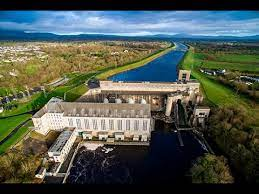
13 August 1925. President W.T. Cosgrave helped to raise the first pylon at the Ardnacrusha power station that would help spread electricity across the Land.

Ardnacrusha power plant is a hydroelectric power station which was originally referred to as The Shannon Scheme. It is located near Ardnacrusha within County Clare approximately 1.5 miles (2.4 km) from the Limerick border. It is Ireland's largest river hydroelectric scheme and is operated on a purpose built canal connected to the River Shannon.

The generating plant at Ardnacrusha is composed of three vertical-shaft Francis turbine generators (commissioned in 1929) and one vertical-shaft Kaplan turbine generator (commissioned in 1934) operating under an average head of 28.5 metres.

In 1924-25 the new Irish Free State's Minister for Industry and Commerce Patrick McGilligan commissioned the engineer Dr. Thomas McLoughlin to submit proposals. Dr McLoughlin had started working for Siemens-Schuckert, a large German engineering firm, in late 1922, and produced a scheme that would cost £5.2m. This caused considerable political controversy as the new state's entire budget in 1925 was £25m, but it was accepted. The Siemens report drew on earlier hydrological work of John Chaloner-Smith an engineer with the Commissioners of Public Works.

Developed in conjunction with German engineering giant Siemens, most of the skilled workers and engineers on the power station were Germans. A camp was set up for the workers that included living quarters for 750 men and a dining room that seated 600. Initially employment for 700 was provided, whilst at its peak there were 5,200 employed during the construction phase, with this dropping back to 2,500 near completion. The construction project was not without controversy, with national and governmental debate over wages, conditions, strikes, and spending over-runs.

The Shannon Scheme was officially opened at Parteen Weir on 22 July 1929. One of the largest engineering projects of its day, it was successfully executed by Siemens to harness the Shannon River. By 1935, it was producing 80 per cent of Ireland's electricity.

It subsequently served as a model for large-scale electrification projects worldwide. Operated by the Electricity Supply Board of Ireland, it had an immediate impact on the social, economic and industrial development of Ireland and continues to supply significant power into the 21st century.