Tuesday, 7 May 2024


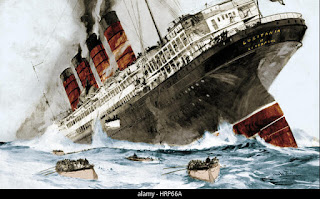
7 May 1915: The liner RMS Lusitania (New York to Liverpool) was torpedoed off the Old head of Kinsale by the German submarine U20 on this day. She sank within 18 minutes. (Two explosions rocked the ship. The first was clearly caused by a torpedo from U-20. The cause of the second explosion has never been definitively determined and remains the source of much controversy.) Of those on board, 761 were rescued, while 1,198 perished, including 115 US Citizens.

On the 7th September 1907 under the command of Captain James B. Watt, the RMS Lusitania sailed on her maiden voyage to New York. She carried over 3,000 passengers and crew. Her passengers were delighted with the new ship. The standards of accommodation and services were well documented. Most third class passengers enjoyed the voyage. Dining on her was like eating in the best restaurants or hotel anywhere.

In August 1914 World War One broke out. The day of anticipation finally arrived when the British Navy needed the ship for wartime service. The Lusitania had to be refitted for the purpose. Her four funnels were fully painted black to conceal her identity from enemy ships

On May 1, 1915, the ship departed New York City bound for Liverpool. Unknown to her passengers but probably no secret to the Germans, almost all her hidden cargo consisted of munitions and contraband destined for the British war effort. As the fastest ship afloat, the luxurious liner felt secure in the belief she could easily outdistance any submarine. Nonetheless, the menace of submarine attack reduced her passenger list to only half her capacity.

Following the loss of the Titanic, the Lusitania was fitted with 48 boats (22 wooden and 26 collapsible). Every boat was fitted with 2 chains to anchor them to the deck. This would prove disastrous when the ship began to sink because the chains would have to be released before the boats could be swung clear of the ship. When the Lusitania was sinking many of the chains were not released thus preventing the boats from being launched successfully. Many boats went down with the ship.

On Friday 7th May 1915 she had reached the War Zone. The usual precautions of blackening out the portholes and doubling the watch were obeyed.

The lookouts were tentatively at their posts. At about 1.30 p.m. Leslie Morton saw the torpedo heading towards the Starboard side travelling at about 22 knots. He gave the alarm stating "Torpedo coming in the Starboard side". The Bridge was slow in reacting to his warnings. Another lookout, Thomas Quinn also said that the torpedo and sounded the alarm. It was too late. The torpedo struck the ship and detonated before Turner could do anything. Power was suddenly lost. The watertight door could not be closed. Radio distress signals had to be sent using battery power.

At 2.10 p.m. after lunch the passengers were eagerly waiting for their desserts when they heard:

"the sound of an arrow entering the canvas and straw of a target magnified a thousand times" or and "a pearl of thunder" and "the slamming of a door".

A second explosion came within seconds. Suddenly the ship took a 15º list to Starboard, which began to sharpen to 16º then 17º etc until the list reached 25º - a point at which the ship could not survive. The list had become so severe that the Officers could not swing the lifeboats clear of the ship.

Panic had set in amongst the passengers. Some jumped into the water trying to flee for their lives. Captain Turner jumped into the water when the Bridge was flooding. He swam for three hours before finding a lifeboat to climb into.

Within 18 minutes the ship had rolled over and sunk with 1,195 passengers. Only 289 bodies were recovered. 764 people survived. 

The survivors were landed at Cobh (Queenstown) in Co Cork. It was here too that the bodies were brought ashore or washed up in the days after the sinking. The corpses, men, women and children, were placed in coffins and lined up along the Cunard Line’s dock. A huge funeral procession made its way through the streets of Cobh to the cemetery. Many of the dead were buried in mass graves, marked by two crudely hewn stones. Others victims, likely the more affluent, were buried in individual graves with headstones noting their death on the Lusitania.

The loss of the Lusitania was to reverberate on the World stage as the USA was shocked and stunned by the actions of the German Navy in sinking what was to all appearances a civilian Liner engaged in peaceful commerce. It pushed US public opinion firmly in the direction of the Allies and helped to bring the USA into the War against Germany in April 1917.


Monday, 6 May 2024


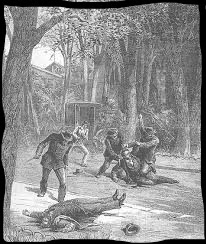
6 May 1882: The Assassination of Cavendish & Burke aka The ‘Phoenix Park Murders’ on this day. The Under Secretary for Ireland Thomas Henry Burke, and the newly arrived Chief Secretary Lord Frederick Cavendish, were both stabbed to death in the Phoenix Park by members of a secret organisation known as ‘The Invincibles’. Five of the assassins were later executed in Kilmainham Jail and a number of others were sentenced to long terms of imprisonment. This event rocked Anglo-Irish relations to the core and was the most shocking and audacious attack on members of the British Political Establishment in Ireland during the course of the 19th Century.

'The Phoenix Park tragedy, as it may well be called, occurred on the evening of Saturday, May 6, 1882. Its victims were Mr. Thomas H. Burke, the under-secretary, and Lord Frederick Cavendish, the new chief-secretary. Undersecretary Burke, on that evening, was walking from the Castle to his lodge or official residence in the Phoenix Park, when he accidentally met Lord Cavendish, who accompanied him in the direction he was going.

When near the Phoenix Monument, they were surrounded by five or six men, armed with knives, who attacked them instantly. Surprised and unarmed the secretaries made scarcely any resistance, and were stabbed and hurled to the ground where they expired in a few minutes.'

https://www.libraryireland.com/Atlas/XCII-Phoenix-Park-Murders.php#:~:text=The%20Phoenix%20Park%20tragedy%2C%20as,%2C%20the%20new%20chief%2Dsecretary.

Cavendish – who was married to Lucy Cavendish the niece of British Prime Minister William Ewart Gladstone, and had worked as Gladstone's personal secretary had only arrived in Ireland the day he was assassinated! He was not the main target but Burke. He had just met by chance with him as they walked towards the vice regal Lodge and was a man of whom it could be truly said he was in the wrong place at the wrong time.

The hunt for the perpetrators was led by Superintendent John Mallon, a Catholic who came from Armagh. He suspected a number of former Fenian activists. A large number of suspects were arrested and kept in prison by claiming they were connected with other crimes. By playing off one suspect against another Mallon got several of them to reveal what they knew.

The 'Invincibles' leader James Carey, along with Michael Kavanagh and Joe Hanlon agreed to testify against the others. Joe Brady, Michael Fagan, Thomas Caffrey, Dan Curley and Tim Kelly were convicted of the murder and were hanged by William Marwood in Kilmainham Gaol in Dublin between 14 May and 4 June 1883. Others were sentenced to serve long prison terms.


Sunday, 5 May 2024


5 May 1981: Bobby Sands MP for Fermanagh and south Tyrone died in captivity after 66 days on Hunger Strike. His death sparked widespread rioting.

He was born in 1954 in Rathcoole, a predominantly loyalist district of north Belfast. Initially uninvolved he was forced out of his job and in June 1972, the family were intimidated out of their home in Doonbeg Drive, Rathcoole and moved into the newly built Twinbrook estate on the fringe of nationalist West Belfast. He joined the IRA and became a full time volunteer. 

In October 1972, he was arrested. Four handguns were found in a house he was staying in and he was charged with possession. He spent the next three years in Long Kesh where he had political prisoner status. Released in 1976 Bobby returned to his family in Twinbrook. He became involved again in the Armed Struggle and was caught in a car with three other men in which was found a handgun. He was held on remand for eleven months until his trial in September 1977. As at his previous trial he refused to recognise the court. 

When he was moved to the H-Blocks he went ‘On the Blanket’ and became a spokesman for the prisoners. When the first Hunger Strike was broken in December 1980 and the terms the prisoners believed were promised to them never happened he became determined to lead the next one - even onto death. This was to  ensure the prisoners 5 Demands were secured. He was now O/C in the Blocks and felt compelled to show leadership to the other men in the same predicament as himself.

He began his fast on 1 March 1981. He kept a secret Diary that lasted the first 17 days but then became too weak to continue. On 30 March, he was nominated as candidate for the Fermanagh and South Tyrone by-election caused by the sudden death of Frank Maguire, an independent MP who supported the prisoners' cause. To the surprise of many he won the seat with over 30,000 votes and caused a watershed in Irish Politics. However his situation was precarious as Mrs Thatcher was not for turning and Bobby Sands knew he was probably going to die before she would give in.

The end came in the early hours of 5 May when he succumbed to the effects of his fast on the 66th day of his ordeal.

I am a political prisoner. I am a political prisoner because I am a casualty of a perennial war that is being fought between the oppressed Irish people and an alien, oppressive, unwanted regime that refuses to withdraw from our land.

Prison Diary Bobby Sands


Saturday, 4 May 2024


4 May 1916 -  Joseph Mary Plunkett, William Pearse, Edward Daly &  Michael O’Hanrahan, were executed by firing squad in Kilmainham Jail Dublin on this day. This was the second batch of prisoners to be shot and further increased public disquiet about the manner in which General Maxwell was handling the aftermath of the Easter Rising.

 Joseph Mary Plunkett was a seriously ill man by this stage and had only left hospital days before the Rising in order to take part in it. Plunkett was one of the original members of the IRB Military Committee that was responsible for planning the Rising and it was largely his plan that was followed. He spent the Rising in the GPO.He traveled to Germany to meet Roger Casement before returning home to implement the plan to initiate a Rising. He famously married his sweetheart Grace Gifford hours before his execution in his prison cell. He was one of the signatories of the Proclamation.

 William Pearse was Padraig Pearse’s younger brother and played only a minor part in the GPO during Easter Week. He was shot because of who he was rather than anything he did.

 Edward "Ned" Daly  was commandant of Dublin's 1st battalion in the Four Courts during the Rising. He was the youngest man to hold that rank and the youngest executed in the aftermath.

 Michael O’Hanrahan was second in command of the 2nd battalion under Commandant Thomas McDonagh (executed). He fought at Jacob's Biscuit Factory.


Friday, 3 May 2024


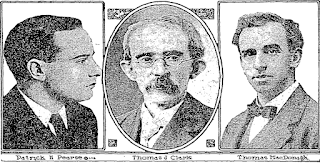
3 May 1916 – Padraig Pearse, Thomas Clarke and Thomas MacDonagh were executed at dawn  by firing squad on this day. They were shot in the stonebreakers yard [above] of Kilmainham Jail, Dublin on the orders of General Maxwell.

 Pearse, MacDonagh and Clarke were all shot minutes apart by a firing squad of British soldiers drawn from the Sherwood Foresters Regiment. They were commanded by a Major Rhodes. As far as we know all died bravely but while Pearse wished to die and Clarke reckoned execution was better than imprisonment again at the hands of the British it was a different story for McDonagh as he left a wife and young family behind him.

 MAY 3rd

 We paraded at the time appointed, marched to Kilmainham Jail. At 3.45 the first rebel MacDonoghue [Thomas MacDonagh] was marched in blindfolded, and the firing party placed 10 paces distant. Death was instantaneous. The second, P.H. Pierce [Pádraig Pearse] whistled as he came out of the cell (after taking a sad farewell of his wife.) [Pearse wasn’t married, and was visited only by a Capuchin priest, Fr Aloysius.] The same applied to him. The third, J.H. Clarke [Tom Clarke], an old man, was not quite so fortunate, requiring a bullet from the officer to complete the ghastly business (it was sad to think that these three brave men who met their death so bravely should be fighting for a cause which proved so useless and had been the means of so much bloodshed).

Diary of Company Sgt Maj. Samuel Henry Lomas Sherwood Foresters

 The 1916 Diaries, published by Mercier Press


After their deaths had been confirmed the bodies were quickly transported to Arbour Hill prison where their remains were buried in quicklime. They were the first of 16 men to be executed for their part in the Rising. But their deaths rather than suppressing dissent ignited it and lit the spark that turned them from ‘rebels’ into Heroes.


Thursday, 2 May 2024


2 May 1882: Charles Stewart Parnell , the Leader of the Irish Parliamentary Party was released from Kilmainham Jail in Dublin on this day. He was let go under the terms of what became known as the ‘Kilmainham Treaty’.

 Parnell had been incarcerated there on the personal orders of the British Prime Minister Gladstone back in October of the previous year. The Irish Leader had vehemently opposed Gladstone in his attempts to implement the 2nd Land Act that was meant to alleviate the rent many Irish people had to pay to rapacious Landlords. Parnell felt that it did not go far enough and roused the people to resist it. Agrarian unrest spread through much of the countryside and ‘Captain Moonlight’ ruled the hours of darkness - that is by night the laws of the British ceased to operate in many of the villages and fields of Ireland.

 Under the terms of the ‘The Kilmainham Treaty’ the British Prime Minister agreed that rent arrears due from some 130,000 tenants would be dropped and 150,000 leaseholders would be allowed the benefits of the 1881 Land Act. In return Parnell agreed to ‘co operate cordially for the future with the Liberal Party in forwarding Liberal principles and measures of general reform.’

 It was seen as a triumph for Parnell as it made him the undisputed Leader of Nationalist Ireland and by daubing the agreement a ‘Treaty’ * he gave people at home the impression that Ireland and Britain could negotiate as two recognisably separate political bodies - in other words as Nation to Nation.

 * Something that Gladstone denied ever took place.


Wednesday, 1 May 2024


1 May 1169: This is the date traditionally assigned to mark the beginning of the Anglo Norman Invasion of Ireland by military forces drawn from England & Wales. The genesis of the Expedition was the bid by  Diarmait Mac Murchada the deposed king of the province of Leinster to win back his kingdom. To do this he needed help from abroad as he knew he could not hope to succeed against the combined armies of - Rory O’Connor/Ruaidhrí Ó Conchobhair -the High King/Ard Rí  of Ireland.

King Diarmait left Ireland in late 1166 to seek help in England from King Henry II. However he was not just king of England but also Duke of Normandy and held extensive territories in France that he was constantly called upon to tour in order to maintain his patchwork Empire. When Diarmait finally caught up with him in France he won his backing on condition that he be Henry’s man - i.e. he recognised Henry as his Overlord. Presumably he would have secured a Charter to carry with him to produce in front of the men of England to show that he had Royal Assent for his raising of Mercenaries in that Country. His efforts met with success.

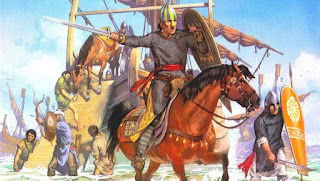
Thus it came about that in May of 1169 a force from England landed at Bannow Bay Wexford under the command of Robert Fitzstephen - whose own mother Nesta was a Lady of Wales. These forerunners of the English Forces of eight  and a half centuries consisted of approximately 30 knights, 60 other horsemen and some 300 archers & footmen. Maurice de Prendergast from Wales arrived the following day with another 10 knights and 60 archers. They weren't of course all ‘English’ as they were would have been many Welsh -esp. the archers - in their ranks and quite possibly some real ‘Normans’ too - but to the Gaels of Ireland they were ‘the English’.

 It was a good place to land as it was on King Diarmait’s home turf. It was also within striking distance of two of Ireland’s most important ports - the Norse held towns of Wexford and Waterford.  King Diarmait was already back in Ireland by this stage and after a period of operating incognito had shown his hand  and had raised a force to dispute with the High King his claim to re take his seat as king of Leinster. He even had a small force of mercenaries with him that he paid out of his own resources. He sent one of his own sons with a force of 500 men to rendezvous with these outside reinforcements and with the combined force Diarmait then advanced and layed siege to Wexford. After initially being repulsed, they forced the Wexfordmen to submit. By prior terms the town and the lands around it were granted to Fitzstephen and de Prendergast.

Then Robert the son of Stephen

Got himself ready the first;

He wished to cross over to Ireland

In order to aid King Dermot.

 Brave knights of great renown

He brought with him, nine or ten.

One was Meiler the son of Henry,

Who was very powerful;

And Miles came there also

The son of the bishop of St. Davids.

Knights came there and barons

Whose names for the most part I do not know.

There crossed over a baron

With seven companions,

Maurice de Prendergast was his name,

As the song tells us.

Hervey too, in truth, crossed over,

He was of Mount-Maurice.

About three hundred crossed over

Knights and common folk besides.

At Bannow they landed

With all their men.

When they had landed

And had all disembarked,

They made their men encamp

On the sea-shore.

The English folk sent word

To King Dermot by messenger

That at Bannow with three ships

They had at that time landed,

And that the king should speedily

Come there without delay.

Song of Dermot and the Earl

Thus Fortune, constant only in her instability, almost deserted not only MacMurchad, but Fitzstephen also. However on the following morning, after Mass had been celebrated throughout the Army, they proceeded to renew the assault with more circumspection and order, relying on their skill as well as their courage, and when they drew near to the walls the townsmen despairing of being able to defend them and reflecting that they were disloyally resisting their Prince sent envoys Dermitius [Diarmait] commissioned to treat of the terms of Peace. At length by the mediation of two bishops who chanced to be in town at the time, and other worthy and peaceable men peace was restored, the townsmen submitting to Dermitius and delivering four of their chief men as hostages for their fealty to him. And the more to animate the courage of his adherents and reward their chiefs for their first success he forthwith granted the town with the whole territory appertaining to it to Fitzstephen and Maurice according to the stipulations in their original Treaty. 

 Expugnatio Hibernica by Giraldus Cambrenus

So these arrivals did not want a payment in specie for their efforts but wished to be rewarded with lands and towns and cities of their own which must of course be at the expense of those who already held them - i.e. lands either granted to them by  Diarmait from those of his underlings or taken at the expense of their common enemies in the rest of Ireland. This was  the root of the idea of the Conquest in the eyes of the men who made it - to usurp the Irish kings and rule in their stead. From such small beginnings emanated many great and bloody events in the History of Ireland.

* Illustration by Angus McBride