Sunday, 9 June 2024


9 June 597 AD: The Death of Saint Columba (aka 'Colmcille' - Dove of the Church) on the island of Iona off the west coast of Scotland.

 Columba was the son of Fedlimid and Eithne of the Cenél Conaill. He was probably born in Gartan, near Lough Gartan, in what is now County Donegal. The earliest surviving evidence – that from his Vita/Life by Adomnán, written about a century after his death – tells us simply that:

‘the holy Columba was born of noble parents having as his father Fedelmid, Fergus’s son, and his mother, Eithne by name, whose father may be called in Latin "son of a ship''

 When sufficiently advanced in letters he entered the monastery of Moville under St. Finnian, then at Clonard, governed at that time by Finnian. Another preceptor of Columba was St. Mobhi, whose monastery was at Glasnevin near Dubhlinn [Dublin]. The pestilence that devastated Ireland in 544 AD caused the dispersion of Mobhi's disciples and Columba returned to the North. However his following years were marked by the foundation of several important monasteries at Kells in the north midlands and at Derry in the North. After political troubles at home for which he was found at fault Columba left Ireland and passed over to the island of Iona in 563 AD. Conall, king of Dál Riata gave him the island to use as his base and there he founded his famous Monastery.

 The people of Scottish Dál Riata shared a language, culture and political life with the Dál Riata of Ireland, and with Ireland as a whole. It is virtually certain that they also shared the Christian faith. Colum Cille came, therefore, to a Scottish Dál Riata which had already accepted Christianity. We can assume that he came to a landscape already dotted with churches, where priests and even an occasional bishop already ministered to their people.

 What Colum Cille brought to Scottish Dál Riata was not Christianity, therefore, but a monastic community of brothers who would live and work and pray together. It is in this light above all that Adomnán seeks to portray him: as the father of monks, founding, teaching and guiding a community. He also portrays him as a man of power – not the secular power of kings and warlords, which Colum Cille had abandoned in Ireland, but the power of the ascetic, the contemplative. He exercises the divine power that is given to those who have rejected wordly power.

Colmcille: Life in Scotland - St Columba Trail

 After spending some years among the Scots of Dál Riata, who were related to the Gaels of north east Ulster, Columba began the great work of his life, the conversion of the Northern Picts. After this the remaining years of Columba's life were mainly spent in preaching the Christian Faith to the inhabitants of the glens and wooded areas of northern Scotland. Of course 'Scotland' as such did not exist then as a separate country and indeed the word Scotland comes from the Roman word for the Gaels of Ireland - Scotii.

 Saint Columba was famous for his prophecies and on Iona he lived the life of an ascetic while also engaged in the business of the Church in Scotland. Adomnán portrays Colum Cille as actively engaged with the kings of Dál Riata in western Scotland– not only obtaining land from them and blessing particular candidates for kingship, but even inaugurating Áedán mac Gabráin as king in the monastery of Iona.

 He also kept in contact with Ireland too and he returned home on occasion even though he was formally exiled. Adomnán says he went back to Ireland when he founded the monastery of Dair Mag (Durrow) between 585 and 597. He also got involved in the politics of the North once again . He returned to Ireland for a conference of kings at which were present Áed mac Ainmirech, king of the northern Uí Néill and eventually king of Tara, and Áedán mac Gabráin, king of Dál Riata. Legend has it that having been told never to put his feet on the soil of Ireland again and agreeing to that he returned wearing shoes of sods of turf in order to keep his promise! Adomnán describes Colmcille as using two separate buildings during his daily life - a writing hut and a hut where he slept and ‘where at night instead of straw he had bare rock and stone for a pillow’.

 He is also credited with the initiation of a continuous record of Irish History as set down in the Annals- the Iona Chronicle - whose successor scribes recorded the History of Ireland on a year by year basis down to the 17th Century. His 'Life' - Vita Columbae was written by his distant successor the 9th Abbot of Iona, Saint Adomnán. Columba is said never to have spent an hour without study, prayer, or similar occupations. He is the greatest Saint to have come out of Ireland.


Friday, 7 June 2024


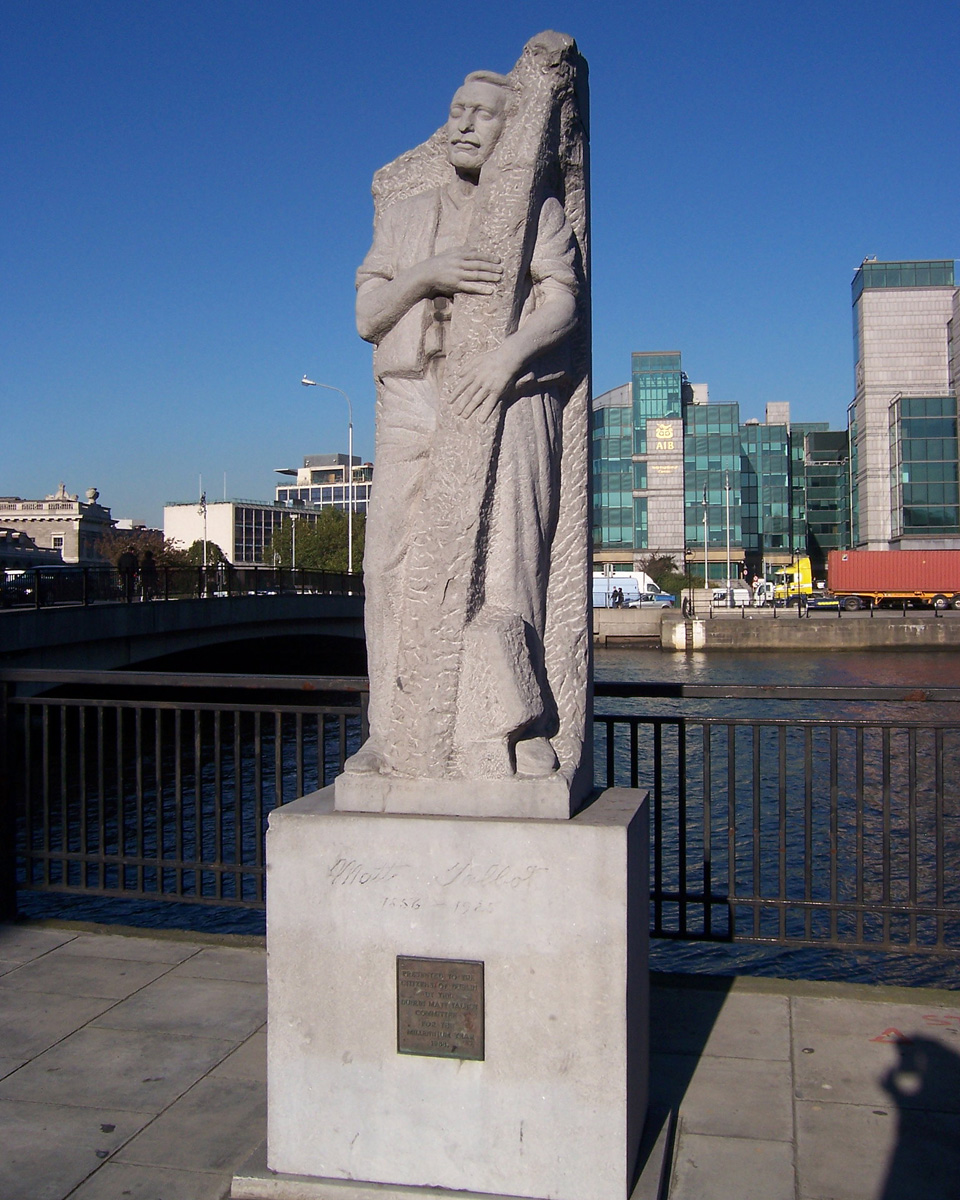
 7 June 1925: The death of Matt Talbot on this day. He was a reformed alcoholic who turned from a life consumed by Drink to one of physical hardship and mortification devoted to religious worship. Matt was born into a large family in Dublin City in 1856. When he was just 12 years old he started to drink and became addicted. He tried numerous times to give it up but met with only temporary success. When he was 28 years old he took the Pledge and kept it until his death 41 years later. A Priest advised him to follow the ways of the early Monks & Holy Men of Ireland in avoiding the Temptations of the Flesh. He henceforth lived a Life of rigorous Work and Prayer.

 He fasted constantly. His breakfast consisted of cocoa prepared the previous evening by his sister, which he often drank cold. With this he ate some dry bread. For his midday meal he had cocoa to which he would add a pinch of tea, and again drank cold. With this he took a slice of bread. His sister would bring him a small evening meal. If she brought fish he would insist that she take it home with her and would make do with bread soaked in the fish juice.

 On Sundays he remained in the church for every Mass. Only on returning to his room at about 2 p.m. would he break his fast for the first time since 6.30 p.m. the previous day. The remainder of the day was spent in prayer, reading the Scriptures and the lives of the saints. He gave all his money to neighbours in need and to the missions.

  Matt Talbot mortified himself rigorously. He slept on a plank bed with a piece of timber for a pillow. This left his face numb in later years. He slept in chains, which he wore for 14 years before his death, round his leg and on his body.

 Reality (July/August 1999), a Redemptorist Publication

  He collapsed and died on his way to Mass on Trinity Sunday, 7 June 1925 at Granby Row in Dublin’s Inner City. A plaque now marks the spot where he fell.

 On 6 November 1931, Archbishop Byrne of Dublin opened a sworn inquiry into the alleged claims to holiness of the former dock worker. The Apostolic Process, the official sworn inquiry at the Vatican, began in 1947.

 On 3 October 1975 Pope Paul VI declared him to be Venerable Matt Talbot, which is a step on the road to his canonisation, a process which needs evidence of a physical miracle in order to be successful. His story soon became known to the large Irish émigré communities. Countless addiction clinics, youth hostels, statues and more have been named after him throughout the world from Nebraska to Warsaw to Sydney. One of Dublin's main bridges is also named after him. Pope John Paul II, as a young man, wrote a paper on him.

 Talbot's remains were removed from Glasnevin Cemetery to Our Lady of Lourdes church on Seán McDermott Street, Dublin, in 1972. The tomb has a glass panel through which the coffin may be seen. On his coffin is inscribed the following words:

 'The Servant of God, Matthew Talbot.'

There is a small plaque in Granby Lane at the site of Matt Talbot's death.


Thursday, 6 June 2024


6 June 1333: The death by murder of William Burke 'the Brown Earl' of Ulster and the Lord of Connacht near Belfast while on his way to Carrickfergus.

The young Earl was only 21 years old. Far from being a callow youth he was already a very able and ruthless man. In November 1332, at Greencastle, near the mouth of Lough Foyle, he had his cousin Sir Walter Liath de Burgh starved to death. In revenge, Sir Walter's sister, Gylle de Burgh, wife of Sir Richard de Mandeville, planned his assassination.

 William had feared that his cousin Walter would be a threat to him after his defeat of the O'Connor's in 1330. Clearly a man of some ambition his foul murder of his own cousin was a bit too much even for that ruthless age.

 William Burke, Earl of Ulster, was killed by the English of Ulster. The Englishmen who committed this deed were put to death, in divers ways, by the people of the King of England; some were hanged, others killed, and others torn asunder, in revenge of his death.

Annals of the Four Masters

 With his death the whole Anglo-Norman rule in the North began to unravel as the DeBurgo 'clan' fought amongst themselves over the division of the dead Earl's vast holdings. With the collapse of their power the first phase of the Conquest that began in 1169 came to an end. From then on until the Reformation the Colony was to be basically on the defensive rather than on the attack against the Gaels of Ireland.

 No such blow had yet befallen the Anglo-Irish Colony. The whole De Burgo Lordship, which had reduced the proudest of the Irish to vassalage and had been the shield and rampart of the English interest in the north and the west, fell at one stroke. Released from a yoke which they alone could never have broken, the O'Neills and the O'Donnells were able to subject eastern and southern Ulster on the one hand, and DeBurgo's lordship of Sligo on the other. Within fifty years practically the whole province went back to the Irish order.

A History of Medieval Ireland

Edmund Curtis


Wednesday, 5 June 2024


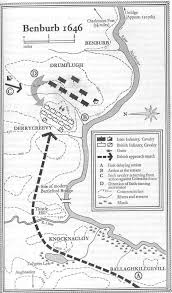
5 June 1646: The Battle of Benburb/ Cath Beann Borb was fought on this day. The Irish General Owen Roe O’Neill met and defeated a superior enemy British army at Benburb  County Tyrone. The battle was fought near the river Blackwater on the border between the counties Tyrone and Armagh. He had deliberately chosen a defensive position on which to meet a British Army under Major-General Robert Monroe. The British men had marched many miles in the days preceding the battle, fighting a series of tiring skirmishes against the Irish on the way. On the day of the battle itself his men had marched some 15 miles before they came up upon the Irish positions. O'Neill's men on the other hand were well rested and some were in concealed positions so the British did not know they were up against O'Neill's Main Force until the battle was joined.

 O'Neill and Monroe were both experienced commanders, O'Neill had fought in the Spanish Army in the Low Countries and had conducted a brilliant defense of the town of Arras in 1640 for weeks against overwhelming odds when besieged by  the French before been forced to surrender. Monroe was a veteran of the 30 Years War in Flanders and Germany.

 O'Neill was determined to bring his opponent to battle on his own terms by taking up a position that would convince the enemy to attack at a disadvantage. Described 'as a man of few words, cautious and phlegmatic in his operations' 'this great adept in concealing his feelings' as the Papal envoy Rinuccini called him. O'Neill kept his plan to himself but its possible he sent a 'deserter' across the lines to point Monroe in the right direction for the battle to be sprung. The British army had crossed the river Blackwater after advancing from Armagh was advancing from the south west upon the Irish with the river on their right flank. The battle took place just over three miles south-east of Charlemont Fort in what is now County Tyrone.

 The Scottish commander had over 6,000 men, made up of six Scottish and four English regiments of foot and around 600 horse. Monroe's infantry was two-thirds musketeers and one-third pikemen. Monroe also had six light cannon with him. O’Neill’s Army consisted of about 5,000 foot, half of whom were pikemen and half musketeers, and 500 horse, many of whom were lancers. He drew up his men with four brigades in the first line and three in the second. The Irish had no artillery available at all. Before the clash of arms, Father Boetius Mac Egan, Chaplain General of the Army, gave general absolution to the O'Neill's men.

 O'Neill delayed the advance of Monroe's Army with lines of skirmishers, falling back step by step. The battle proper then did not begin until late in the day. When the British, confident of victory, finally attacked the Irish lines they were beaten off. Once this attack had been checked O’Neill gave the order to advance with his famous exhortation to his men:

 Let your manhood be seen by the push of your pike

 - your word is 'Sancta Maria'

 - and so in the name of the Father, the Son and the Holy Ghost

Advance!

 - and give not fire till you are within pike-length.

 With that the Irish lines went forward to break the enemy's lines. By this stage the sun and wind were behind the Irish lines giving them a distinct tactical advantage. After about an hours' heavy fighting late in the evening the British lines began to buckle. Eventually most Monroe's troops broke and ran. Monroe was lucky to escape with his life and he lost probably half of his men in this rout, some 3,000 or so. Only Sir James Montgomery's Regiment got away in good order. Much of his baggage and all of his artillery was taken. Irish casualties were in the low hundreds and they were left masters of the field as the sun went down. It was the greatest Irish Victory of the War of the Confederation.

Tuesday, 4 June 2024


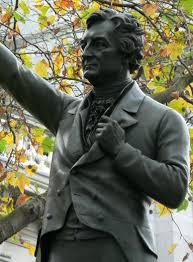
4 June 1820 - Henry Grattan, the moving force behind the Irish Parliament at College Green Dublin before it was dissolved by the Act of Union, died on this day in London.

Grattan was born at Fishamble Street, Dublin, in 1746, and baptised in the nearby church of St. John the Evangelist. A member of the Anglo-Irish elite of Protestant background, Grattan was the son of James Grattan MP, of Belcamp Park, County Dublin and Mary youngest daughter of Sir Thomas Marlay, Attorney-General of Ireland, Chief Baron of the Exchequer and finally Lord Chief Justice of the Court of King's Bench (Ireland). He thus came from a very privileged and aristocratic background.

Grattan was a distinguished student at Trinity College, Dublin where he began a lifelong study of classical literature, and was especially interested in the great orators of antiquity.

He entered the Parliament of Ireland in 1775, sponsored by Lord Charlemont. He quickly established a reputation as a brilliant speaker and one who was determined to press the Crown for Legislative Independence for Ireland. With Britain bogged down in the trying to suppress the American Revolutionaries he saw his chance to make his case. In this he was able to rely on the Anglo-Irish Volunteers who organised a Volunteer Army to 'Guard' the Country as more British troops were sent out of Ireland to fight in America. As a result of such agitation in 1782 the restrictions on Ireland having to submit legislation to the English Privy Council for prior approval or rejection was removed. It was to be Grattan's greatest Triumph.

For his efforts in securing Legislative Independence he was awarded £50,000 by the House of Commons in Dublin 'in testimony of the gratitude of this nation for his eminent and unequalled services to this kingdom'. The money allowed him to by a house in Tinnehinch, co. Wicklow, and an estate at Moyanna in Queen's county (County Laois) .

However the subsequent operation of 'Grattan's Parliament' was limited by its restrictive nature, its members being confined to those of the Established Church, and thus the exclusion of Catholics and Presbyterians from its benches. Crucially it had no independent Executive, all Ministers being in the gift of the Crown.

Grattan, in the aftermath of the outbreak of the French Revolutionary Wars in 1792, was able to achieve one more success by helping to bring in legislation that gave a limited franchise to Catholics in a 'Catholic Relief Act'. The expectation was that the logical conclusion to such a move was that Catholic Emancipation (the right of Catholics to sit in Parliament) must come about sooner rather than later.

In this Grattan and his supporters were to be disappointed, especially in 1795 in the quick recall of the new Lord Lieutenant Fitzwilliam. He had privately asked Grattan to propose a Bill for Catholic emancipation, promising the support of Pitt the British Prime Minister. But finally it appeared that the he had either misunderstood or exceeded his instructions; and on 19 February 1795 Fitzwilliam was recalled to London as the forces of Reaction had undermined him.

While Grattan kept a cool head in the aftermath of this setback his ability to influence the political scene was severely undermined as the forces of Revolution and Reaction took centre stage. He retired from politics in 1797 and though his name was implicated in the Rising of 1798 it would appear these accusations were unfounded.

With the prospect of a Union between Britain and Ireland looming in the aftermath of the crushing of the Rising he returned to Parliament to fight for its continued existence. When he was defeated in that effort he again stepped down but was returned for Dublin City in 1805 and took his seat in Westminster.

Here his oratorical skills were recognised and admired as one of the great parliamentarians of the age but as one amongst hundreds his influence was negligible and he was left in the Limelight. He continued to press for Catholic Emancipation but with conditions attached - re the appointment of Catholic Bishops being within the approval of the British Government. As the years wore on he made less and less appearances in the House of Commons and reluctantly accepted that the Union was now a political reality.

In 1820 he left Ireland for London to attend the House once again but fell ill while there. He died at Portman Square, Baker Street, London on the 4th of June. He had wanted to be buried back home but such was the respect he had in the British Parliament that it was decided to bury him amongst the great and the good in Westminster Abbey.

As the only Irish politician to have a phase of parliamentary history named after him -'Grattan's Parliament' - Henry Grattan is unique in Irish history.

There is a fine statue of him [above] situated in College Green Dublin facing his old Alma Mater of Trinity College


Monday, 3 June 2024


3 June 618 AD: The death of St Kevin/Naomh Caoimhghin at Glendaloch ( Gleann Da Locha - The Valley of the two Lakes) on this day.

Caoimhghin means of fair birth and it would seem that St Kevin was born into a dominant family whose People controlled what is now north Wicklow in the 6th century. He was baptized by Cronan, and educated by St Petroc during that saint's sojourn in Ireland. He lived in solitude at Disert-Coemgen for seven years, sleeping on a dolmen (now known as "Saint Kevin's Bed") perched on a perilous precipice, that an angel had led him to, and later established a church for his own community at Glendalough. This monastery was to become the parent of several others. Eventually, Glendalough, with its seven churches, became one of the chief pilgrimage destinations in Ireland.

St. Kevin is said to have first lived in Kilnamanagh (church of the monks) in what is modern-day Tallaght, Dublin 24, but moved on to Glendalough in order to avoid the company of his followers, a group of monks who founded a monastery on the site. Locals say that it was his monastery that was demolished by developers in the 1970s when building the housing estate that is there today. St. Kevin’s well is all that remains today as the plot was unsuitable for building. It is now surrounded by a garden kept by locals in the saint’s honour. St. Kevin is today the patron saint of the Kilnamanagh parish.

After Bishop Lugidus ordained Kevin a priest he left Killnamanagh and set out to find his own hermitage. On arrival in Glendalough Kevin chose the area of the upper lake and settled on the south side of the foot of that lake in St. Kevin's Bed, an artificial cave about thirty feet above the level of the lake which was originally a Bronze Age tomb. Kevin lived the life of a hermit there with an extraordinary closeness to nature, his companions were the animals and birds all around him. He lived as a hermit for seven years wearing only animal skins, sleeping on stones and eating very sparingly.

Disciples were soon attracted to Kevin and establishment of a further settlement enclosed by a wall, called Kevin's Cell and Reefert Church, situated nearer the lakeshore. All this building and expansion would have bothered Kevin who never really wanted to leave his hermit's life and seemed to have sought solitude and the life of a hermit whenever possible. By 540 Saint Kevin's fame as a teacher and holy man had spread far and wide. Many people came to seek his help and guidance.In time Glendalough grew into a renowned seminary of saints and scholars.

In 544 Kevin went to the Hill of Uisneach in Co.Westmeath to establish a league of brotherly friendship with other holy abbots. Until his death around 618 Kevin presided over his monastery in Glendalough, living his life by fasting, praying and teaching.

Image: http://www.imogenstuart.com

Saturday, 1 June 2024


1 June 1866: The start of the Fenian Invasion of Canada & the Battle of Ridgeway on this day.

 The invading force of more than 1,300 Irishmen 'The Fenians' was determined to attack the British Empire on its own soil to divert British military resources from Ireland and cause the Empire International embarrassment. They met no resistance when they crossed the Niagara River on June 1 but by the time they reached Ridgeway a Canadian force was deployed in front of them with orders to engage and defeat them.

 At Ridgeway the Canadians initially stood their ground by as the day wore on they broke ranks and became visibly disorganised. The Irish commander, Colonel O'Neill spotted their discomfort and quickly ordered a bayonet charge that completely routed the inexperienced Canadians. The Fenians took and briefly held the town of Ridgeway. Then, expecting to be overwhelmed by British reinforcements, they quickly turned back to Fort Erie where they fought a second battle - Battle of Fort Erie - against a small but determined detachment of Canadians holding the town.

 The Canadian loss was 7 killed on the field, 2 died of wounds in the immediate days following the battle, and 4 died of wounds or disease later and 37 were wounded, some severely enough to require amputation of their limbs. O'Neill said he had four or five men killed, but Canadians claimed to have found six Fenian bodies on the field. A U.S. gunboat prevented reinforcements of 10,000 waiting to cross and join the invasion and the invading force of Fenians retreated back to Buffalo. A funeral was held at St. James Cemetery in Toronto to commemorate the Canadians killed in the Battle of Ridgeway [above].

 Thus ended a bizarre and unsuccessful attempt by the US based Fenians (many of them Irish veterans of the US Civil War) to attack Britain through Canada. While tactically well conducted there was no chance of success once the US authorities blocked supplies and reinforcements reaching Colonel O'Neill's men on the Canadian side of the border. This episode was a fiasco and a waste of badly needed money and resources where they could have had no lasting effect. O'Neill withdrew on 3 June to United States territory where he and his men were arrested.