Wednesday, 22 August 2012


22 August 1922: Michael Collins was shot dead on this day. He was killed in an ambush at Béal na mBláth (Mouth of the Flowers) near Macroom in Co. Cork by a party of the local IRA. Huge controversy surrounds the unfolding of events on that day. It is not certain if the ambushers knew that Collins was in the Free State Army convoy that they attacked or whether they even recognised him.

 Late in the evening as the light started to fade the column was stopped by rifle fire in a narrow road that was overlooked by the IRA. Instead of putting the boot down and accelerating out of this death trap Michael Collins decided to fight it out. When the first shots were fired at the convoy, Emmet Dalton had ordered the driver to "drive like hell" out of the ambush. Collins himself countermanded the order and said "Stop! We'll fight them"

He stepped out of the armoured car he was being escorted in, the Slievenamon, and opened fire on the assailants. This proved his Nemeses as he became an instant target and was fatally hit. The general consensus at that time was it was a ricochet that took him out but that has been challenged in recent years.

The most recent authoritative account suggests that the shot was fired by Denis ("Sonny") O'Neill, an Anti-Treaty IRA fighter and a former British Army marksman who died in 1950.


Collins's men brought his body back to Cork where it was then shipped to Dublin because it was feared the body might be stolen in an ambush if it were transported by road. His body lay in state for three days in Dublin City Hall where tens of thousands of mourners filed past his coffin to pay their respects. His funeral mass took place at Dublin's Pro Cathedral where a number of foreign and Irish dignitaries were in attendance. He was buried in Glasnevin Cemetary Dublin.


Tuesday, 21 August 2012


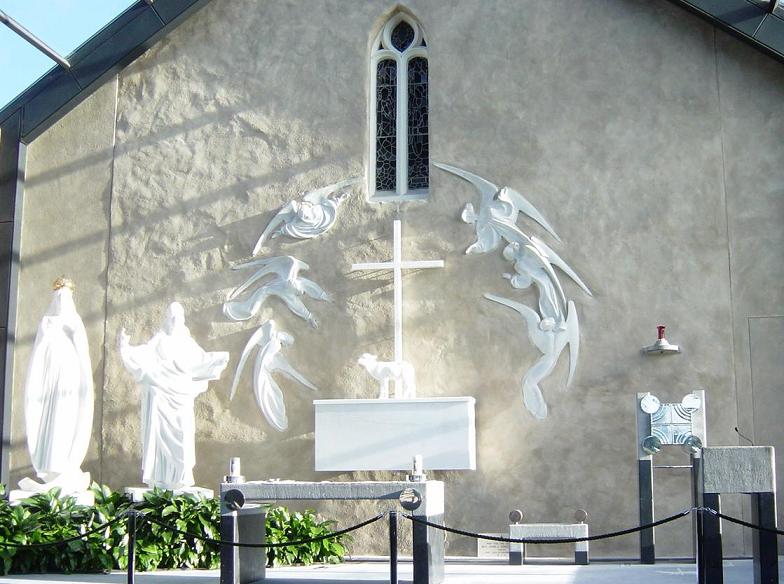
21 August 1879: The Apparition of Knock on this day. A number of witnesses of various ages reported that they had seen the Virgin Mary, St Joseph and St John the Evangelist appear on the wall of Knock Church. As a result Knock became a major centre of Pilgrimage.

On a wet Thursday evening, 21st August 1879, at about 8 o'clock, a heavenly vision appeared at the south gable of the Church of St. John the Baptist in Knock, Co. Mayo. Fifteen people - men, women and children - ranging in age from six years to seventy-five, watched the Apparition in pouring rain for two hours, reciting the rosary. Though they themselves were soaked, no rain fell in the direction of the church gable, where the ground remained perfectly dry.

Our Lady wore a large white cloak, fastened at the neck. Her hands and eyes were raised towards heaven, in a posture of prayer. On her head was a brilliant crown and where the crown fitted the brow, was a beautiful rose. On her right was St Joseph, head bowed and turned slightly towards her as if paying her his respects. He wore white robes. On our Lady's left was St John the Evangelist, dressed as a bishop, with a book in his left hand and right hand raised as if preaching. His robes were also white. Beside the figures and a little to the right in the centre of the gable was a large plain altar. On the altar stood a lamb, facing the West and behind the lamb a large cross stood upright. Angels hovered around the lamb for the duration of the Apparition

Most Rev. Dr. John MacHale, Archbishop of Tuam, only six weeks after the Apparition, set up a Commission of Enquiry. Fifteen witnesses were examined and the Commission reported that the testimony of all taken as a whole, were trustworthy and satisfactory.


There was a 2nd Commission of enquiry in 1936 when, Mary Byrne, one of the last surviving witnesses, was interviewed.

 The commissioners interviewed her in her bedroom, as she was too ill to leave. She gave her final testimony and concluded with the words:

'I am clear about everything I have said and I make this statement knowing I am going before my God' 

She died six weeks later.


Monday, 20 August 2012


19 August 1504: The battle of Knockdoe/Cnoc Tuagh (the Hill of Axes) was fought on this day. This battle was the greatest clash of arms seen in Ireland in hundreds of years. It took place around Knockdoe, a hillock about eight miles north east of Galway city. The combatants were the forces under Garret Fitzgerald, the Great Earl of Kildare and his rival Ulick Burke of Clanrickard.

Despite a somewhat uncertain relationship the Great Earl was King Henry VII’s man in Ireland. He was charged with ensuring that no other than himself should dictate the state of affairs in this Country. Something of a poacher turned gamekeeper the Great Earl would brook no rivals. Ulick Burke had thrown down the gauntlet however by seizing three castles belonging to the O’Kellys of south Galway and also taking under his control the Royal city of Galway. Ironically Ulick was also Garret’s son in law! While not a certainty he seems to have fallen out with his wife Eustacia and she had returned to under her fathers roof. The O’Kellys also appealed to him for the restitution of their fortresses.

He decided to lead an Army to the West and settle the issue through battle. He led a formidable force with him, perhaps as many as 6,000 warriors and many of them the iron clad Gallowglass who dominated the battlefields of Ireland in the latter Middle Ages. To oppose him Ulick gathered a similar type of force but he could not match the Great Earls resources or network of connections. He had maybe about 4,000 men in the field on the day of battle. The Great Earl mustered forces from Leinster and Ulster with some Connacht allies too. Burkes’ own force was comprised of his retinue from south Galway, and his allies from northwest Munster. To the Gaels it seemed that the great wars between the provincial kings of old in the days before the English arrived had returned. But to Garret it was more like a version of a suppression of a rebellion against Royal authority that the King of England might engage upon across the water. In truth there was a mixture of both these analogies in what happened.

In the event Garret Fitzgerald beat his opponent decisively and retook Galway from Ulick Burke. The battle though was bloody and hard fought – ‘a dour struggle’. Essentially an infantry battle both sides hacked and slashed at each other to bring the other down. It is also the first battle to record the use of a gun - a Palesman beat out his opponent’s brains with the butt of his piece! It was really a medieval battle of the old style and the last great one of its kind. Both sides clashed early in the morning and it was late in the day before the remnants of Burkes’ much depleted host broke and ran. The Geraldine force camped on the battlefield that night to collect booty and bring in the stragglers. The Great Earl proceeded the next day to enter the City of Galway in Triumph and received the keys of the metropolis from the grateful Mayor.

A fierce battle was fought between them, such as had not been known of in latter times. Far away from the combating troops were heard the violent onset of the martial chiefs, the vehement efforts of the champions, the charge of the royal heroes, the noise of the lords, the clamour of the troops when endangered, the shouts and exultations of the youths, the sound made by the falling of the brave men, and the triumphing of the nobles over the plebeians. The battle was at length gained against Mac William, O'Brien, and the chiefs of Leath-Mhogha; and a great slaughter was made of them; and among the slain was Murrough Mac-I-Brien-Ara, together with many others of the nobles. And of the nine battalions which were in solid battle array, there survived only one broken battalion. A countless number of the Lord Justice's forces were also slain, though they routed the others before them. It would be impossible to enumerate or specify all the slain, both horse and foot, in that battle, for the plain on which they were was impassable, from the vast and prodigious numbers of mangled bodies stretched in gory litters; of broken spears, cloven shields, shattered battle-swords, mangled and disfigured bodies stretched dead, and beardless youths lying hideous, after expiring.

Annals of the Four Masters


18 August 670: St. Fiacre the Abbot, who was born in Ireland about the end of the sixth century, died on this day. He retired to a hermitage on the banks of the Nore at Kilfera, County Kilkenny. Disciples flocked to him, but, desirous of greater solitude, he left his native land and arrived, in 628 AD, at Meaux in what is now France. St. Faro was the Bishop there and generously received him. He gave him a solitary dwelling in a forest, which was his own patrimony, called Breuil, in the province of Brie. Here he founded a Monastery and a Hospice. He resided in a little cell and led a frugal existence surrounded by a small garden, which he worked himself. He was very strict on the rule that no women should be about the place. He was noted for his great ability to cure the sick and many flocked to him to be cured.

After his death his Shrine became a place of Pilgrimage and in later centuries he had some very famous devotees. Anne of Austria attributed to the meditation of this saint, the recovery of Louis XIII at Lyons, where he had been dangerously ill; in thanksgiving for which she made, on foot, a pilgrimage to the shrine in 1641. She also sent to his shrine, a token in acknowledgement of his intervention in the birth of her son, Louis XIV. He is also a patron saint of gardeners and of the cab-drivers of Paris. French cabs are called fiacres because the first establishment to let coaches for hire, in the middle of the seventeenth century, was in the Rue Saint-Martin, near the hotel Saint-Fiacre in that City.

Thursday, 16 August 2012


16 August 1927: The Alderman Jinks Affair. Mr Denis Johnstone, the leader of the Labour Party, proposed a motion of No Confidence in the Government of Mr W.T. Cosgrave. Johnstone opened the crucial debate with the following words:

The motion down in my name and which I move is:

“That the Executive Council has ceased to retain the support of the majority in Dáil Eireann.”
In effect, it is clear that that motion is intended to test the views of the House as to whether the present Executive Council shall continue in office. It is based on Article 53 of the Constitution, which says: “The President and Ministers nominated by him shall retire from office when they cease to retain the support of the majority in Dáil Eireann.”

The result was a tie of 71 votes each. As a result the vote of the Speaker Mr Michael Hayes decided the issue for the Government. The absence of Mr Jinks of the National League Party (who were in alliance with Fianna Fail) was crucial to Cosgrave’s survival.


It is widely believed that Jinks non-appearance was due to the intervention of Major Bryan Cooper [above] and J.M. Smyllie (editor of the Irish Times) who plied Jinks with liberal quantities of drink in the hours before the vote was taken. Their hospitality apparently rendered their hapless guest in no fit state to attend the House. The pair convinced their drinking companion that a ticket home was a better course of action than attendance upon the House when he was obviously the worse for wear. They then put him on the Sligo train and thus unable to partake in the day’s parliamentary proceedings. This development thus saved Mr Cosgrave’s Government from almost certain defeat.


Wednesday, 15 August 2012


15 August 1569: The sack of Enniscorthy on this day by Sir Edmund Butler, the brother of the Earl of Ormond. The Co Wexford town held a great Fair on this date, named ‘Lady Day’ after Our Lady the Mother of Christ. This was in the tradition of the great Medieval Fairs where people would come from miles around to trade and buy the wares on offer. Many valuable commodities would be on display and those with the coinage to buy or goods to barter would be there in plenty.

But the Fair this year was held against a backdrop of a vicious War full of atrocities and counter atrocities committed by both sides. As the townsmen and country folk went about their business a large Geraldine raiding party overcame them. This was no doubt a well planned operation, designed to loot and punish the inhabitants in order to undermine the ability of the English Crown to protect them.

The Earl of Ormond, i.e. Thomas…, being at this time in England, his two brothers, Edmond of Caladh and Edward, had confederated with James, the son of Maurice. These two sons of the Earl went to the fair of Inis-corr on Great Lady-Day; and it would be difficult to enumerate or describe all the steeds, horses, gold, silver, and foreign wares, they seized upon at that fair. The Earl returned to Ireland the same year, and his brothers were reconciled to the State.

Annals of the Four Masters

No quarter was given to the hapless inhabitants. Many of the Anglo-Irish Merchants were put to death and their bodies thrown in the River Slaney and their womenfolk raped. It was reported that ‘divers young maidens and wives’ were defiled before their parents and husbands faces’.  The Castle of Enniscorthy was also taken and ransacked and lay abandoned for thirteen years thereafter. 

Tuesday, 14 August 2012


14/15 August 1969: The British Army was deployed on the streets of Derry and Belfast to stave off the collapse of the Northern State. This was to try and stem the serious rioting in both cities and in other urban centres across the North and to stop the collapse of the State that could come about if the situation continued to spiral out of control. In response to the growing Crises the Taoiseach Jack Lynch had gone on the airwaves the previous day to announce the setting up of Field Hospitals near the Border and Refugee Camps further south to deal with the expected influx of people fleeing their homes. This gesture however seriously angered and worried moderate Unionists and inflamed the more hard line and paranoid Loyalists - while doing nothing of real material benefit to help the beleaguered Nationalists at that time.

The situation calmed down in Derry as the RUC were withdrawn from the Bogside & the British Army took up positions there. However the situation in Belfast slid out of control.  There was also serious rioting in Armagh, Newry & Omagh and other areas throughout the North. In Armagh a man was shot dead by the RUC. Five people were killed in overnight rioting in Belfast, one of them a nine year old boy. As the sectarian clashes worsened houses and business premises were set alight and hundreds were damaged or destroyed. It soon became clear that the discipline of a considerable number of the regular RUC and more particularly the B-Specials had collapsed. Numerous individuals from these organisations went on the rampage and became indistinguishable from the Loyalist mobs on the loose that night.

While the situation in the Six Counties had became much more dangerous over the Summer the multiple deaths in open sectarian clashes was a huge shock to the people of Ireland. For the first time in decades people had been killed in almost open warfare between the Orange and the Green. It was a watershed in Modern Irish Politics.