Saturday, 15 June 2013


15 June 1919: The British aviators John Alcock and Arthur Whitten Brown made the first non-stop flight across the Atlantic on this day. They flew a modified Vickers Vimy bomber plane from St. John’s Newfoundland and to Clifden, Co Galway thus winning theDaily Mail prize of £10,000. They were feted as heroes and were Knighted a few days later by King George V.

The flight nearly ended in disaster several times owing to engine trouble, fog, snow and ice. It was only saved by Brown's continual climbing out on the wings to remove ice from the engine air intakes and by Alcock's excellent piloting despite extremely poor visibility at times and even snow filling the open cockpit. The aircraft was badly damaged upon arrival due to the attempt to land in what appeared from the air to be a suitable green field but which turned out to be the bog on Derrygimlagh Moor, but neither of the airmen was hurt.

Legend has it that the birds of Ireland did not sing for a week afterwards!

Both men had served as Aviators in the Great War and both had been shot down and captured. Alcock was tragically killed some months later in December 1919 while flying to the Paris Air Show. Brown lived on until 1948.

Friday, 14 June 2013


14 June 1884: Count John McCormack was born on this day. He is considered the greatest Tenor that Ireland has ever produced. He was the fourth of eleven children born to Hannah and Andrew McCormack, and one of the five to survive childhood. Though his own parents hailed from Scotland his paternal Grandfather was originally from County Sligo. He was educated locally by the Marists in Athlone where his singing abilities were first recognised.

 I was nine and a slip of a lad and shy. It was in the Marist brothers' school on a feast day, when Dr. Woodlock, Bishop of Clonmacnoise, was the guest of honor. I'll not forget the sensation at hearing the words, which Brother Hugh whispered in my ear. ‘We want you to sing, John, for Bishop Woodlock’. With that the good man lifted me upon a table, and left me looking at the gathering…


I think they must have liked it. They seemed to. I had no extensive repertoire, but what I knew I knew. And the singing spirit must have been there. Like the man born to be hanged, I possibly was intended to sing

Afterwards he won a Scholarship to study at the Diocesan College in Summerhill County Sligo. He completed his studies there in 1902. After considering trying his hand at various lines of work he was offered a position with the Palestrina Choir in Dublin’s Pro Cathedral. Vincent O’Brien, the choir master & organist there, saw the great potential in him and recommended for the position of Tenor with the Choir.

He was organist of the Marlborough Street Cathedral, in Dublin; a splendid musician, a fine man, and a staunch friend. He had vision and appeared, intuitively, to feel that all I needed was study and opportunity to achieve a goal worthy of serious aspiration.

It was the beginning of a hugely successful career that saw him perform around the World to International acclaim. He is best remembered at home though for his magnificent performance of César Franck's Panis Angelicus to the hundreds of thousands who thronged Dublin's Phoenix Park for the 1932 Eucharistic Congress. Pope Pius XI made him a Count of the Church in 1928. He died in Dublin in 1945 and is buried in Deans Grange Cemetery.

Thursday, 13 June 2013


13 June 1798: The Battle of Ballynahinch on this day. This battle occurred in County Down between the insurgents of the United Irishman under General Henry Munro, (who was actually a linen merchant from Lisburn) and the forces of British Crown under General Nugent. The town had been seized some days previously by local insurgents but on the day before the battle a well-armed force of some 2,000 military under Nugent entered it and set about upending the place. That evening there was a great deal of skirmishing and much of Ballynahinch was ransacked as the soldiers and Yeomanry engaged in drinking and revelry. The insurgents had established themselves on the hills to the south and east of the town and had in all about 5,000 men under arms. However most were armed only with pikes and any attempt to meet the Crown Forces in open battle was bound to be a massacre. The superior firepower along with the discipline and cohesion of the soldiers was bound to tell against the insurgents if the British Army was to march out the next morning in line of battle.

Munro’s officers urged him to launch a night attack upon the town and catch the enemy off guard, as they were audibly not in a coherent state that night anyway to resist a determined assault. But he hesitated to do so as he did not have confidence in his men that they could carry off with any degree of certainty such a risky manoeuvre as a night attack. So the the hours of darkness slipped away and with it a substantial number of the men who had gathered under the flag of the United Irishmen. Many of them in turn lacked confidence in Munro’s judgement and his obvious lack of experience. They felt that defeat was all but inevitable if the Crown Forces gained the initiative. It was readily apparent that when Nugent marched out his men out the next day that the odds would be stacked against them. Even though the United Irishmen had the numbers the Crown Forces cohesion and discipline and would be able to use their Combined Arms tactics of Infantry, Cavalry and Artillery to devastating effect upon them.


An eyewitness reported:

A mixed and motley multitude met the eye. They wore no uniforms, yet they presented a tolerably decent appearance, being dressed no doubt in their Sunday clothes, some better and some worse. The only thing in which they all concurred was the wearing of the green, almost every individual having a knot of ribbon of that colour, sometimes intermixed with yellow in his hat.


In their arms there was as great a diversity as in their dress. By far the majority of them had pikes, which were truly formidable instruments in close fight, but of no use in distant warfare ... others wore swords, generally of the least efficient kind, and some had merely pitchforks.
James Thompson


At daylight Munro finally decided to attack and launched his men against the enemy inside the town. Bloody hand to hand fighting ensued and the fortunes of war ebbed and flowed amongst the burning buildings of the town. At one stage it looked like Victory lay within the grasp of the United Irishmen as the Crown Forces fell back. But they eventually rallied and counterattacked and broke the back of the pikemens brave charges upon their positions.

In the meantime Nugent had directed other columns to come round in the rear of the hillside camps of his opponents and turn their positions. A detachment from the garrison in Downpatrick had arrived under Colonel Stapelton and circled the town to attack Montalto, a commanding eminence skirted by a thick wood. This was where Munro had established his HQ some days prior to the battle.


These developments unnerved his men and caught between the obvious superiority now being gained by the military within the town and the imminent closing off of any viable avenue of escape. This led to the collapse of their morale and a precipitate retreat away from Ballynahinch by the survivors of the battle. Munro attempted to rally his men on Ednavady Hill outside the town but all he could muster by that stage was a motley force of about 150 combatants. With the Crown Forces closing in for the kill they decided to make a break for it and scatter, every man for himself. Munro sought refuge nearby and evaded capture for a few days. But he was taken through betrayal, brought back to Lisburn and tried and executed within a very short period of time. He was hanged almost within view of his own front door and his head was placed upon display in the Market Square. The town of Ballynahinch itself lay in ruins with almost half the houses within it burned out or destroyed in the fighting, with looting and pillaging that took place over the course of the battle and its aftermath.

This battle to all intents and purposes ended organised resistance in County Down. In the following days and weeks the military spread out across the Countryside, inflicting many atrocities upon those they suspected of being active participants or silent supporters of the Rising.


Wednesday, 12 June 2013


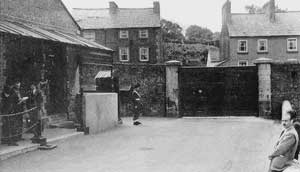
12 June 1954: The IRA Raid on Gough Barracks in Armagh

In an audacious raid the Irish Republican Army seized control of a British Army barracks in Armagh and took 19 British soldiers captive while a party looted the Arsenal of its weaponry. This was the biggest raid carried out on the British Army since the War of Independence in 1921.

The barracks had been well staked out in advance with one of the IRA men joining the British Army some months before in order to be placed on duty there. With the information he garnered IRA GHQ were able to build up a comprehensive picture of the mode of operations of life at the base.

The operation was launched on 12 June 1954, from a farm just outside Dundalk. A large red cattle truck had been commandeered at the last moment and 19 IRA men, about half of the Dublin Brigade, climbed in and were informed as to what their target was. It was almost 3 o'clock on a busy Saturday afternoon when the cattle truck and a car drove into Armagh.

After overpowering the single unarmed guard on the gate the raiders then quickly fanned out and located the Arsenal. They had with them a huge bunch of keys (200!)* but finding the right key to the door proved something of a problem. Eventually the right key was found and in the men went to catch the astounded soldiers within completely off guard.

In less than 20 minutes the place was cleared out. The lorry carrying 340 rifles, 50 sten guns, 12 bren guns, and a number of small arms drove out of the barrack gates and back across the Border. The rearguard in a car followed after locking every gate and door for which they could find keys. At 3.25pm the first alarm in the barracks was given but it was not until 5 o'clock that the general alarm was given and by that time the big red truck was long gone....

This operation was a huge morale boost for the IRA after years in the doldrums and considerably raised their profile both at home and abroad. Conversely it was a huge embarrassment for the British Government and especially the British Army who had failed to secure a place of military operations under their charge from capture by enemy forces.

* the keys were later auctioned in America to raise funds for the IRA.

Tuesday, 11 June 2013


11 June 1534: The Revolt of Silken Thomas on this day. Lord Thomas Fitzgerald or ‘Silken Thomas’ as he was more popularly known, was a young man of just 21 years of age when he rode through the streets of Dublin with a large band of followers, and entered the Chapter House of St. Mary's Abbey where the King's Council were awaiting him.

Whereupon with his brilliant retinue of seven score horsemen he rode through the streets to St. Mary's Abbey; and entering the chamber where the council sat, he openly renounced his allegiance, and proceeded to deliver up the sword and robes of state.
From A Concise History of Ireland by P. W. Joyce


His father was none other than Garret Óg, the Earl of Kildare, the most powerful man in Ireland. In his father’s absence in England to answer charges against his name Lord Thomas had been appointed the King’s Deputy in his place. But false rumours that Henry VIII had executed Garret Óg reached his ears. He concluded, without waiting to check the veracity of this information, that his father was indeed dead. He felt that no time could be lost in staking out his claim to lead the Catholics of Ireland in opposing Henry and his now openly Protestant Court. He that day renounced his stewardship of being the King’s Deputy in Ireland and declared himself no longer bound to King Henry VIII by word or deed.


Henry VIII treated his defiance of Royal Power as an act of open revolt and confined Garret Óg to the Tower of London, where Garret died two months later. After a bloody Revolt that lasted into 1535 Silken Thomas gave himself up when his forces were defeated and conveyed to London for Trial. He too was placed in the Tower and held in wretched conditions. He wrote home from that place of cold captivity a letter full of pathos:

I never had any money since I came into prison, but a noble, nor I have had neither hosen, doublet, nor shoes, nor shirt but one; nor any other garment but a single frieze gown, for a velvet furred with budge [i.e. instead of a velvet furred with lambskin fur], and so I have gone wolward [shirtless] and barefoot and barelegged divers times (when it hath not been very warm); and so I should have done still, but that poor prisoners of their gentleness hath sometimes given me old hosen and shoes and shirts.
P. W. Joyce

The unfortunate Silken Thomas, born into a life of wealth and privilege, eventually was sent to the gallows. He was hanged  at Tyburn,* London alongside five of his captured uncle: James,Oliver, Richard, John and Walter on 3 February 1537. His epic Revolt marked the start of the of a series of Wars by the Irish against the growing power of a centralised Monarchy committed to enforcing English Royal Rule and the Protestant Religion in this Country.

* near Marble Arch

Monday, 10 June 2013


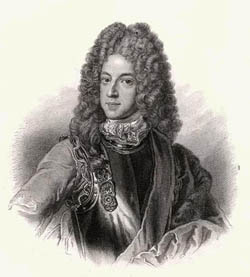
10 June 1688: James Francis Edward Stuart, aka ‘King James III of England and VII of Scotland’ was born on this day. He was born at St James Palace, London. He was the only legitimate son of James II by his wife Mary of Modena.

From his birth James bore the titles of "Prince of England, Scotland, France, and Ireland, Duke of Cornwall and Rothesay, Earl of Carrick, Lord of the Isles, and Great Steward of Scotland". At his birth he was also named "Prince of Wales and Earl of Chester", although he seems not to have been formally so created. He was baptised according to the rites of the Catholic Church in the Chapel Royal, St. James' Palace, October 15, 1688; his godparents were the Queen Dowager (Catherine of Braganza, widow of King Charles II) and Pope Innocent XI (for whom the papal nuncio Ferdinando d'Adda stood as proxy).

His birth triggered a Constitutional Crises in these islands as he was baptised a Catholic and stood to inherit his fathers’ Realms in due course. Later that year occurred the ‘Glorious Revolution’ and the deposition and flight of James II to France. It was rumoured that the actual infant died at birth and a substitute was surreptitiously brought into the birth chamber inside a Warming Pan. While this is almost certainly a piece of propaganda spread by the enemies of his father, such rumours undermined his status in England in particular when he reached maturity. His birth thus triggered a series of actions that led to the ‘War of the Two Kings’ that was fought upon the soil of Ireland between 1689 and 1691.

On the death of James II in 1701 he proclaimed himself King James III. He was recognised by the followers of the Stuart Cause as the legitimate successor to his father’s Kingdoms. He was also acknowledged as such by a number of Continental Powers incl France & Spain. He also had many secret adherents within England, Scotland and Ireland. As a young man he saw action in the War of the Spanish Succession and twice attempted to establish himself upon the Throne. In 1708 he was thwarted in a landing upon the coast of Scotland. His best chance came upon the death of Queen Anne in 1714 when the Crown was vacant and before George of Hanover (a Protestant) could arrive to take it. But delay proved fatal and James’s Scottish supporters only raised the banner of revolt in late 1715. Their attempt, though initially well backed proved a Fiasco. By the time James landed in December support was ebbing away and after a few weeks he was forced to depart for the Continent. He never saw the island of his birth again. 

Eventually he settled in Rome under the protection of the Papacy where he took up residence at the Palazzo Muti and held a Jacobite Court there with funds provided by the Vatican, the Spanish Monarchy and his supporters. He thereafter lived a long but frustrating life. He married Princess Maria Klementyna Sobieska of Poland in 1719 and had two sons by her. She however died in 1733 and he never remarried. He lived long enough to see his son ‘Bonnie Prince Charlie’ fail in his attempt to overthrow the Hanoverian Dynasty in 1745/46. He was known in his years of Exile as the ‘Old Pretender’ to his enemies or ‘The King over the Water’ to his friends and admirers in these islands. He died in Rome on 1 January [O.S.] 1766 and is buried in St Peters. 

In following such a record of broken hopes and unrelieved failure, the initial sense of disappointment 
yields gradually to a more temperate compassion. There is an indefinable pathos in the spectacle of this tragedy- king, parading his solemn travesty of sovereignty before an unromantic and imperturbable audience. When it is remembered that he lived to see no less than five sovereigns on the English throne, all of whom he had been taught to regard as usurpers, it may help towards understanding how deeply the iron must have entered into his soul. 

Macaulay

Sunday, 9 June 2013


9 June 597 AD: The Death of Saint Columba (aka 'Colmcille' - Dove of the Church) on the island of Iona off the west coast of Scotland.

Columba was the son of Fedlimid and Eithne of the Cenél Conaill. He was probably born in Gartan, near Lough Gartan, in what is now County Donegal.

The earliest surviving evidence – that from his Vita/Life by Adomnán, written about a century after his death – tells us simply that:

‘the holy Columba was born of noble parents having as his father Fedelmid, Fergus’s son, and his mother, Eithne by name, whose father may be called in Latin "son of a ship''

When sufficiently advanced in letters he entered the monastery of Moville under St. Finnian, then at Clonard, governed at that time by Finnian. Another preceptor of Columba was St. Mobhi, whose monastery was at Glasnevin near Dubhlinn[Dublin]. The pestilence that devastated Ireland in 544 AD caused the dispersion of Mobhi's disciples and Columba returned to the North. However his following years were marked by the foundation of several important monasteries at Kells in the north midlands and at Derry in the North.


After political troubles at home for which he was found at fault Columba left Ireland and passed over to the island of Iona in 563 AD. Conall, king of Dál Riata gave him the island to use as his base and there he founded his famous Monastry.

The people of Scottish Dál Riata shared a language, culture and political life with the Dál Riata of Ireland, and with Ireland as a whole. It is virtually certain that they also shared the Christian faith. Colum Cille came, therefore, to a Scottish Dál Riata which had already accepted Christianity. We can assume that he came to a landscape already dotted with churches, where priests and even an occasional bishop already ministered to their people.


What Colum Cille brought to Scottish Dál Riata was not Christianity, therefore, but a monastic community of brothers who would live and work and pray together. It is in this light above all that Adomnán seeks to portray him: as the father of monks, founding, teaching and guiding a community. He also portrays him as a man of power – not the secular power of kings and warlords, which Colum Cille had abandoned in Ireland, but the power of the ascetic, the contemplative. He exercises the divine power that is given to those who have rejected wordly power.
http://www.colmcille.org/colmcille/life-in-scotland


After spending some years among the Scots of Dál Riata, who were related to the Gaels of north east Ulster, Columba began the great work of his life, the conversion of the Northern Picts.  After this the remaining years of Columba's life were mainly spent in preaching the Christian Faith to the inhabitants of the glens and wooded areas of northern Scotland. Of course 'Scotland' as such did not exist then as a separate country and indeed the word Scotland comes from the Roman word for the Gaels of Ireland -Scotii.

Saint Columba was famous for his prophecies and on Iona he lived the life of an ascetic while also engaged in the business of the Church in Scotland.

Adomnán portrays Colum Cille as actively engaged with the kings of Dál Riata in western Scotland– not only obtaining land from them and blessing particular candidates for kingship, but even inaugurating Áedán mac Gabráin as king in the monastery of Iona.

 He also kept in contact with Ireland too and he returned home on occasion even though he was formally exiled.


Adomnán says he went back to Ireland when he founded the monastery of Dair Mag (Durrow) between 585 and 597. He also got involved in the politics of the North once again . He returned to Ireland for a conference of kings at which were present Áed mac Ainmirech, king of the northern Uí Néill and eventually king of Tara, and Áedán mac Gabráin, king of Dál Riata. Legend has it that having been told never to put his feet on the soil of Ireland again and agreeing to that  he returned wearing shoes of sods of turf in order to keep his promise!

Adomnán describes Colmcille as using two separate buildings during his daily life - a writing hut and a hut where he slept and‘where at night instead of straw he had bare rock and stone for a pillow’.

He is also credited with the initiation of a continuous record of Irish History as set down in the Annals - the Iona Chronicle - whose successor scribes recorded the History of Ireland on a year by year basis down to the 17th Century.

His 'Life' - Vita Columbae was written by his distant successor the 9th Abbot of Iona, Saint Adomnán.

Columba is said never to have spent an hour without study, prayer, or similar occupations. He is the greatest Saint to have come out of Ireland.