Tuesday, 28 January 2014


28 January 1939: The death of William Butler Yeats on this day. He died at Roquebrune-Cap-Martin, in the south of France. He was Ireland’s most distinguished poet and playwright of the 20th Century. Yeats’ works drew heavily on Irish mythology and history. He never fully embraced his Protestant past or the Catholic Religion but he devoted much of his life to study in numerous subjects including theosophy, mysticism, spiritualism, and the Kabala.

He was born on 13 June 1865 in Sandymount in County Dublin, Ireland. His father was John Butler Yeats, a well known portrait painter and his mother was Susan Mary Pollexfen who was the daughter of a wealthy family from County Sligo. In 1884 W. B. Yeats enrolled in the Metropolitan School of Art in Dublin during which some of his first poems were printed in the Dublin University Review. He afterwards moved to London where his father was based though he was often homesick for Ireland. Though he visited Sligo almost every summer. He spent time in the British Museum of Natural History doing research for such collaborations as Fairy and Folk Tales of the Irish Peasantry (1888), Irish Fairy Tales (1892), and A Book of Irish Verse (1895).

In 1894 Yeats met Lady Augusta Gregory of Coole Park and he became involved with The Irish Literary Theatre, which became the Abbey Theatre. One of the first plays to be performed there was Yeats’ Cathleen ni Houlihan, with Maud Gonne in the title role. The Abbey Theatre opened in December of 1904 and became the flagship for leading Irish playwrights and actors. Yeats’ On Baile’s Strand was one of its first productions. Of his many dramatic and successful works to follow, The Countess Cathleen (1892), The Land of Heart’s Desire (1894) and The King’s Threshold (1904) are among his best known.

As a successful poet and playwright, in 1903 Yeats went on a lecture tour of the United States, and again in 1914, 1920, and 1932. Yeats and his sisters started the Cuala Press in 1904, which would print over seventy titles. At the age of forty-six, in 1911, Yeats met Georgie (George) Hyde Lees (1892-1968) and they married on 20 October 1917. They had two children; Anne (born 1919) and Michael was born August 1921.

In 1916 the Easter Rising occurred in Dublin, and some of Yeats’ friends participated in it. This prompted his poem “Easter” (Sept. 1916). In this year the first volume of Yeats’ autobiography Reveries over Childhood and Youth was published, with the second following in 1922 titled The Trembling of the Veil. In 1917 Yeats bought the Norman tower ‘Thoor Ballylee’ near Coole Park in Galway for his summer home. The Wild Swans at Coole was then published in 1919.

In 1922 Yeats received an Honorary degree from Trinity College, Dublin . He was elected to the Irish Free State Senate in the same year, and he served for six years before resigning to due to failing health. In December of 1923 he established his International reputation when he was awarded the prestigious Nobel Prize for Literature. He continued to work on his essays, poetry and the poetry anthology Oxford Book of Modern Verse 1892-1935. As well as Coole Park he also spent time in his home ‘Riversdale’ at Rathfarnham, Dublin but also spent a number of winters abroad.

When he died in France at the age of 73 he was first buried there, but in 1948, as were his wishes he was re-interred “under bare Ben Bulben’s head” in Drumcliff churchyard, County Sligo, Ireland. As a mark of Honour, the Irish Navy sent a ship to bring his body back to Ireland. His gravestone is inscribed with the epitaph Cast a cold Eye, On Life, On Death. Horseman pass by!




Sunday, 26 January 2014


26 January 1316: The Battle of Ardscull on this day. Edward Bruce, the Scottish claimant to the Crown of Ireland, defeated an Anglo-Irish army led by Edmund Butler the Justicar, John Fitzthomas Baron of Offaly, Arnold Power, Seneschal of Kilkenny and Maurice Fitz Thomas (afterwards 1st Earl of Desmond). The battle site, near the Motte of Ardscull (Hill of Shouts) was about three miles east of Athy, Co Kildare. Bruce had been making his way south out of Ulster, raiding and burning as he went but his men were tired and hungry by the time he reached this place. A terrible famine was sweeping across the land and provisions were in short supply. To put a stop to the depredations of the Scots, the Anglo-Irish assembled a large but ramshackle force to meet them in the field. In the event the day was won by Bruce who had an easy victory over the Sassenach, as he led his battle hardened veterans against what was primarily a scratch force of country yokels with a leavening of English and Anglo Irish fighting men.

After the Battle, the Scottish dead were buried in the graveyard attached to the Dominican Priory in Athy, which occupied the area on the east bank of the River Barrow. Among those buried were two Scottish chiefs, Lord Fergus Andressan and Lord Walter de Morrey. The English lost two men worthy of note, Hamon le Gras and William of Prendergast. No doubt many of the lesser fry on both sides fell on this day as well.

This was the third defeat that the forces loyal to King Edward II of England had suffered since Edward Bruce had landed in Ireland the previous May. The English charged with defending the Colony were mortified to be defeated once again and John of Hotham, who had been commissioned by King Edward to make arrangements for the expulsion of the Scots, sent a report to him that excused the loss of the battle with the words:

‘but by bad luck the enemy kept the field, losing however some of their good people, while the kings forces lost only one, thanks to God’.
 
Clearly being the bearer of bad tidings was an enterprise fraught with danger for one’s career then as now!
 
However it was Victory that was of limited use to the Scotsman as conditions rapidly became so bad that he had no choice but to turn round and march back to Ulster and the relative security of being in a Province where the Gaels of the North could offer him succour and his back would be towards Scotland and the promise of further help. Thus this battle decided nothing other than that if the English of Ireland wished to defeat the Scots here and stop the Country slipping completely out of their control they needed better equipped and supplied forces than were currently available during this campaign.


Saturday, 25 January 2014


25 January 1356: Maurice FitzThomas Fitzgerald, the 1st Earl of Desmond, died in Dublin Castle on this day. He was the first in a long line of the holders of this powerful name that ruled over much of south and southwest Ireland during the late Middle Ages. The name Desmond derived from the Gaelic name Deasmhumhain, which means south Munster. An ambitious Anglo-Irish Freebooter at a time when Ireland was divided between the Gaels and the English he led a mixed force of English and Irish soldiers and into which Force he accepted any man willing to fight on his side. These bands were known as ‘MacThomas’s Rout’ and terrorised the towns and the countryside wherever they made their appearance.


He was later accused by other Colonialists that he:

‘had filled his heart with such pride and ambition that he thought to obtain the whole of Ireland for his own and to crown himself a false king’

There is at least a fair level of plausibility that he wished to rule if not all of Ireland then at least a fair chunk of it by carving the Country up between the most powerful magnates, both Gaelic and of English stock, and to pretty well ignore the King of England’s writ if that could be done.

In the turbulent 1320’s Maurice FitzThomas made war upon his enemies across Munster and especially with the powerful De Poer family based at Kilkenny. To placate him and also hopefully to reign in his depredations he was created by the Crown the 1st Earl of Desmond in August 1329. However the new Earl was determined to remain his own master and he resented the overbearing interference of Crown Officials sent over from England. His ambition though exceeding his ability to do so for in 1331 he was forced to submit to the Justicar and remained a prisoner of the Crown for almost two years. In 1341 he was the primary hand in the letters of complaint issued by the ‘Kilkenny Parliament’ that were sent to King Edward III. Yet despite his proto Anglo-Irish identity his continued ability to alienate the Colonial townsfolk of the various urban settlements such as Clonmel and Tipperary led to further complaints against him.

His most dangerous moments came in 1345 when the new Justicar, Ralf Ufford, a man as ruthless as Maurice FitzThomas himself, launched an expedition from Dublin down to Limerick and Kerry to bring the obstreperous Earl to heel. Gathering an Army of over 2,000 men, both Foreign and Gaelic, the Justicar quickly took the Earl’s Castles of Askeaton in Limerick and Castleisland in Kerry. The Earl had to flee and go into hiding to avoid capture. But a stroke of Fortune paved the way for his recovery when Ufford died the following year. The Earl then made his way to England on issue of a summons to plead his case in person before King Edward III. Eventually after an enforced stay of some five or so years he was allowed to return home and restored to his lands.

Despite further tribulations in July 1355 he achieved a full acceptance by the Crown when he was made the Justicar of Ireland, that is the King of England’s right hand man here. It was the pinnacle of his vicious and bloody career and no doubt of immense satisfaction to himself to have reached such high office and to be at last in the King’s favour. On the other hand the appointment of such a man to that position must have filled his most ardent enemies, chiefly the townsfolk of the English Colony and the Magnates of the other great Lordships with foreboding and not a little anger that such an individual would be trusted to rule in the King’s name.

 
However his enjoyment of such new found power was to be of short duration for he died in Dublin Castle on 24 January 1356 just months after acceding to the position. He was interred in the Church of the Friars-preachers in Tralee and succeeded by his son Maurice, the 2nd Earl of Desmond.


Thursday, 23 January 2014


24 January 1933: A General Election was held in the Irish Free State on this day. Eamon de Valera, the President of the Executive Council had unexpectedly called the election earlier that month as he sensed an opportunity to exploit the obvious disarray of his political opponents to put together an effective challenge to his Government. Also for the previous year he had been reliant on the informal support of the Labour Party to uphold his minority Government and that relationship was coming to an end. In the event his political acumen more or less paid off as FF was returned with an increased number of deputies and a slender majority of one! From then until 1937 De Valera managed to maintain his position without the support of any other Party in the House.

The results were:

Fianna Fáil (Eamon de Valera): 77 - a gain of 5 seats.

Cumann na nGaedhael (William T. Cosgrave): 48 – a loss of 9 seats.

Labour (William Norton): 8 – a gain of 1 seat.

National Centre Party (Frank McDermott): 11 seats. [New Party]

Independents: 9 – a loss of 4 seats.

Wednesday, 22 January 2014


22 January 1902: The death of Queen Victoria on this day. She died at her Royal home at Osborne on the Isle of White, England. Her playboy son, Edward The Prince of Wales, Earl of Dublin etc, succeeded her as King Edward VII.

Her relation with Ireland was always problematical. She became known as the ‘The Famine Queen’ after the disastrous events of 1845-1849 and during which she appeared so detached from the terrible sufferings of so many of her ‘Subjects’. She donated the miserly sum of just £2,000 towards Relief out of her ample personal Fortune. She first visited here as Queen in 1849 and returned in 1853 and 1858 for brief visits. After that it was to be another 42 years before she returned again!

Her last visit in April 1900 was a three week affair and generally considered a success. On each of these visits she was greeted with great enthusiasm by large crowds of well wishers as well as idle curiosity seekers. However it would seem there was a direct correlation between those who welcomed her presence and those who held political and social power in this Country at the time. The Ascendancy, the Gentry, the Protestant Churches and the followers of those denominations were the most enthusiastic. Amongst the Catholics of Ireland her reception was more lukewarm but not actively hostile either, at least at a personal level. The ‘Castle Catholics’ and certain sections of the Hierarchy were eager to ingratiate themselves but most kept their distance or were there for appearances only.

While she had affection for the Irish People as individuals she never seemed able to comprehend Ireland’s desire to manage her own affairs. Though reasonably tolerant in religious matters she was a reactionary in politics, viewing for instance the members of the Irish Parliamentary Party as ‘low disreputable men, who were elected by order of Parnell.’ As regards the Repeal of the Union she opposed it on the grounds that to countenance it would be repugnant to her Coronation Oath.

Her death was greeted in Ireland with regret by some but indifference by most. The Victorian Era was not one in which Ireland’s lot had improved but if anything declined - while there was no doubt that the converse had happened in her 'Other Island'.

Tuesday, 21 January 2014


21 January 1919: The Declaration of Irish Independence on this day. The first meeting of Dáil Éireann was held in Dublin to bring together all the T.D.s still at liberty to attend. Assembling in the Round Room of the Mansion House, those members elected the previous month in the General Election and not held prisoners by the British or on the run unanimously voted in favour of the Independence of Ireland.

Of the 73 Sinn Féin MPs elected only 27 TDs present, 36 were “Fé ghlas an Gallaibh” including Eamon De Valera and Arthur Griffith.  


The Declaration was as follows:

Whereas the Irish people is by right a free people: And Whereas for seven hundred years the Irish people has never ceased to repudiate and has repeatedly protested in arms against foreign usurpation: And Whereas English rule in this country is, and always has been, based upon force and fraud and maintained by military occupation against the declared will of the people: And Whereas the Irish Republic was proclaimed in Dublin on Easter Monday, 1916, by the Irish Republican Army acting on behalf of the Irish people: And Whereas the Irish people is resolved to secure and maintain its complete independence in order to promote the common weal, to re-establish justice, to provide for future defence, to insure peace at home and goodwill with all nations and to constitute a national polity based upon the people's will with equal right and equal opportunity for every citizen:

And Whereas at the threshold of a new era in history the Irish electorate has in the General Election of December, 1918, seized the first occasion to declare by an overwhelming majority its firm allegiance to the Irish Republic: Now, therefore, we, the elected Representatives of the ancient Irish people in National Parliament assembled, do, in the name of the Irish nation, ratify the establishment of the Irish Republic and pledge curselves and our people to make this declaration effective by every means at our command: We ordain that the elected Representatives of the Irish people alone have power to make laws binding on the people of Ireland, and that the Irish Parliament is the only Parliament to which that people will give its allegiance: We solemnly declare foreign government in Ireland to be an invasion of our national right which we will never tolerate, and we demand the evacuation of our country by the English Garrison.

We claim for our national independence the recognition and support of every free nation in the world, and we proclaim that independence to be a condition precedent to international peace hereafter: In the name of the Irish people we humbly commit our destiny to Almighty God who gave our fathers the courage and determination to persevere through long centuries of a ruthless tyranny, and strong in the justice of the cause which they have handed down to us, we ask His divine blessing on this the last stage of the struggle we have pledged ourselves to carry through to Freedom.

A Ministry pro tempore [Temporary Cabinet] was then selected to run the Country for the time being and attempt to bring effect to the Independence of Ireland so proclaimed:

Cathal Brugha was the First President, Professor Eoin MacNeill was Minister of Finance, Michael Collins of Home Affairs, George Noble Count Plunkett of Foreign Affairs and Richard Mulcahy in charge of National Defence.

Monday, 20 January 2014


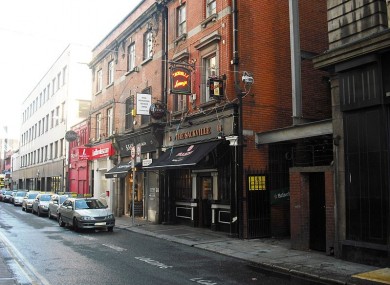
20 January 1973: A Loyalist no warning bomb in Sackville Place Dublin on this day. The bomb killed a bus conductor and injured 17 other people. It exploded at 3.20 pm on a Saturday afternoon, as Ireland were playing the All-Blacks Rugby team at Lansdowne Road. The man killed was Thomas Douglas (21), originally from Stirling, Scotland. He had been living in Dublin for just four months. His mother was a native of Achill Island, Co. Mayo.

The car used in the bombing had been hijacked at Agnes Street, Belfast. While no organisation claimed responsibility for this attack it was generally accepted that a Loyalist gang carried it out. The location of the explosion was almost at the same spot of a bomb the previous month, which killed two other members of Dublin’s bus service. A man with an English accent telephoned a warning to the main telephone exchange stating that a bomb would explode on O'Connell Bridge. But the warning given was ten minutes before the actual explosion and the Gardaí concluded afterwards that it was a diversionary tactic.
 
No one was ever charged or convicted for this attack.