Thursday, 27 February 2014


28 February 1921: Six IRA men were executed in Victoria Barracks, Cork on this day. The men were shot by firing squad. They were Sean Allen, Timothy McCarthy, Thomas O’Brien, Daniel O’Callaghan, John Lyons and Patrick O’Mahony. All bar the first (Sean Allen from Tipperary) had been captured at Dripsey, outside Cork City on 28 January. As they laid in wait to ambush a British convoy the men were surrounded and captured by the 1st Manchester Regiment. A local Loyalist Mrs Lindsay had given their position away. The IRA seized her and James Clarke (her Chauffer) as hostages to hold them against the execution of the men. The local British Commander, General Strickland, was informed by letter of the consequences. The letter he received read:


To General Strickland…

We are holding Mrs Mary Lindsay and her Chauffeur, James Clarke as hostages. They have been convicted of spying and are under sentence of death. If the five of our men taken at Dripsey are executed on Monday morning as announced by your office, the two hostages will be shot.

Irish Republican Army

 
Strickland and General Macready, the British Commander in Ireland, dismissed the idea that the threat was real. They did not believe that the Cork IRA would push it that far. Both men doubted that the IRA would kill a woman in cold blood and decided that the sentences should be carried out.

On the morning of the executions a large crowd gathered outside and prayed for the souls of the dead men who were executed in batches. That night the Cork IRA launched a number of attacks against British forces at different locations throughout the City. Six British soldiers were killed and four were seriously wounded.

Two other men captured at Dripsey were still detained in military custody: Captain James Barrett and Volunteer Denis Murphy. Barrett died in captivity on 22 March 1921. Murphy stood trial in Victoria Barracks on 9 March, he was found guilty and sentenced to death but this sentence was later commuted to one of 25 years' imprisonment.

Following the trial of Volunteer Denis Murphy the Cork IRA executed Mrs. Lindsay and James Clarke.




Wednesday, 26 February 2014


26 February 943: The Vikings of Dublin got a lucky break, when they ambushed the heir apparent to the High King, ‘Muirchertach of the Leather Cloaks/ Muirchertach na Cochall Craicinn’ and slew him on this day.

Muirchertach son of Niall, i.e. Muirchertach of the Leather Cloaks, king of Ailech and the Hector of the western world, was killed by the heathens, i.e. by Blacair son of Gothfrith, king of the foreigner, at Glas Liatháin beside Cluain Chaín, in Fir Rois, on the first feria, fourth of the Kalends of March [26 Feb]
Ard Macha was plundered by the same foreigners on the following day, the third of the Kalends of March…
ANNALS OF ULSTER

Muirchertach was the son of Niall Glundubh who had himself been killed fighting the Vikings at Dublin in 919 AD. He had fought and won many battles and in one report is mentioned as leading a naval expedition against the Norsemen of the Hebrides. However he suffered an embarrassing episode in 939 when in a surprise raid his enemies’ ships raided his fortress of Aileach (outside Derry) and carried him off. He was forced to ransom his own release to regain his freedom. Muirchertach, under the ancient rule of the kingship of Tara alternating between the northern and southern O’Neills, was due to replace King Donnachadh on the latter’s demise. Sometimes though ambition got the better of him and he clashed with his senior colleague and at other times co-operated with him. Muirchertach married Donnchad's daughter Flann, but relations between the two were not good. Conflict between them is recorded in 927, 929, and 938.

His most remarkable feat came in 941 when he carried out a Circuit of Ireland with a picked force of 1,000 men and secured pledges from all the principal kingdoms and carried away with him hostages as security. The Dalcassians (Brian Boru’s people) alone refused to submit. But Muirchertach eventually handed over all his hostages to Donnachadh as a mark of respect.

But his luck ran out in 943 when he was taken by surprise by the Vikings of Dublin somewhere near Ardee, Co Louth. It looks like Muirchertach was attempting to fend off a raid by them that was heading north towards Armagh when he was taken off guard:


Muirchertach son of Niall, heir designate of Ireland, was killed in Áth Firdia by the foreigners of
Áth Cliath, and Ard Macha was plundered by the heathens.
Chronicon Scotorum


Tuesday, 25 February 2014


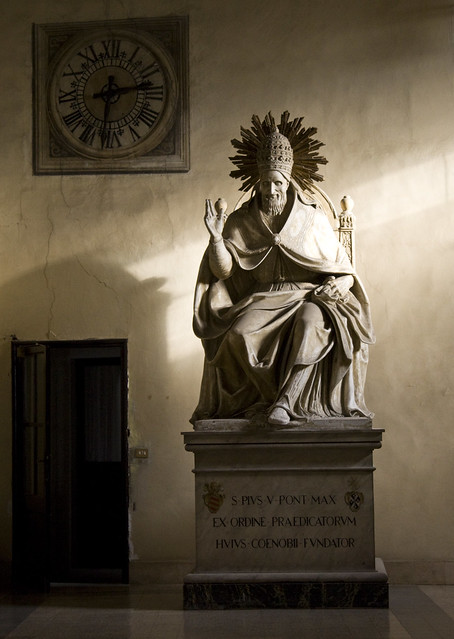
25 February 1570: Pope Pius V excommunicated Queen Elizabeth of England on this day. He issued a Papal Bull called Regnans in Excelsis (‘ruling from on high’) that absolved all her subjects from any obligations of allegiance to her. As Elizabeth claimed Ireland as part of her inheritance this Papal decree released by inference the Catholics of Ireland from any sense of obligation to her they may have felt. While the excommunication was of no personal interest to Elizabeth - who had long since abandoned the Catholic Faith - the political ramifications were profound. The Excommunication made her dealings with the Catholic Powers of Europe more problematical and difficult and increased the chances of Spain under Philip II in particular lending his support to revolts within these islands.

In response she increased anti-Catholic persecution and set out to eliminate the presence of the Jesuits from her Realms. The position of the ‘New English’ Protestants in Ireland was made even more precarious as the Catholics here saw that the Pope himself was now openly opposed to her rule. The English Monarch did not have a high opinion of the Irish anyway as she expressed in a Letter to Sir Francis Walsingham in that month of February 1570:
 
We have heard and knowne it to be true, that certain savage rebells, being men of no valour, had fled out of our realme of Ireland into Spaine, and to cover their lewdness, and procure both reliefe for themselves and for such like as they are in Ireland, they do pretend their departure out of the land for matter of religion, where indeed they be neither of one nor other religion, but given to beastiality, and yet have they writt enough to shewe hypocrisy for their purpose.


Monday, 24 February 2014


24 February 1969: A General Election was held in the North on this day. It was called by their Prime Minister Terence O’Neill [above], who hoped to strengthen his position to deal with the rapidly changing political situation that was developing due to advent of the Civil Rights Movement. The Rev Ian Paisley ran against him in his own constituency of Bannside and secured 6,331 votes to O’Neill’s 7,741 – an ignominious result for O’Neill who was not used to being challenged for a seat he saw as his own. It was an embarrassing victory given his previous unchallenged position.

On the Nationalist side this election saw the rise of John Hume (Independent) in the Foyle Constituency of Derry. He defeated the veteran leader of the Nationalist Party Eddie Mc Ateer by 8,920 votes to 5,267 in a major upset.

The Unionist Party won 36 seats; the Unofficial Unionist Party 3 seats; the Northern Ireland Labour Party 2 seats; the Nationalist Party 2 seats; the Republican Labour Party 2 seats & Independents 2 seats.

For O’Neill it was a Pyrrhic Victory for out of the 39 Unionists returned only 27 were in support of his policies and 12 were against or undecided. Four days later he was re-elected as leader of the Unionist Parliamentary Party and thus was confirmed again as the North's PM. It was obvious though that his days were clearly numbered. He resigned from his position in April 1969 and left active politics altogether in January 1970.

Saturday, 22 February 2014


23 February 1886: Lord Randolph Churchill spoke at a meeting in Belfast in which he uttered the phrase ‘Ulster will fight and Ulster will be right.’

Lord Churchill was anxious to undermine the rapport that had developed between the Liberal Party under William Gladstone and the Irish Parliamentary Party under Charles Stewart Parnell. The Liberals had won the General Election the previous year but had not secured an overall majority. They then relied on Parnell to secure their hold on the House of Commons. The price for such support was Gladstone committing himself to bring forward a Bill for Home Rule for Ireland in the current session of Parliament.

Churchill was fundamentally opposed to Home Rule and planned to use his name in Ulster to give heart to those within the ranks of the Orange Order that were prepared to resist by any means the bringing in of such a measure. He had written to a friend some days previously what his plan was:

I decided some time ago that if the G.O.M.* went for Home Rule, the Orange card would be the one to play. Please God it may turn out to be the ace of trumps and not the two.

* Grand Old Man – Mr Gladstone
 
The revitalised Orange Order had sponsored meetings for all who were against Home Rule. It arranged the meeting in the Ulster Hall at which the main speaker was to be Lord Randolph Churchill himself. He gave, to a wildly enthusiastic audience, a slogan that was to become their rallying cry in the years ahead:

Ulster will fight and Ulster will be right.

Thus began the close association between the Conservative Party and the Unionists in Ireland that was to such a feature of Anglo-Irish relations for decades to come.


22 February 1832: Glasnevin (Prospect) Cemetery, Dublin opened its gates on this day. The first internment was of Michael Carey, aged four, of Francis Street. This place of burial was established to allow the Catholic population of the City to have a place to bury their dead without impediment. The old Penal Laws had meant that all bodies had to be interred in Protestant graveyards. With the coming of full Catholic Emancipation in 1829 the imperative to establish a graveyard free from religious connotations took hold. When Glasnevin opened it was for the use of every person of regardless of Religion. The establishment of Prospect Cemetery coincided with burial reform and the rise of the 'garden cemetery' movement in Britain and Europe.

It now holds the graves of some 1.2 million people including those of many famous Irishmen and women. Amongst those were laid to rest within its walls are Daniel O'Connell, Charles Stewart Parnell, Eamon De Valera, James Larkin, Maud Gonne MacBride, Countess Markievicz, Ann Devlin, Brendan Behan, Michael Collins, Gerard Manley Hopkins, and many victims of the Great Famine.

There is now a full Museum on the site [above] that tells the story of the establishment of the institution and the stories of some of the famous and indeed infamous people interred within.


Tuesday, 18 February 2014


18 February 1366: The Viceroy, Lionel Duke of Clarence and Earl of Ulster and son of the King of England, summoned a Parliament at Kilkenny on this day. From this emerged the series of infamous ordinances that became known as the ‘Statutes of Kilkenny’ and were designed to put a legal framework on the division of Ireland into two separate peoples: the English and the Irish. It contained thirty-five chapters of note.

For instance if any man took a name after the Irish fashion, used the Irish language, or dress, or mode of riding (without saddle), or adopted any other Irish customs, all his lands and houses were forfeited, and he himself was put into jail till he could find security that he would comply with the law. The Irish living among the English were permitted to remain, but were forbidden to use the Irish language under the same penalty. To use or submit to the Brehon law or to exact coyne and livery was treason.

Lionel's wife died in Dublin in 1363, leaving behind a daughter, Philippa, whose descendants would one day claim the throne for the House of York. A second marriage was arranged for Lionel with Violante, daughter of Visconti, lord of Pavia; the enormous dowry which Galeazzo promised with his daughter being exaggerated by the rumour of the time.

Journeying to fetch his bride, Lionel was received in great state both in France and Italy, and was married to Violante at Milan on 28 May 1368. Some months were then spent in festivities, during which Lionel was taken ill at Alba, where he died. There was strong speculation at the time that he had been poisoned by his father-in-law although this has never been proven.

The Statute of Kilkenny, though not exhibiting quite so hostile a spirit against the Irish as we find sometimes represented, yet carried out consistently the vicious and fatal policy of separation adopted by the government from the beginning. It was intended to apply only to the English, and was framed entirely in their interests. Its chief aim was to withdraw them from all contact with the "Irish enemies"--so the natives are designated all through the act--to separate the two races for evermore.

From A Concise History of Ireland by P. W. Joyce