Wednesday, 31 December 2014


31 December 1961: Telefís Éireann was launched on this day. It was originally intended that the first Live broadcast would be on Christmas Eve. However Eamon Andrews (of This is Your Life fame) who was at the time the Chairman of the Radio Éireann Authority, gave everybody a break over the Christmas so the initial broadcast (on Channel 7) went ahead on the last night of the year. The station launched at 7 pm and President Eamon de Valera was the first person to appear to officially launch the Station.


He gave a cautious welcome to the arrival of television in Ireland, and expressed the hope that the new media would provide sources of recreation and pleasure, but also information, instruction and knowledge. However, he admitted to being somewhat afraid, as "Never before was there in the hands of men an instrument so powerful to influence the thoughts and actions of the multitude."


He believed that the new medium, like Atomic power had the ability to do incalculable good or irreparable harm and that he felt it was the viewers would ultimately decide what kind of programs they got to see.


The President was followed by the Primate of All Ireland, Cardinal d'Alton, who also sounded a note of caution regarding how things might develop.  The latter part of the first night was a live concert from the Gresham Hotel in Dublin and featured the Chairman of the Radio Eireann Authority, Eamonn Andrews, Patrick O'Hagan, the Artane Boys Band and the voice of Micheal O hEithir who was the commentator on the night’s proceedings. [above]

While a limited numbers of viewers had been able to pick up poor quality TV signals from the BBC and UTV up until then, this event marked the real birth of the Television Age in the Republic and within a few short years nearly every home had a TV set as a central part of their household.

However the rapid growth of television viewing in Ireland during the 1960’s helped to transform the nature of society in way’s that did not always meet with everyone’s approval!



Monday, 29 December 2014


29 December 1937: The new Irish Constitution came into effect on this day. The titles "Executive Council" and "President of the Executive Council" (a Legacy of the Treaty of 1921 with Britain) were changed to read "Government" and "Taoiseach" respectively and the office of President came into existence.


 The new Constitution had been approved in a Referendum this year and it marked the culmination of Eamon De Valera’s attempts to undo the Anglo-Irish Treaty of 1921, which he had opposed from day one. De Valera became the first Taoiseach and Douglas Hyde the first President of Ireland or Eire as the Free State now wished to be known. The only residue of the Treaty now left was the link to the Crown through the State’s continued and reluctant membership of the British Commonwealth – but that particular bugbear was to fall (ironically enough) to a leader of Fine Gael to accomplish.

Sunday, 28 December 2014


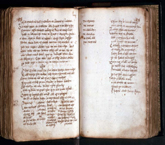
28 December 1650: In Galway city Dubhaltach MacFhirbhisigh, last of the great scribes of Ireland, added an index of just under three thousand entries to his masterpiece the Leabhar na nGenealach, or the Book of Genealogies on this day. An index was rare in a Gaelic manuscript and MacFhirbhisigh was probably adapting more modern methods to his enormous work. In its current printed edition it runs to five volumes.


The work is a compilation of Irish genealogical lore relating to the principal Gaelic and Anglo-Norman families of Ireland and covering the period from pre-Christian times to the mid-17th century and collected from a variety of sources. The fact that many of these sources no longer exist adds considerably to the value of Mac Fhirbhisigh's work. This great work stands comparison with The Annals of the Four Masters and is all the more remarkable for being the work of just one man.


Preserved over the centuries it was not printed in full until Mayoman Nollaig Ó Muraíle published his comprehensive edition in five volumes (by De Burca books) in 2004. This is one of Ireland’s greatest Literary/Historical Treasures.

The original manuscript [above] is now in the posession of University College Dublin.


Saturday, 27 December 2014


27 December 1171 AD: Petrus Ua Mórda [ang: Peter O’Moore) the Bishop of Clonfert/Clúain Fearta in what is now Co Galway, was drowned on this day in the River Shannon.

He appears to have been a member of a family from Ui Maine, one of the oldest and largest kingdoms located in Connacht, Ireland. Ua Mórda was abbot of Grellach dá Iach, the first of three sites inhabited by the Cistercians and who finally settled at Boyle Abbey. In around 1150 AD, he became Bishop of Clonfert; styled as Bishop of Cluain-fearta-Brenainn or Bishop of Ui Maine.

Petrus (Ua Mordha), bishop of Ui-Maine of Connacht (otherwise, bishop of Cluain-ferta of [St.] Brenann), a devout monk and authoritative man, was drowned in the Sinand (namely, at Port-da-Chaineg), namely, on the 6th of the Kalends of January [Dec. 27].

Annals of Ulster

Friday, 26 December 2014


26 December 1796: Wolfe Tone wrote in his Journal aboard the French Man of War Indomptable the following entry:


December 26th —Last night, at half after six o'clock, in a heavy gale of wind still from the east, we were surprised by the Admiral's frigate running under our quarter, and hailing the Indomptable with orders to cut our cable and put to sea instantly; the frigate then pursued her course, leaving us all in the utmost astonishment. . . . All our hopes are now reduced to get back in safety to Brest, and I believe we will set sail for that port the instant the weather will permit. . . . Notwithstanding all our blunders, it is the dreadful stormy weather and the easterly winds, which have been blowing furiously and without intermission since we made Bantry Bay, that have ruined us.
 

Thus ended the hopes of Theobald Wolfe Tone and the other Irish revolutionaries to liberate Ireland from England’s rule by enlisting the help of Revolutionary France. Never again was such a major Expedition undertaken by Paris to help the Irish free themselves from Foreign rule.


While Wolfe Tone’s hopes were dashed on this occasion he returned in the wake of the Rising of 1798 but was captured off Donegal. Facing execution he cut his own throat in prison to deprive his captors of the satisfaction of seeing him hanging from a rope.

Thursday, 25 December 2014


25 December 1245: The terrible and unusual snow that had been falling in Ireland for the previous few weeks finally ended:


Poisonous
snow fell on the night of the festival of Saint Nicholas, [Dec.6]
which took off the heels and toes of those who walked
in it; and this snow did not disappear until Christmas
arrived.


Annals of Loch Cé

Wednesday, 24 December 2014


24 December 1895: The loss of the Dun Laoghaire/Kingstown Lifeboat, Civil Service No. 7 with all hands on this day. 15 men of the RNLI were swept to their deaths when attempting to rescue a boat in difficulties on Christmas Eve. The alarm had been raised earlier that morning. Onlookers on the shoreline had spotted that a Finnish ship of the Russian Mercantile Navy, the Palme, was in distress just outside the harbour entrance. A tremendous Storm was raging at the time and indeed so ferocious were the conditions that this ship had been pushed back up the Irish Sea by the intensity of the winds. The Captain had decided to run for the nearest port and seek shelter. Unfortunately his attempt to gain the harbour was in vain and he had no choice but to try and ride it out at anchor and await less stormy conditions. However his position was a precarious one and the ship was in imminent danger of been swept onto the rocky shoreline nearby.

The alarm was raised and the 15 volunteers of Civil Service No. 7 put out into the terrible seas to endeavour to rescue the crew. Alas within minutes of reaching the stricken vessel their own boat was overturned by a huge wave, and all the men went into the water. The boat, of a modern design, was supposed to right itself but this did not happen. Some of the crew managed to scramble onto the upturned hull but the temperature being so low hypothermia soon seized them. One by one they slid down the side and were swept away to their doom. The sailors on board the Palme, seeing the plight of their would be rescuers attempted to lower their own boat but it was smashed against the hull and they gave up all hope of being rescuers or indeed rescued themselves from their terrible plight.

The second Lifeboat on Station, the Hannah Pickard then put to sea. Pulling hard on the oars her crew attempted to make headway but she too capsized and all the men were thrown into the water. Fortunately for them they were close enough to the shore to swim for it and all were saved.

Other boats in the vicinity tried without success to close with her but the heavy seas drove them back. After that the Palme was left to her fate as no more could done for her. All that night and on Christmas Day and again that night she stood off shore at the end of a tenuous anchor. The Storm finally abated on the morning of St Stephens Day. Eventually a ship was able to approach and lower a boat that made a number of runs to her and first took off the Capitan’s wife and baby. Then the other 17 members of the crew and the Captain himself were brought ashore. Even the ships cat was rescued. But of the brave sailors lost only their bodies were ever recovered. It was the greatest loss of life ever recorded here in Ireland of the men of the RNLI.


The men lost were:

Alexander Williams. Aged 35 married with 6 children. The Coxswain.

Henry Williams . Aged 60 (Father of above) veteran silver medal holder. Ex-coxswains who had two other sons,

George Sanders. Aged 30 married no children.

Francis Saunders. Aged 27 (Brother of above) married with 5 children.

Edward Shannon, Aged 28 married with 4 children

Patrick Power. Aged 22. Single.

Edward Crowe, Aged 30 married no children.

John Baker. Aged 33 married with 3 children (wife very delicate).

Henry Underhill. Aged 32 years just married. No children.

John Bartley, Aged 45 married with two children.

William Dunphy Aged 40 married with 6 children.

Thomas Dunphy. Aged 31 (Brother of above) Married 3 children. _Nanny & Two Brothers.
Sarah Dunphy, Tom Dunphy & Jack Dunphy.

Edward Murphy. Aged 30 married 3 children.

Francis McDonald. Whose son was born to his widow early in 1896.

James Ryan Aged 24 not married