
Sunday, 10 March 2019

Image result for sir phelim o'neill

10 March‭ ‬1653: Sir Phelim O'Neill was hanged, drawn and quartered at Dublin on this day. Sir Phelim was a wanted man from the day back in October 1641 when he led the Irish of Ulster out in revolt against the English Parliament. He was a most unlikely ‘Rebel’ for his family had sided with the English during the Nine Years War (1594-1603) and again during O’Doherty’s Rebellion in 1608 in which his own father was killed in the service of King James I. 

O’Neill in turn had openly adapted to the new dispensation,‭ ‬studied Law in London and on return had settled down to the life of a powerful if spendthrift landlord in Tyrone. But by the early 1640’s the situation both in Britain and Ireland was rapidly spinning out of control as King Charles personal rule fell apart and the Puritans rose in power. O’Neill amongst others recognised that these people sought to further colonise Ireland and suppress the Catholic Religion.

On the night of 22 October 1641 he opened the Revolt by seizing Charlemont Fort in Tyrone. Two days later, O'Neill issued a proclamation declaring that he and his associates had taken up arms only for the defence and liberty of themselves and the native Irish; the insurgency was not intended to harm either King Charles or any of his subjects in Ireland. In a brilliant move he had forged a commission early in November 1641, purporting to bear the King’s Seal and which authorised the Irish to rise in defence of their liberties against the Westminster Parliament.

Sir Phelim had mixed success in the years that followed,‭ ‬never quite getting the better of his enemies, and never quite securing command of the Irish of Ulster. His initial success was marred by an outbreak of vicious massacres and ‘ethnic cleansings’ of Protestant settlers that was greatly exaggerated but widely believed in Scotland and England. While O’Neill stood aloof he was blamed nonetheless by the Puritans and they were determined to execute him if he was ever taken alive. 

He commanded a Regiment at the great Irish Victory of Benburb in‭ 1646 but had to flee the field at Scariffhollis in 1650. He tried to defend Charlemont Fort against the English Parliamentary army in August 1650 but was forced to flee and go into hiding as the Cromwellians tightened their grip on Ireland. They put a price of £300 on his head and in February 1653 his hiding place on an island in Lough Roughan in County Tyrone was betrayed and he was captured. Brought to Dublin he was imprisoned to await Trial but he must have known he was doomed to the gallows.

He was tried by the Cromwellian‭ ‘‬High Court’ sitting in Dublin which was specifically charged with executing as many of the ringleaders of the 1641 Rising as they could. The trial was held at the Court of Chancery in Dublin. Here the Judges sat, and were directed what questions they should allow by a Committee, who placed themselves in an adjoining room, called the Chancery Chamber. A communication was kept up between this Committee and the Judges by means of a messenger, who went constantly between them, relating to the Committee all proceedings that passed in the Court, and bringing their instructions to the Judges on every occasion, speaking to them through a square hole in the wall. His examiners were most anxious to know whether his Great Seal from the King was genuine or a forgery. O’Neill would not pleasure them with an answer even though they insinuated that his life could be spared if he answered in the affirmative.

After a trial of just five days Sir Phelim O'Neill was found guilty and sentenced to be hung drawn and quartered. The execution was duly carried out and his head was fixed on the bridge at Dublin, and his quarters were scattered throughout different parts of Ireland. 

While not a commanding figure,‭ fate had placed Sir Phelim in a pivotal position in the Autumn of 1641 where his actions triggered a series of events that were to have profound effects across the Three Kingdoms of these islands that still resonate down to the present day.





Saturday, 9 March 2019


9‭ March 1932: Eamon de Valera was elected President of the Executive Council of the Irish Free State in Leinster House on this day. It is believed that that he and his fellow deputies in Fianna Fáil entered the House with revolvers in their pockets, such was their distrust of their ex Civil War opponents in Cosgrave’s defeated Government. They had deep suspicions that a coup d’etat would be attempted by disaffected elements in the Free State Army who would not allow a changeover to take place. But in the event everything went smoothly and parliamentary forms were observed to the letter by all sides.

Of the TDs assembled that day‭ 81 deputies voted in favour of his election and 68 against the motion. De Valera was five seats short of an overall majority but William Norton, leader of the Labour Party committed his seven parliamentary colleagues in ensuring that Dev was elected the President. 

After thanking the House de Valera proposed his Cabinet as follows:‭ 
The President himself,‭ ‬in charge of the Department of External Affairs;
Deputy Seán T.‭ ‬O'Kelly,‭ Vice-President, in charge of the Department of Local Government and Public Health;
Deputy Patrick J.‭ Ruttledge, in charge of the Department of Lands and Fisheries;
Deputy Seán F.‭ Lemass, in charge of the Department of Industry and Commerce;
Deputy Seán MacEntee,‭ ‬in charge of the Department of Finance;
Deputy James Ryan,‭ in charge of the Department of Agriculture‬
Deputy Frank Aiken,‭ in charge of the Department of Defence
Deputy Thomas Derrig,‭ in charge of the Department of Education
Deputy James Geoghegan,‭ ‬in charge of the Department of Justice
Senator Joseph Connolly,‭ ‬in charge of the Department of Posts and Telegraphs

To avoid political embarrassment the Governor General James McNeill came in person to Leinster House to officially announce the result.‭ This was to avoid Dev himself having to make the trip out to the Vice Regal Lodge in the Phoenix Park – which was still seen as a symbol of the old Imperial Regime by his supporters.

Eamon de Valera was to remain in power for the next‭ 16 years until he was defeated in the 1948 General Election.


Friday, 8 March 2019


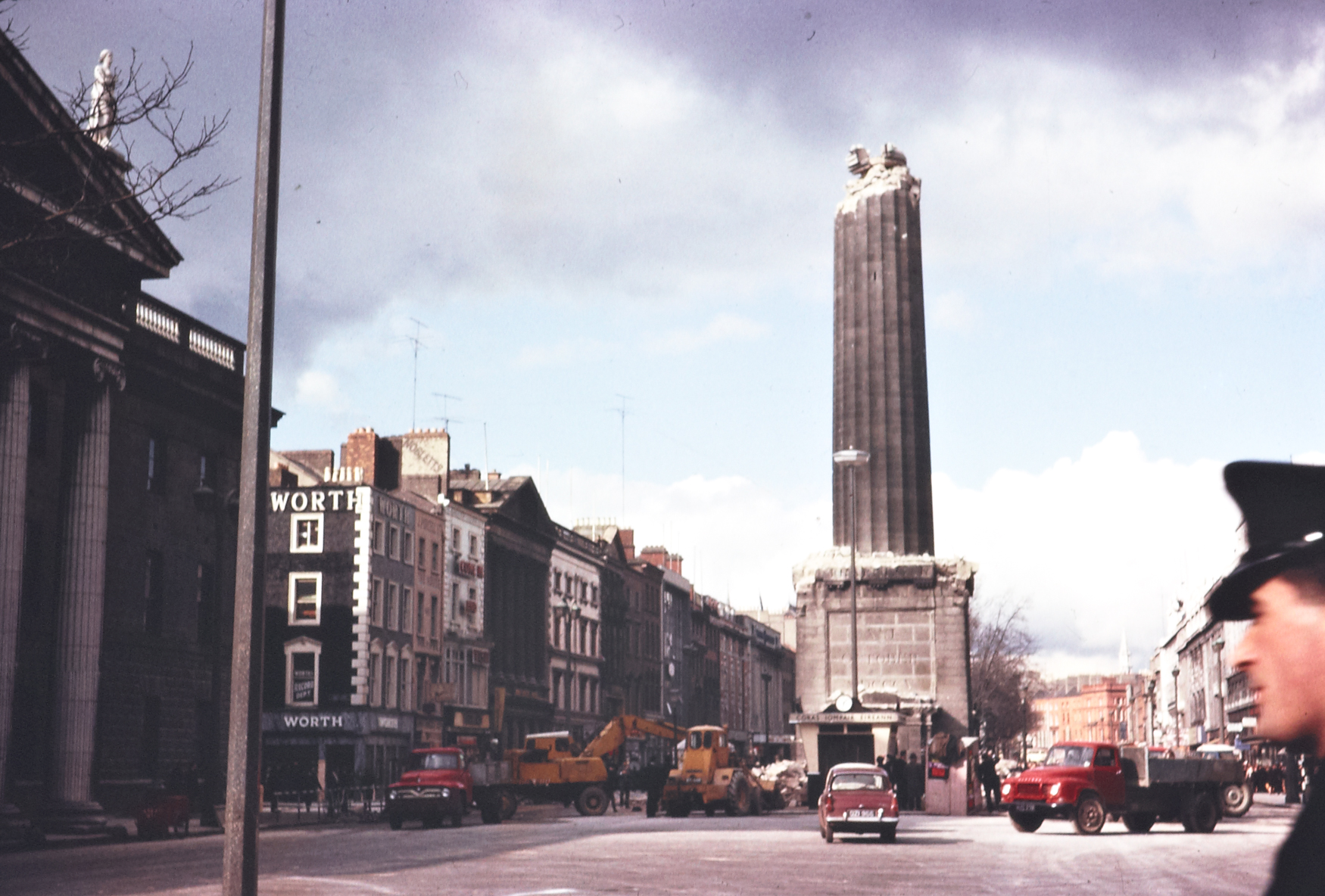
8‭ ‬March 1966: A group of Irish Republicans blew up Nelson’s Pillar in Dublin on this day. The 121 foot high column to England’s greatest Naval Hero, Admiral Lord Nelson, was erected in 1808 to commemorate his victories at sea and his death at the Battle of Trafalgar in 1805. A subscription was raised from amongst the Loyal citizens of Dublin to fund the design and construction of the column and also the 13 foot high statue of Nelson that was placed on top of this imposing edifice.   

A number of attempts over the years,‭ some legal and others not so legal, were initiated to have it removed. Some were based on aesthetic and others on commercial grounds - that it was a block on traffic etc. But after 1922 a more political angle emerged as it was seen as an embarrassment that such an open symbol of British Imperial history dominated the main thoroughfare of Ireland’s Capital city. Notwithstanding this the open platform perched high above O’Connell Street remained a popular visit for both tourists and natives alike. It was also a well-known meeting place and landmark and the phrase ‘I’ll meet you at the Pillar’ was one that fell from many a Dubliners lips for generations. Many of the city' Trams and later the Buses had the simple words ‘The Pillar’ on their frontage as the name of their destination with no further explanation necessary to the passengers. 

However with the approach of the Commemoration of the‭ ‬50th anniversary of the Easter Rising in‭ 1966 a small group of non-aligned republicans decided to remove the object by way of explosion. A plan, ‘Operation Humpty Dumpty’ was initiated to place within the pillar a device of such force that the structure would collapse. It was decided to plant a time-bomb on the stairs set to go off in the early hours of a weekday so as to avoid civilian casualties. No warning was to be issued and the perpetrators took a huge risk in this endeavour but Dublin was a far more deserted night time city back then than it is now and this played in their favour. 

At around‭ 2 AM on the morning of 8th March a huge explosion rocked the City and awakened the more alert of the citizens situated near the city centre. The bomb destroyed the upper half of the pillar, throwing the statue of Nelson onto the street and causing large chunks of masonry to litter the surrounding area.  By sheer good Fortune no one was killed or injured.

So long had the Admiral cast his eye over the City that at first many people did not believe the news on being told.‭ But disbelief soon turned into undisguised amusement that this political eyesore was gone at last and in such bizarre circumstances. More mirth was had some days later when the Irish Army was ordered to remove the remains of the column by detonation. While this was accomplished the resultant official bombing destroyed many of the shop front windows in O’Connell St – none of which were subject to damage in the initial explosion!

Within days the event was commemorated in a ballad called‭ ‘Up went Nelson in O’Connell Street’ by a group from Belfast called ‘The Go Lucky Four’ that reached Number 1 in the Irish Charts and stayed there for eight weeks. While Lord Nelson’s head from the statue survived damaged but intact it suffered further indignities as it was stolen from storage in a Student Prank and used to raise funds. It appeared in a TV add and on stage with the Dubliners. After many years on view in the Civic Museum it is now on display in the Dublin City Library (Gilbert Library) in Pearse Street.

In September‭ 2000 Liam Sutcliffe, a resident of Dublin, claimed during a radio interview that he was one of the people responsible for the attack on the monument. On being questioned by the Gardaí he refused to substantiate his claim and the matter was let drop. No one was ever charged or convicted for this attack in what was probably the most popular bombing ever to occur in Ireland. Liam Sutcliffe died in 2017 but no one now doubts he was the man who pulled it off.

‭The Spire now occupies the spot where Nelson’s Column once stood - but no one so far has attempted to demolish it....yet.


Thursday, 7 March 2019


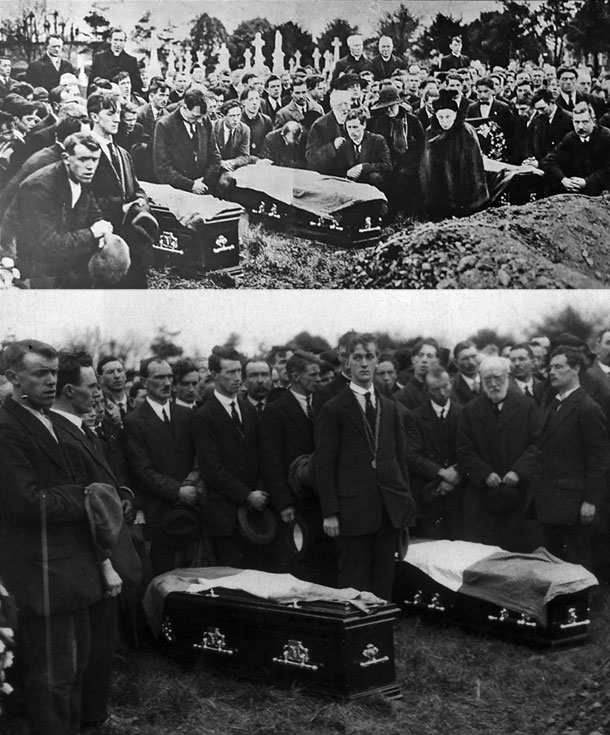
7‭ ‬March‭ 1921: George Clancy the Mayor of Limerick, and his immediate predecessor, Michael O'Callaghan were shot dead in their homes on this day. Known as ‘the Curfew Murders’, as their houses were raided during the hours of curfew, their deaths shocked the whole City and Country and became International News. Mrs Clancy was wounded in a vain attempt to shield her husband from assassination and Mrs O'Callaghan also witnessed the murder of her spouse. Both victims were distinguished members of the Community and had been involved in the struggle for Independence.
Clancy was an ex University Professor and a friend of James Joyce.‭ He is believed to have provided the background for a character in Joyce’s Classic ‘Portrait of an artist as a young man.’ 

O'Callaghan’s grandfather, Eugene O' Callaghan, was Mayor of Limerick in 1843. A third leading Citizen, Joseph O’Donoghue, was taken from his house that night and found shot dead in a field some hours later.‬ 

Their‭ ‬assailants were in Mufti, wore goggles and with their coat collars turned up but it quickly became obvious that the gang in question were serving members of the Crown Forces. Mrs O’Callaghan gathered what evidence she could collect and demanded an Inquest but no inquiry other than a military one was ever carried out.‭ ‬Even the ex British Prime Minister Herbert Asquith stated that members of the RIC (Auxiliaries) were the culprits. However the particular individuals who carried these attacks were never formally identified with the crimes. Many years later in the 1950s a deceased British Officer was named as one of the murderers but no conclusive proof was ever established as to his involvement.


Wednesday, 6 March 2019

Image result for gibraltar three

6 March 1988: Three IRA Volunteers were shot dead by members of Britain’s SAS regiment in Gibraltar on this day. They were Mairéad Farrell, Sean Savage and Daniel McCann. Their deaths had all the hallmarks of politically sanctioned killings by the British State.

Somehow or other MI5 got wind of plans by the IRA to bomb the changing of the guard in Gibraltar that was carried out with some ceremony by members of the British Military. A plan was put in place - Operation Flavius - to intercept this attempt and kill or capture the members of the IRA involved. In the event no attempt was made to capture and all identified members of the team were cut down without warning.

When Savage, McCann and Farrell—known IRA members—travelled to Spain in preparation for the attack, they were tracked at the request of the British government. On the day of the shootings, Savage was seen parking a white Renault in the car park used as the assembly area for the parade; McCann and Farrell were seen crossing the border shortly afterwards.

After a military bomb-disposal officer reported that Savage's car should be treated as a suspected bomb, the police handed over control of the operation to the SAS. As soldiers were moving into position to intercept the trio, Savage split from McCann and Farrell and began running south. Two soldiers pursued Savage while two approached McCann and Farrell; as they did so, the pair were said to make threatening movements, as a result of which the soldiers opened fire, shooting them multiple times. As soldiers caught up with Savage, he was alleged to have turned around to face them while reaching into his jacket; he was also shot multiple times.

All three were subsequently found to be unarmed, and Savage's car was found to contain no explosives; enquiries resulting from keys found on Farrell led authorities to a second car, containing a large quantity of explosives, in a car park in Spain. In all probability their presence in Gibraltar that day was a ‘test run’ and there was no immediate threat to anyone on the Rock that day.

Their deaths created huge controversy as it was hard to mask the fact that they had been killed in cold blood - a charge the British Government denied but without much success. When the bodies of the deceased were returned to Dublin they were met by thousands of well wishers in the pouring rain at Dublin Airport. The Corteges were escorted to the North by large numbers of vehicles and many more turned out to pay homage as the funeral cars made their way to the Border and back to Belfast.
Once the Border was crossed their was a different atmosphere as the Crown Forces clamped down on any open expressions of sympathy. Further deaths then followed at their funerals that shocked the Nation and indeed abroad in one of the most dramatic and bloody weeks in recent Irish History.


6 March 1918: John Redmond M.P. died on this day. Ireland’s foremost politician of 1914 died in a London Hospital a forgotten and discredited man. He had brought Ireland to the brink of Home Rule (his lifetime ambition) only to see fate take a different turn and it all to slip through his fingers. 

He was born in 1856 in County Wexford to a family with strong and active interest in constitutional politics. His father was a member of Parliament. He was educated at Clongowes College, a boarding school that many of the Irish middle class sent their sons to. He then went on to study Law in the Anglo - Irish bastion of Trinity College Dublin but his studies were cut short by his father’s ill health. He went over to London to help him out and became a follower of Charles Stewart Parnell the formidable Leader of the Irish Party in Westminster. He finally won a seat for New Ross in 1881 and entered Parliament. He did great fund raising work in Australia and the USA for the Party and eventually returned and completed his Law studies to become a Barrister.

When Parnell was forced to resign over the Kitty O’Shea affair in 1890 he emerged as the leader of the rump of the Party - the Irish National League - that remained loyal to their old leader.  Redmond lacked Parnell's oratory and charisma but did demonstrate both his organisational ability and his considerable rhetorical skills. He raised funds for the Parnell Monument in Dublin. When in 1900 the different factions re united Redmond was elected Chairman of the Irish Parliamentary Party- which he held till his death. Redmond's low-key and conciliatory style of leadership gave the impression of weakness but reflected the problem of keeping together a factionalised party.

He kept up the pressure in Westminster for Home Rule but while the Liberal Party was generally sympathetic the Conservatives were totally opposed and the House of Lords was seen as an insurmountable obstacle. But when the Lords' veto was abolished under the Parliament Act 1911, Irish Home Rule (which the Lords blocked in 1894) became a real possibility. By 1914 the Lords could no longer block legislation passed by the House of Commons on Home Rule and in the next session of Parliament it would become a reality. However in the North the Ulster Loyalists had armed themselves to the teeth and were determined to resist it. The British Government dithered and was unsure if they could even rely on the Army to enforce it on Ulster. The Country stood on the brink of a huge Constitutional Crises and the distinct possibility of Civil War.

But events abroad changed everything. In August 1914 the First World War began and Britain mobilised for War on an unprecedented scale. Redmond was unsure how to play it. He first offered the Irish Volunteers to hold Ireland against invasion by an outside enemy [Germany] but this met with little recognition in the corridors of Power in London. All parts of the Empire were expected to play their part. Edward Carson the Leader of the Irish Unionists had immediately offered the Ulster Volunteer Force [UVF] to join up and fight at the Front. This put Redmond on the spot. He could not stand idly by but he had to have something halfway tangible to sell back home to his supporters if he was to throw in his lot with the War Effort. This came in September when the Home Rule Bill was eventually given the Royal Assent - but with the proviso that it was suspended for the duration of the War. This was enough to satisfy Redmond and he encouraged the Volunteers to join up and fight. Tens of thousands did so at his behest and at first all went well and it appeared his gamble had paid off.

However a rump remained that did not follow him and Redmond’s followers became known as the National Volunteers while those who disavowed him remained the Irish Volunteers. A rump within that organisation organised the 1916 Rising that brought Revolution to the streets of Dublin. Redmond was aghast and condemned it. But his own Party was split and as the months rolled by the prospect of a United Ireland under Home Rule became more and more unlikely. The War was not going well and the horrendous casualties caused many to wonder if it was all worth it. The Ulster Unionists were as implacable as ever. Recruitment declined and Sinn Fein started taking seats at bye elections from the Irish Party - change was in the air and Redmond and his Party were increasingly isolated from National opinion.

The Conscription Crises of 1918 united all of Nationalist Ireland against the British and Sinn Fein was the growing power in the land. Redmond had become yesterdays man. When he died he was confined to the dustbin of History and viewed as a Traitor by many. It is only in recent times that he has been somewhat rehabilitated as a man who did his best for Ireland but who was a victim of circumstance as much as his own Blunders - particularly in backing Britain’s War Effort in 1914 that cost so many Irishmen their lives to no avail.


Tuesday, 5 March 2019

A contemporary illustration of the Battle of Tallaght from the London Illustrated News

5/6‭ March 1867: The Fenian Rising happened on this day. Long planned it turned into a complete fiasco. On Shrove Tuesday that year thousands of volunteers turned up at various locations in Dublin, Cork, Tipperary, Limerick, and to a lesser extent in Clare, Waterford and Louth. 

However most were armed with pikes if at all.‭ Very few firearms were available. There was no coherent plan of operations. Attempts were made to take a number of police barracks and engage the Constabulary in action but all ended in failure. An informer, Corydon, betrayed the plans and to add to the insurgents woes a great snow storm made absolutely impossible not only all communications but all movements of men. The Constabulary knew something was afoot but decided to allow events to take their course and then take action. In the Dublin area it is possible that as many as two thousand men assembled with perhaps twice that number in county Cork and a few hundred elsewhere. One of the greatest Irish movements of the century ended apparently in complete failure.

While the British Government was caught off guard the Rising was over before they could react.‭ Hundreds of men were rounded up and imprisoned. Some were sentenced to Death all these were commuted and no one was actually executed for their part in this affair. However long terms of imprisonment were handed down and many of the prisoners were subjected to very harsh conditions while in captivity. On top of this the Rising showed that Irish Republicanism was still a potent force and had by no means been crushed by the British. 

This event did have important repercussions however as it led to a reorganisation of much of the underground activities of the IRB and the formation in America of Clan na Gael that was determined to prosecute a campaign against British rule notwithstanding recent setbacks.‭ The failure of the 1867 Rising did not mark an end but a new beginning for those who were determined to end British rule over Ireland.