Wednesday, 10 September 2014


10 September 1966: Donogh O’Malley the Irish Education Minister announced a scheme for free secondary education on this day. His surprise decision that he would implement free secondary education up to Intermediate Level for all students caught both his political colleagues and opponents on the hop. He announced that from 1969 all schools up to Intermediate level would be free and that free buses would bring students from rural area to the nearest school.

O’Malley seems to have made this decision himself without consulting other ministers, however, he did discuss it with An Taoiseach Sean Lemass. Jack Lynch, who was Minister of Finance at the time had to find the money to pay for it, was certainly not consulted and was dismayed at the announcement. In spite of this O’Malley’s proposals were hugely popular with the public and it was impossible for the government to go back on its word. O’Malley’s impromptu decision opened the way for free secondary education in the State that continues to this day.

O’Malley’s brilliant but flamboyant political career was cut tragically short when he was killed in a motorcar crash in 1968. He left a wife and two children behind him. He was a close colleague of Brian Lenihan and C. J. Haughey Had he lived he would undoubtedly have been a senior political player for many years more. His nephew Desmond O'Malley succeeded him as the TD for Limerick East.

Sunday, 7 September 2014


9 September circa 544/45 AD: The death of Naomh Ciarán (Saint Kieran) of Clonmacnoise on this day. He was born around 512 AD in Fuerty, County Roscommon. The son of Beoit, a carpenter and wheelwright, he inherited a love of learning from his mother’s side of the family, as his maternal grandfather had been a bard, poet, and historian. Baptized by deacon Justus, who also served as his first tutor he continued his education at the monastery of Clonard, which was led by St. Finnian. After completing his studies under Finnian, he left Clonard and moved to the monastery of Inishmore in the Aran Isles, which was directed by St. Enda.


After many wanderings he eventually settled at a location in the centre of Ireland, on the east bank of the River Shannon at a place called the meadows of the sons of Noise: Cluan mac Noise as Gaeilge or in the English language: Clonmacnoise. It was here he laid the foundations of what became one of Ireland’s greatest monasteries that was to last nearly a 1,000 years through many trials and turmoils. St. Ciarán’s task was greatly eased by the help and lands he received from Diarmait mac Cerbaill, the last pagan King of Tara. However just not long after he had commenced his great work St. Ciarán died. His early demise was in all probability from the Bléfed (the Great Plague) that was sweeping across Europe at the time and had made its way to the shores of Ireland.

Due to his great learning, his sanctity, and the generosity he displayed to those less fortunate in life and because of his prominence in the early Irish church, St. Ciarán is known as one of the “Twelve Apostles of Ireland.”

The panel above shows what is believed to be a representation of St Ciarán and King Diarmait mac Cerbaill planting a stake in the ground at Clonmacnoise. If so it shows the symbiotic relationship between Church & State in early Medieval Ireland - the Church gained protection and the King gained the blessing of the Church - even though in this case King Diarmait was a Pagan!

Saturday, 6 September 2014


6 September 868: The Battle of Cell ua nDaigri/ Killineer on this day. This clash of arms was fought just a few miles north of Drogheda, Co Louth. The opponents were the forces of the King of Tara, Aed Finnliath of the northern Uí Néill, and his dynastic rivals the Uí Néill of Brega [east Meath] who had as allies the Vikings of Dublin and the men of Laigin [south Leinster]. King Aed had for support King Conchobor of Connacht who seems to have contributed the bulk of the warriors. The northern king appears to have brought south with him just a picked force of about one thousand men. Aed was faced with what was an alliance by the kings of greater Leinster against his hegemony – as they all feared dominance by a king as powerful and as skilful as he.

In the event he defeated his enemies in what was probably a hard fought battle. It looks like the men of the East were the ones who opened the battle but were held in check. As both sides had more or less equal numbers its probable that the contest was a long drawn out affair. It certainly was a bloody one as the King of Brega and his ally Diarmait mac Etarscéle, the King of Loch Gabor were amongst the fallen. Many of the Vikings were also put to sword. But King Aed lost from amongst his own one Fachtna mac Mael Dúin, (the man selected to succeed him in the North) when he launched his own counter assault upon his enemies.

King Aed was one of the most successful kings to rule in Ireland in the 9th Century. He drove the Vikings out of the North and checked their power in north Leinster. He was also adept at keeping Irish rivals from usurping him from his throne. He died a peaceful death at the Monastery of Dromiskin, some 30 miles north of where this great battle was fought, in the year 879.

Aed (the son of Niall) who was the king of Temair [Tara], and Conchobor (the son of Tadc) who was the king of Connacht, won a battle at Cell ua nDaigri on the 8th of the Ides [6th of September] against the Uí Néill of Brega and the Laigin, and a large force of foreigners, i.e. three hundred or more.

Flann son of Conaing had five thousand and Aed Finnliath had one thousand,

Flann son of Conaing, king of all Brega, and Diarmait son of Etarscéle, king of Loch Gabor, fell in this battle.

Very many of the heathens were slaughtered there and Fachtna (the son of Mael Dúin), heir designate of the North, fell in the counterattack of the battle.

Chronicon Scotorum 868 AD

Thursday, 4 September 2014


4 September 1828: The Annaghdown/Anach Cuain Boat Tragedy. Eleven men and eight women were drowned on the river Corrib aboard an old and decrepit boat the Caisleán Nua. The tragedy was the subject of a poem by Anthony O’Rafferty Anach Cuain. On September 4th, 1828 the boat left Annaghdown Pier bound for a fair at Galway City. On board were some sheep, which were for auction at the fair, and some thirty men and women who had intended to make a holiday out of the visit to Galway. Some two miles from the city on the river Corrib tragedy struck.

Its not quite certain what caused the boat to sink, but the story is told that one of the sheep on board got restless and poked his hoof through the floor of the boat. One of the men on board tried to stuff the hole with a piece of clothing but only succeeded in knocking a plank out of the boat which caused the water to pour in. Nineteen men and women on board drowned in the ensuing panic and scarcely a family in the village of Annaghdown remained unaffected by the tragedy.

The boat and passengers proceeded without obstruction until they arrived opposite Bushypark, within two miles of the town, when she suddenly went down and all on board perished except twelve persons who were fortunately rescued from their perilous situation by another boat.
Galway Advertiser 6 September 1828


One man on board was named John Cosgrave who was a strong swimmer. He saved several people and went back to save the woman he was shortly to marry. Some desperate people clung to him in a desperate bid to save themselves but only succeeded in drowning him also.

The recovered bodies of those who drowned were brought ashore near Menlo/Mionnloch Castle, [above] itself the scene of a tragic fire in 1910. It is now a ruin.

Wednesday, 3 September 2014


3 September 1939: The Emergency Powers Act was enacted on this day. It gave the government of An Taoiseach Eamon DeValera sweeping and draconian powers to order and control many aspects of daily life in the Irish Free State. It thus gave legislative effect to the State of Emergency that the government had declared the day before after Hitler’s Invasion of Poland and the imminent Declaration of War on Germany by Britain and France. The act had been introduced the day before by De Valera with the following words:

I ask for leave to introduce a Bill entitled “an Act to make provision for securing the public safety and the preservation of the State in time of war, and, in particular, to make provision for the maintenance of public order and for the provision and control of supplies and services essential to the life of the community, and to provide for divers other matters (including the charging of fees on certain licences and other documents) connected with the matters aforesaid.”

The act gave the government the ability to maintain Irish neutrality during The Emergency by providing sweeping new powers to the government for the duration of the emergency, such as internment, censorship of the media and mail by postal censorship, and the government control of the economy.


The State of Emergency was not to be lifted until September 1946 and remained on the Statute Books until 1976!


Tuesday, 2 September 2014


2 September 1022 AD: The death of the King of Mide, Máel Sechnaill mac Domnaill, on this day. His passing marked the end of an era in Irish History. Since the Battle of Ocha in circa 483 AD the southern and northern O’Neill’s had shared the title of King of Temair (Tara) between them on a more or less continual basis. This made the holder of the title the most influential king in Ireland - if he had the wherwithal to make use of the status the title gave him. For it was believed that in ancient times Ireland had been ruled from the Royal seat of Tara. The O’Neills believed that any man who held that hallowed ground was the heir to a lost Kingdom. However Brian Boru of Munster in 1002 had pushed aside King Máel and had himself recognised as the superior king in his stead.

It was only with the death of King Brian at the Battle of Clontarf in 1014 that Máel Sechnaill had regained his position. But by then he was an old man and Ireland had changed greatly since his predecessors had established their dual kingdoms all those centuries before. After him Mide(Meath) would no longer be the force it was in Irish Wars and Politics.

Mael Sechnaill son of Domnall son of Donnchad, overlong of Ireland, pillar of the dignity and nobility of the western world, died in the 43rd year of his reign and the 73rd of his age on Sunday the fourth of the Nones 2nd of September, the second of the moon.

1. (Nine score prime seats had the king—

A lord in the abundance of cloaks and food bestowed—

A weighty ól-measure for the King of the Elements

Was in the middle of each of these citadels.

2. You are mistress for a splendid seven times six years,

A king who draws from the foreigners a cry of fear;

The supreme ruler of Cronn's stronghold

Shall never die from a spear-point.)

Annals of Ulster 1022 AD

Mael Sechnaill son of Domnall, son of Donnchad, overking of Ireland, the

flood of honour of the western world, died in Cró-inis of Loch Aininne in

the forty-third year of his reign on the 4th of the Nones 2nd of September,

that is, on Sunday, the second day of the moon, the one thousandth and

twenty-second year after the Lord's Incamation, and died penitent and at

peace, with the successors of venerable saints Pátraic and Colum Cille and

Ciarán present and assisting him.

1. Three hundred forts has the King,

From which he gives clothes and food;

There are guests from the King of the elements

In the middle of each fort of them.

2. The vat of the man of the Tulach in the west—

If the King of Midhe feels any desire

On Sunday, he quaffs a drink of it

On Monday morning in Midhe.
Chronicon Scotorum

Monday, 1 September 2014


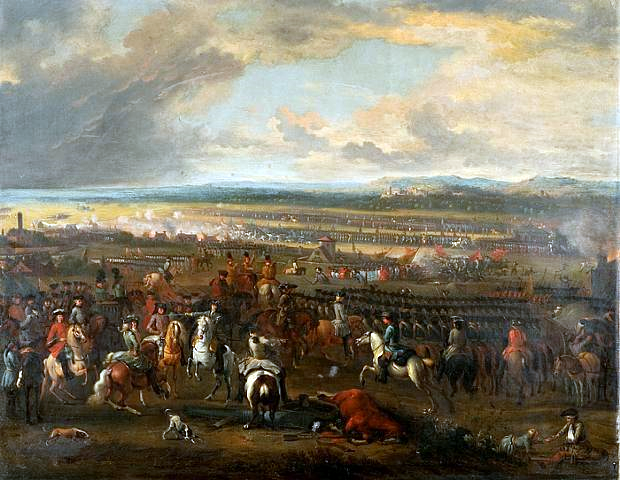
1 September 1701: The Irish Brigade in the service of France fought in the Battle of Chiari [above]*on this day. This clash of arms took place in Lombardy in northern Italy during the War of the Spanish Succession. The French Army was under the command of Marshal Villeroy who was opposed by Prince Eugene of Savoy in the service of the Austrian Empire. Villeroy decided to attack the town of Chiari as he felt it was his duty to fight for King Louis rather than just observe the enemy.

Villeroy ignored the warnings of his subordinate Marshal Catinat that Eugene was in a strong position, remarking his deputy that the King had not sent so many brave men there just to look at the enemy through their spy glasses!

The attack was however a fiasco as the French were cut down in droves. Amongst the regiments leading the attack was the Irish regiment of Galmoy (Its Colonel was Pierce Butler, 3rd Viscount Galmoy), which suffered heavily in the assault. Eventually the attempt was called off and the surviving troops were told to retire. The French losses were over 2,000 men killed or wounded while their enemies sustained a loss in the low hundreds. The most prominent Irish casualty was Dominick Sarsfield, 4th Lord Killmallock who was killed at the head of his men in the attack.


Some of the Irishmen who survived were badly wounded. Felix MacNamee, aged 35, a native of Armagh, had had his left arm taken off by a cannon ball and, put out of service, was admitted into the military hospital of Les Invalides in Paris, dying at Arras in 1726. The ensign of the Colonel’s company, Terence Sweeny, aged 33, was hit in the right thigh by cannon shot and across the body by a musket ball. He too, was admitted to Les Invalides and survived until 1750. Also hit by a cannon shot in the right leg was the reformed Lieutenant Thomas Meade, aged 31, a native of Kilmallock, who survived until 1736. John Conor, aged 31, a Kerryman and the sergeant of grenadiers, lost his right arm though a musket ball but lived until 1721.


* Battle of Chiari, by Jan van Huchtenburg