Wednesday, 6 March 2019

Image result for gibraltar three

6 March 1988: Three IRA Volunteers were shot dead by members of Britain’s SAS regiment in Gibraltar on this day. They were MairĂ©ad Farrell, Sean Savage and Daniel McCann. Their deaths had all the hallmarks of politically sanctioned killings by the British State.

Somehow or other MI5 got wind of plans by the IRA to bomb the changing of the guard in Gibraltar that was carried out with some ceremony by members of the British Military. A plan was put in place - Operation Flavius - to intercept this attempt and kill or capture the members of the IRA involved. In the event no attempt was made to capture and all identified members of the team were cut down without warning.

When Savage, McCann and Farrell—known IRA members—travelled to Spain in preparation for the attack, they were tracked at the request of the British government. On the day of the shootings, Savage was seen parking a white Renault in the car park used as the assembly area for the parade; McCann and Farrell were seen crossing the border shortly afterwards.

After a military bomb-disposal officer reported that Savage's car should be treated as a suspected bomb, the police handed over control of the operation to the SAS. As soldiers were moving into position to intercept the trio, Savage split from McCann and Farrell and began running south. Two soldiers pursued Savage while two approached McCann and Farrell; as they did so, the pair were said to make threatening movements, as a result of which the soldiers opened fire, shooting them multiple times. As soldiers caught up with Savage, he was alleged to have turned around to face them while reaching into his jacket; he was also shot multiple times.

All three were subsequently found to be unarmed, and Savage's car was found to contain no explosives; enquiries resulting from keys found on Farrell led authorities to a second car, containing a large quantity of explosives, in a car park in Spain. In all probability their presence in Gibraltar that day was a ‘test run’ and there was no immediate threat to anyone on the Rock that day.

Their deaths created huge controversy as it was hard to mask the fact that they had been killed in cold blood - a charge the British Government denied but without much success. When the bodies of the deceased were returned to Dublin they were met by thousands of well wishers in the pouring rain at Dublin Airport. The Corteges were escorted to the North by large numbers of vehicles and many more turned out to pay homage as the funeral cars made their way to the Border and back to Belfast.
Once the Border was crossed their was a different atmosphere as the Crown Forces clamped down on any open expressions of sympathy. Further deaths then followed at their funerals that shocked the Nation and indeed abroad in one of the most dramatic and bloody weeks in recent Irish History.


6 March 1918: John Redmond M.P. died on this day. Ireland’s foremost politician of 1914 died in a London Hospital a forgotten and discredited man. He had brought Ireland to the brink of Home Rule (his lifetime ambition) only to see fate take a different turn and it all to slip through his fingers. 

He was born in 1856 in County Wexford to a family with strong and active interest in constitutional politics. His father was a member of Parliament. He was educated at Clongowes College, a boarding school that many of the Irish middle class sent their sons to. He then went on to study Law in the Anglo - Irish bastion of Trinity College Dublin but his studies were cut short by his father’s ill health. He went over to London to help him out and became a follower of Charles Stewart Parnell the formidable Leader of the Irish Party in Westminster. He finally won a seat for New Ross in 1881 and entered Parliament. He did great fund raising work in Australia and the USA for the Party and eventually returned and completed his Law studies to become a Barrister.

When Parnell was forced to resign over the Kitty O’Shea affair in 1890 he emerged as the leader of the rump of the Party - the Irish National League - that remained loyal to their old leader.  Redmond lacked Parnell's oratory and charisma but did demonstrate both his organisational ability and his considerable rhetorical skills. He raised funds for the Parnell Monument in Dublin. When in 1900 the different factions re united Redmond was elected Chairman of the Irish Parliamentary Party- which he held till his death. Redmond's low-key and conciliatory style of leadership gave the impression of weakness but reflected the problem of keeping together a factionalised party.

He kept up the pressure in Westminster for Home Rule but while the Liberal Party was generally sympathetic the Conservatives were totally opposed and the House of Lords was seen as an insurmountable obstacle. But when the Lords' veto was abolished under the Parliament Act 1911, Irish Home Rule (which the Lords blocked in 1894) became a real possibility. By 1914 the Lords could no longer block legislation passed by the House of Commons on Home Rule and in the next session of Parliament it would become a reality. However in the North the Ulster Loyalists had armed themselves to the teeth and were determined to resist it. The British Government dithered and was unsure if they could even rely on the Army to enforce it on Ulster. The Country stood on the brink of a huge Constitutional Crises and the distinct possibility of Civil War.

But events abroad changed everything. In August 1914 the First World War began and Britain mobilised for War on an unprecedented scale. Redmond was unsure how to play it. He first offered the Irish Volunteers to hold Ireland against invasion by an outside enemy [Germany] but this met with little recognition in the corridors of Power in London. All parts of the Empire were expected to play their part. Edward Carson the Leader of the Irish Unionists had immediately offered the Ulster Volunteer Force [UVF] to join up and fight at the Front. This put Redmond on the spot. He could not stand idly by but he had to have something halfway tangible to sell back home to his supporters if he was to throw in his lot with the War Effort. This came in September when the Home Rule Bill was eventually given the Royal Assent - but with the proviso that it was suspended for the duration of the War. This was enough to satisfy Redmond and he encouraged the Volunteers to join up and fight. Tens of thousands did so at his behest and at first all went well and it appeared his gamble had paid off.

However a rump remained that did not follow him and Redmond’s followers became known as the National Volunteers while those who disavowed him remained the Irish Volunteers. A rump within that organisation organised the 1916 Rising that brought Revolution to the streets of Dublin. Redmond was aghast and condemned it. But his own Party was split and as the months rolled by the prospect of a United Ireland under Home Rule became more and more unlikely. The War was not going well and the horrendous casualties caused many to wonder if it was all worth it. The Ulster Unionists were as implacable as ever. Recruitment declined and Sinn Fein started taking seats at bye elections from the Irish Party - change was in the air and Redmond and his Party were increasingly isolated from National opinion.

The Conscription Crises of 1918 united all of Nationalist Ireland against the British and Sinn Fein was the growing power in the land. Redmond had become yesterdays man. When he died he was confined to the dustbin of History and viewed as a Traitor by many. It is only in recent times that he has been somewhat rehabilitated as a man who did his best for Ireland but who was a victim of circumstance as much as his own Blunders - particularly in backing Britain’s War Effort in 1914 that cost so many Irishmen their lives to no avail.


Tuesday, 5 March 2019

A contemporary illustration of the Battle of Tallaght from the London Illustrated News

5/6‭ March 1867: The Fenian Rising happened on this day. Long planned it turned into a complete fiasco. On Shrove Tuesday that year thousands of volunteers turned up at various locations in Dublin, Cork, Tipperary, Limerick, and to a lesser extent in Clare, Waterford and Louth. 

However most were armed with pikes if at all.‭ Very few firearms were available. There was no coherent plan of operations. Attempts were made to take a number of police barracks and engage the Constabulary in action but all ended in failure. An informer, Corydon, betrayed the plans and to add to the insurgents woes a great snow storm made absolutely impossible not only all communications but all movements of men. The Constabulary knew something was afoot but decided to allow events to take their course and then take action. In the Dublin area it is possible that as many as two thousand men assembled with perhaps twice that number in county Cork and a few hundred elsewhere. One of the greatest Irish movements of the century ended apparently in complete failure.

While the British Government was caught off guard the Rising was over before they could react.‭ Hundreds of men were rounded up and imprisoned. Some were sentenced to Death all these were commuted and no one was actually executed for their part in this affair. However long terms of imprisonment were handed down and many of the prisoners were subjected to very harsh conditions while in captivity. On top of this the Rising showed that Irish Republicanism was still a potent force and had by no means been crushed by the British. 

This event did have important repercussions however as it led to a reorganisation of much of the underground activities of the IRB and the formation in America of Clan na Gael that was determined to prosecute a campaign against British rule notwithstanding recent setbacks.‭ The failure of the 1867 Rising did not mark an end but a new beginning for those who were determined to end British rule over Ireland.


Monday, 4 March 2019


4‭ ‬March‭ ‬1778: Robert Emmet was born in Dublin on this day. He was the youngest son of Dr Robert Emmet and Elizabeth (Mason). His father was a well to do Physician in the City with  a house on St Stephens Green and another one down the Country. His elder brother Thomas Addis Emmet was a personal friend of Wolfe Tone who visited the family home on many occasions.

[Robert Emmet] was born in Molesworth-street, Dublin, in 1778. Shortly after his birth his father removed to 109 Stephen's-green West (corner of Lamb-lane). There, and at Casino, his father's country place near Milltown, his early years were passed. He was sent to Oswald's school, in Dopping's-court, off Golden-lane; subsequently he was removed to Samuel White's seminary in Grafton-street; and was afterwards put under the care of Rev. Mr. Lewis, of Camden-street. On 7th October 1793 he entered Trinity College. His college course, like his brother's, was brilliant. He exhibited great aptitude for the exact sciences, especially mathematics and chemistry.
http://www.libraryireland.com/biography/RobertEmmet.php

When he entered Trinity College in‭ ‬1793 and joined the College Historical Society, a debating society. He became secretary to the United Irish Society in the college, but had abandon his studies in April 1798 when he and a number of students were expelled for their Republican sympathies. In 1799 he travelled to France to escape arrest and to secure support for another Rising in Ireland.

He returned home in late‭ 1802 after the Peace of Amiens between Britain & France and began to lay plans to seize Dublin from the British. Unfortunately his plans were laid open by a premature explosion of his arsenal in July of the following year. He then banked all his hopes on an immediate eruption on 23 July but his venture quickly fell apart and he want into hiding. A few weeks later he was captured, tried for ‘Treason’ and gave the speech of his Life before the Court that quickly became a sensation and secured his reputation as a Patriot.

My country was my idol.‭ ‬To it I sacrificed every selfish, every endearing sentiment, and for it I now offer up myself … I acted as an Irishman, determined on delivering my country from the yoke of a foreign and unrelenting tyranny and the more galling yoke of a domestic faction, which is its joint partner and perpetrator in the patricide…
Delivered at the Session House in Dublin before the court which had convicted him of high treason, September 19, 1803.

He was sentenced to be hung,‭ drawn and quartered. This was duly carried out on 20 September before a large crowd in Thomas Street Dublin. The whereabouts of his body today remains a mystery.

Sunday, 3 March 2019


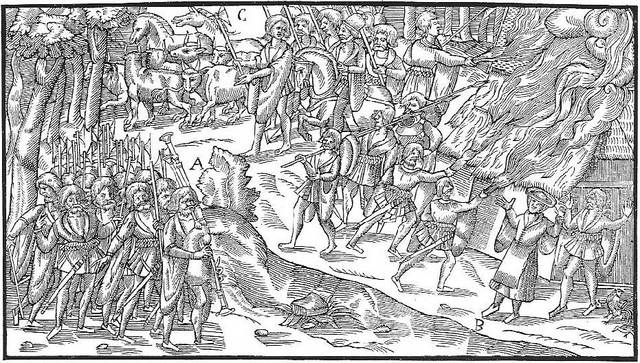
3 March 1577: The town of Naas, Co Kildare was torched by Rory Og O’More and Cormac MacCormac O’Connor on this day. These two Gaelic Chieftains with a select force of 140 men and boys ran through Naas like the ‘haggs and furies of hell, with flakes of fire fastened on poles’, and burned between 700 & 800 of the thatched houses belonging to the local townsfolk - who were still recovering from celebrating St David’s Day [1 March].

The English Lord Deputy Sydney was furious that Irish ‘rebels’ from the bogs of Laois were able to make such a surprise attack upon one of the chief towns of the Pale, cause such destruction in such a short space of time and then get clean away. He wrote that:

They had not one horseman, nor one shot with theim; they ran through the town, beinge open, like haggs and furies of hell, with flakes of fier fastened on pooles ends, and so fiered the low thatched howsies; and being a great windie night, one howse took fiere of another in a moment; they tarried not half an houre in the town, neither stoode they upon killinge or spoylinge of any.
There was above fyve hundred mennes boddies in the towne manlyke enough in appearance, but neither manfull, nor wakeful as it seamed; for they confesse they were all aslepe in their bedde, after they had filled themselves and surfeyted upon their patrone day; which day is celebrated, for the most part, of the people of this country birthe, with gluttonye and idollatrye as farre as they dare.

But Sydney was a cold and ruthless man. An insult to his authority like this could not be passed over. He was determined to bring in Rory O’More dead or alive. All that year and well into the next he harried his elusive opponent. He killed any of O’More’s soldiers he could engage in battle and also members of the O’More family - including Rory’s wife Margaret (O’Byrne). Finally in June 1578 O’More was killed in a skirmish, his head cut off and brought to the Lord Deputy who had it stuck on a pole on the walls of Dublin Castle. 

Rury Oge, the son of Rury Caech, son of Connell O'More, fell by the hand of Brian Oge, son of Brian Mac Gillapatrick. This Rury was the head of the plunderers and insurgents of the men of Ireland in his time; and for a long time after his death no one was desirous to discharge one shot against the soldiers of the Crown.
Annals of the Four Masters


Saturday, 2 March 2019

Image result for rory gallagherImage result for rory gallagher

2 March 1948: Rory Gallagher was born on this day in Ballyshannon Co Donegal. Rory was a pioneer for Irish Rock in the 1970s and 1980s who toured all over the World with his own unique take of Rock songs and ballads. He built up a dedicated group of admiring fans who were stunned by his brilliant riffs and his stage presence. Compared to the Super Groups that were around even then he kept it tight with just himself on vocals and lead guitar & Gerry McAvoy on bass guitar; they had a succession of drummers such as Rod De’Ath. Wilgar Campbell, Ted McKenna and Brendan O’Neill, along with the late Lou Martin on keyboards.

His love of music dated back to the early days of his childhood in Cork City. He purchased his trademark Fender Stratocaster Sunburst model in 1963, from Michael Crowley of Crowleys Music Store at the age of fifteen. Heavily influenced by US Rock n’ Roll, Blues and Soul as well as folk ballads it was a style he kept with him throughout his career. He cut his teeth with the Irish Showbands of the 1960s and got used to touring and life on the road. But he was not made to stop there and in 1968 he put together his own Band - ‘Taste’ - that made a name for himself and gave Irish Rock a much bigger profile. However it was a short lived affair and after a stunning performance at the Isle of White in 1970 they split up.

He formed his own band the following year and went on the road. He never really stopped after that. In 1972, Rory Gallagher topped the Melody Maker Guitarist of the Year Poll, ahead of contemporaries such as Eric Clapton, Jimmy Page and Jimi Hendrix.

Gallaghers’ dexterity on a wide variety of instruments and his prowess as a unique electric and acoustic guitarist is defined by his considerable recorded output, and the critical acclaim his work has received over the decades both prior to and since his demise....His outstanding performances were best captured on film specifically by acclaimed film maker Tony Palmer in Irish Tour 1974, capturing Rory and the band in full flight, in what many of his fans considered to be his golden era.Marcus Connaughton
https://www.rte.ie/culture/2018/0302/944564-rory-gallagher-rocks-celebrating-his-life-and-legacy/

Rory always kept true to his own take on what Rock Music was and where you could take it - he eschewed any attempt to be ‘popular’ just for the sake of it. He demanded the best from himself and those around him and was really at a loss when not touring or recording. He never really could adjust to ‘normal’ life. It was a two edged sword though as constant touring took its toll on him and he developed addictions that meant his health was up and down over the years.

By the time he died in a London Hospital in 1995 at the age of 47 due to post operative complications from a liver transplant he had sold over 30 million albums and was a firmly established icon in not just Irish circles but on the International circuit too. Curiously though he has never been inducted into the Rock and Roll Hall of Fame - a glaring error if ever there was one!


Friday, 1 March 2019


1 March 560 AD: St. Senan traditionally died on this day. Bishop and confessor. He was born at Magh Lacha, near Kilrush, Co. Clare circa 488 AD.  His parents were called Erean and Comgella.
St Senan is considered one of the ‘Twelve Apostles of Ireland’ part of an elite group of Holy Scholars who studied under the guidance of St Finnian at his Monastery at Clonard, Co Meath. He commenced his missionary career by founding a church near Enniscorthy, in around 510 and the parish is still known as Templeshannon/Tempeal Senan. He then visited Menevia, Rome and Tours before returning to Ireland.

 He founded a number of Monasteries but his most famous was on an island not far from the place of his Birth. This was on Iniscathaigh, today know as Scattery Island in the Estuary of the River Shannon. Here many Holy men and devotees came to visit him but no women – for the Saint made a strict point that no member of the fairer sex could set foot on the island. It is reputed that even his own sister, herself a saintly woman, was allowed to disembark there. To honour her dying wish to be buried near her beloved brother St Senan on her death had her body brought out on a boat near the island. When the tide was low he had her mortal remains buried beneath the tidal mud so that the spirit if not the letter of her last earthly desire was met.  

St Senan though was not against womanhood but believed in the rule of celibacy being strictly followed. He was patron to nunneries as well which he visited. It was while returning from one such visit on 1 March 560 AD that he suddenly took ill in a field outside the nuns church. Knowing his end was near, he raised his hands in thanksgiving to God, and telling his companions that his hour had come to depart from them, he bade them on his death to convey his body to Iniscathaigh.