Thursday, 16 July 2020

Hotels near Kilmainham Gaol | Clayton Hotels Ireland


16 July 1924: Eamon De Valera was released from captivity on this day. He had been held in Kilmainham Jail Dublin by the Free State. He had been in detention since August 1923 after having been arrested in Ennis Co Clare at a political rally he was due to address in the General Election of that year.

There were other Republican prisoners held in the jail too but De Valera was only allowed sporadic contact with them and did stints in solitary confinement. While there he thought over the events that had led him back into prison and pondered how he would go about breaking the Treaty and re establishing a Republican Party that was likely to be able gain the support of the Irish People.

On his release the Prison, which was built in 1792, was closed down and never used as a place of incarceration again. It is now a Museum dedicated to telling the story of Ireland's struggle to achieve Freedom.

The day De Valera came out of there saw the start of his comeback in Irish Politics and led two years later to his break with Sinn Féin and the foundation of his own political Party - Fianna Fáil.

....the immense crowds and the enthusiasm which everywhere greeted his appearance was a surprise even to the more optimistic Republicans who had believed that a long period of depression and defeatism had set in.
Chapter Ninety The Irish Republic by Dorothy Macardle


Wednesday, 15 July 2020

Image result for countess markievicz statue

15 July 1927:  Countess Constance Markievicz died on this day. Society Girl, Artist, Revolutionary, Feminist and Socialist there is no doubt that she was a woman who lived Life to the full and gave it her all for Ireland and her People. She was born in London in 1868 to the Artic explorer Sir Henry Gore Booth and Lady Georgina, Lady Gore-Booth. Her father owned a large Estate at Lissadell House in Co Sligo.

In the 1890s she studied Art in London and Paris where she met her future husband, the Polish Nobleman ‘Count Markievicz’ - and there after she was known as Countess Markievicz! She gave birth to their daughter, Maeve, at Lissadell in November 1901.The family moved to Dublin in 1903 and the Countess moved in the Literary and Art circles of the city, notably in the circle of the famous portrait artist Sarah Purcell. There she met many people who were involved in the politics of the day and from this her interest in Ireland’s future deepened.

 In 1908, she became actively involved in nationalist politics in Ireland and joined Sinn Fein which was the most advanced Nationalist Party of its day. In 1913 Markievicz's husband moved back to Ukraine, and never returned to live in Ireland. However, they did correspond and he was by her side when she died.

When the 1916 Rising broke out she played an active part in it and was rumoured to have shot dead a DMP policeman while trying to storm Dublin Castle. She was part of the Stephens Green garrison that later withdrew to the Royal College of Surgeons on the Green. When the Rising was over she was taken prisoner, held in solitary confinement and sentenced to Death. Much to her disappointment the sentenced was commuted to Life Imprisonment. However she was released in 1917 after having served her time in an English Prison.

In the British General Election of December 1918 she was elected for a Dublin Constituency taking 66% of the vote, thus becoming the first woman  ever elected an MP - but refused to take her seat in the London Parliament. When the 1st Dáil met in January the Countess was back in an English Prison and when the roll call was taken her absence was noted by the words - fé ghlas ag Gallaibh -"imprisoned by the foreign enemy". She was made the Minister for Labour and held that position until January 1922. She also sat in the Cabinet of the Irish Republic from April 1919 till August 1919 - thus making her the First Woman Cabinet Minister in Irish History.

She left the government in January 1922 along with Eamon De Valera and others in opposition to the Treaty. She fought actively for the Republican cause in the Irish Civil War helping to defend Moran's Hotel in Dublin. After the War she toured the United States. However, her staunch republican views led her to being sent to jail again. In prison, she and 92 other female prisoners went on hunger strike. Within a month, she was released. 

She joined the new Fianna Fáil on its foundation in 1926, chairing the inaugural meeting of the new party in La Scala Theatre. In the June 1927 Election she was re-elected to the Dáil as a candidate for the new party, which was pledged to return but died only five weeks later, before she could take up her seat.

Constance Markievicz died at the age of 59 on 15 July 1927, of complications related to appendicitis. She had given away the last of her wealth, and died in a public ward "among the poor where she wanted to be". One of the doctors attending her was her revolutionary colleague Kathleen Lynn. Also at her bedside were Casimir and Stanislas Markievicz, Eamon de Valera & others came by to pay their last respects. Refused a state funeral by the Free State government, she was buried Glasnevin Cemetery  Dublin, and Eamon de Valera gave the funeral oration. Sean O’Casey said of her: One thing she had in abundance—physical courage; with that she was clothed as with a garment.


Tuesday, 14 July 2020


14‭ July 1798: The Patriot brothers John and Henry Sheares were executed on this day. They were both members of the Legal Profession and had joined the United Irishmen to fight tyranny and free Ireland from English rule. They were the sons of a wealthy banker who sat as a member of the Parliament in Dublin. In 1792 they had visited Revolutionary France and had caught the Spirit of the times there. They soon joined the United Irishmen on their return.

‭However they trusted others without caution and were led into revealing details of the conspiracy to overthrow the Ascendancy. A Spy, one Captain John Armstrong who had befriended them in order to betray them, revealed their intentions to Dublin Castle. They were arrested on 21 May 1798. Found guilty of treason, they were publicly hung, drawn & quartered outside Newgate Prison [Green Street] in Dublin. Both were buried in the vaults of St. Michan's Church in Dublin City where their perfectly preserved coffins [above] are still on display.

At midday on Saturday,‭ ‬July 14th, the hapless men were removed to the room adjoining the place of execution, where they exchanged a last embrace. They were then pinioned, the black caps put over their brows, and holding each other by the hand, they tottered out on the platform. The elder brother was somewhat moved by the terrors of his situation, but the younger bore his fate with unflinching firmness. They were launched together into eternity--the same moment saw them dangling lifeless corpses before the prison walls. They had lived in affectionate unity, inspired by the same motives, labouring for the same cause, and death did not dissolve the tie. "They died hand in hand, like true brothers."
`Speeches from the Dock‭'
By D.‭ S. Sullivan


Monday, 13 July 2020


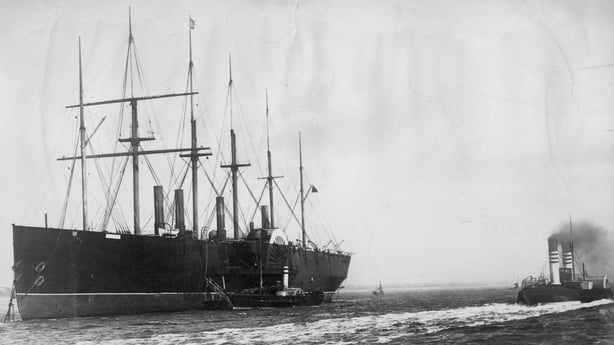
13 July 1866: The Great Eastern steamship [above], the largest vessel afloat at that time, departed Valentia Island Co Kerry for Newfoundland on this day. Its task was to attempt once again to try and lay a working telegraph cable from Europe to the Americas.

‘It was the brainchild of American entrepreneur Cyrus Field, who made two unsuccessful attempts before finally succeeding. The first officer on the Great Eastern - the biggest vessel in the world at the time - was Wicklow native Captain Robert Halpin. While Belfast born scientist and engineer, Lord Kelvin, worked on the technical aspects of the cable.

Prior to the laying of the Transatlantic Cable it took approximately two weeks for message from Europe to reach North America … weather permitting as all communications were sent via boat.

The idea of a transatlantic cable was first proposed in 1845, but the distances and depths presented formidable problems. In 1856 the Atlantic Telegraph Company was registered with a capital of £350,000 (then about $1,400,000). On the American side Cyrus W. Field was the driving force; on the British side it was Charles Bright and brothers John and Jacob Brett.

After so many failed attempts, the final, successful, cable was laid with virtually no problems. On 27 July 1866, the cable was pulled ashore at a tiny fishing village in Newfoundland known by the charming name of Heart’s Content. The distance was 1686 nautical miles from Valentia Island. The Great Eastern had averaged 120 miles a day while laying out the cable.

The first message sent on this, finally successful, cable was: “A treaty of peace has been signed between Austria and Prussia”. Queen Victoria, then at Osborne, in the Isle of Wight, sent a message to the President of the United States. “The Queen congratulates the President on the successful completion of an undertaking which she hopes may serve as an additional bond of Union between the United States and England.'' *

Almost immediately, the cable opened for business but only the very wealthy could afford it – the initial rates were a startling $1 a letter, payable in gold – at a time that a monthly wage for a labourer might be $20.''
http://www.valentiaisland.ie/explore-valentia/valentia-transatlantic-cable-station/

For the next 100 years Valentia Island was a major portal for the dispatch and reception of messages between the distant continents in what was for its time an Information Superhighway in itself. The station finally ceased being a conduit for transatlantic communication in 1966 when air mail & satellites made it un-economic to maintain it any longer. It was an end of an Era.

* No mention of Ireland!


Sunday, 12 July 2020

William III at the Battle of the Boyne.jpg


12 July [O.S. 1 July] 1690: The Battle of the Boyne/Cath na Bóinne was fought on this day. The Protestant Army of King William of Orange defeated the Catholic Army of King James II. With around 36,000 Williamites against 25,000 Jacobites this battle, in terms of the numbers of men on the battlefield was the largest clash of arms ever fought in Ireland.

Both kings commanded their armies in person assisted by a number of men of high rank and status. King William had under his orders English, Scottish, Dutch, Danish, French Huguenots and Protestants from Ireland. King James Army mainly consisted of Catholic Irishmen, and a scattering of Englishmen loyal to the Stuarts. The King was also backed by around 6,500 regular French troops sent by King Louis XIV.  William sent 10,000 men towards Slane with the advance guard under Count Meinhard, which drew the bulk of the Jacobites upstream in response.With some 1,300 Jacobites posted in downstream in Drogheda, only 6,000 were left at Oldbridge to confront 26,000 Williamites. Duke Frederick Marshal Schomberg (William’s top General) then led the Dutch Blue Guards and other regiments into the waters of the Boyne and across to the other side.

Opposing them were just seven regiments of the Catholics who shot their attackers down in great numbers as they attempted the passage of the Boyne at Oldbridge. A want of sufficient cavalry and artillery to block the crossing of so formidable a host eventually told against the Irishmen. They were pushed back from the riverbank as their enemies gained a toehold and then flowed across. William himself eventually crossed at Drybridge slightly downstream with about 3,500 mounted troops.

Marshal Schomberg brought down to the ford of Ouldbridge the gross of his cavalry, with orders to push on and suffer no check. At this, the seven regiments aforesaid of Irish foot, observing they would be soon overpowered, they cried to their own for horse to sustain them. In the meanwhile, they made a smart fire at the enemies, and laid them in heaps, as they were entering the waters. But their crying for horse was in vain; for they received but one troop, which was as good as nothing.

By the time reinforcements arrived it was too late and the enemy was across in strength. The seven regiments of Irish foot, which guarded the great ford of Ouldbridge, not being supported by horse, were also forced to retreat, but were in danger to be intercepted by such of the enemy as had traversed first the river before they joined their main army, which the duke of Tyrconnell, from the right, perceiving, flew with his regiment of horse to their rescue, as did the duke of Berwick with the two troops of guards, as did colonel Parker with his regiment of horse, and colonel Sutherland with his. It was Tyrconnell's fortune to charge first the blue regiment of foot-guards to the prince of Orange, and he pierced through.

Further upstream Count Meinhard had by then crossed the Boyne by the ford at Rosnaree and though blocked by O’Neills cavalry regiment he was soon reinforced. With King James flank now turned his position was a precarious one. Most of his army was at this critical moment of the battle betwixt and between these two vital points and unable to render assistance to either in enough strength to turn the days events.

The King himself with a considerable portion of his Irish and French troops did however block Lord Douglas in the Williamite service from crossing the Boyne at Donore - which is situated between the fords of Rosnaree and Oldbridge. But this was a stalemate while the outcome of the battle was decided to the left and the right of the King’s position at Donore.

Eventually the Williamites across the river in strength on both the left and right flanks the order was given to fall back on Duleek to the south and stop that village been taken by the enemy. If King Williams’s men had taken the vital bridge there then the whole of the Jacobite army would have been cut off from retreat and in all likelihood captured in its entirety.

As it turned out the retreat was carried out in good order and despite further clashes Lord Tyrconnel, given command of the rearguard, was able to effect an orderly withdrawal. The enemy were content to follow in their footsteps and not risk a reverse.

However in these follow up operations the Williamites lost their best military leader – Marshal Schomberg.

Twas during these encounters that one master Bryen O'Tool, of the guards, discovering his former acquaintance, marshal Schomberg, near the village of Ouldbridge, resolved to sacrifice his life to the making him away, upon which he, with a few of the guards, and a few of Tyrconnell's horse, made up to him, and O'Tool with his pistol shot the marshal dead. But, soon after, fighting like a lion, he was slain.

King James's army retreated across the river Nanny at Duleek and evaded capture. It had been a ‘close run thing’ and though the battle had been lost the Army was intact and still a cohesive fighting force.

Bad tactics rather than bad fighting had cost King James and his Irish followers the chance of victory against a more numerous enemy. The line of the Boyne might well have been held but King James had been outmanoeuvred by Marshal Schomberg’s plan - even though this crusty old Huguenot did not live to savour the Victory he had so materially helped to achieve.

Though there was some hot fighting in the course of the battle overall the casualties were light on both sides with perhaps 1,500 soldiers lying dead along the banks of the Boyne. Considering the strategic consequences of this clash of arms it was a very low number for a battle that determined the political and religious balance of power in Ireland for centuries to come and that still resonates down to our own day.


Saturday, 11 July 2020

Image result for the truce 1921


11‭ July 1921: ‘The Truce’ began at 12 noon on this day. This brought to an end organised military operations between the Irish Republican Army and the British Crown Forces during the Irish War of Independence. The negotiations leading up to the cessation of hostilities had been concluded some days previously at the Mansion House [above] in Dublin between representatives of the Irish President Eamon de Valera and the British Prime Minister Lloyd George.

The terms agreed were that no British reinforcements would enter Ireland,‭ raids and arrests would cease and secret operations end. The Irish in turn agreed to cease attacking the British, not to interfere with private or British owned property and not to disturb the peace that would necessitate military interference. Both sides agreed not to engage in provocative displays of their respective forces, armed or unarmed.

The following day an Irish Delegation consisting of Eamon de Valera,‭ Arthur Griffith, Austin Stack and Robert Barton departed for London to open negotiations with the British Government. The Lord Mayor of Dublin, Count Plunkett and Erskine Childers also accompanied the delegation. It looked like the violence that had wracked Ireland for the last two and a half years was coming to an end.

But while an uneasy Peace settled down upon most of the Country it was a different story in the North, particularly in the city of Belfast. It had always been a volatile place in July – owing to the parades of the Orange Order on 12th July – but this was violence intensified and militarised on a scale not seen before. There sectarian violence resulted in an orgy of murders, burnings and intimidation with the Police & Military openly taking sides against the Nationalist population.

The 11th fell on a Monday that year, and the previous day became known as Belfast's 'Bloody Sunday'. That day 16 people were killed violently, 1 RIC man, 10 Catholic and 5 Protestant civilians. By the end of the week, 23 people had been killed in Belfast, hundreds more wounded, two hundred homes destroyed and a thousand people made homeless.
See: www.theirishstory.com

Friday, 10 July 2020

Image result for kevin o'higgins


10 July 1927: The Assassination of Kevin O’Higgins, Vice-President of the Executive Council, Minister for Justice and Minister for External Affairs on this day.

His role in the Irish Civil War had still not been forgotten or forgiven by many Republicans. He had taken the side of those supporting the Anglo-Irish Treaty of 1921, which included an Oath of Fidelity to the British King. While a brilliant Minister and a shrewd politician he was also a man of ruthless determination. His decision to acquiesce in the execution of the best man at his own wedding, Rory O’Conner, was seen as a particularly hard act. He was viewed by quite a number of people as the most forceful personality in the Cumann na nGaedheal government. As a result of this legacy of bitterness plans were laid by a small group of Republicans to carry out an attempt on his life.

On the fateful Sunday in question O’Higgins left his house, (situated in south County Dublin)accompanied only by his bodyguard Detective O’Grady. His intention was to attend Mass at the local Catholic church on Booterstown Avenue. The Minister clearly forgot something along the way and he sent O’Grady back to fetch it, whatever it was. He then proceeded on alone down Cross Avenue to its junction with that of Booterstown. It was here that the assassins struck. A number of them approached him and opened fire simultaneously. Shot a number of times O’ Higgins started to run slowly across Booterstown Avenue only to collapse at the gates of a private residence, Sans Souci.

The gunmen thought they had mortally wounded him but then O’Higgins inadvertently committed a fatal error. He raised his hand, possibly to call attention to his plight. His assailants at once returned and pumped him full of more bullets before fleeing in a car up the avenue and off down the Stillorgan road in the direction of the nearby countryside.

 Within minutes people were rushing to his aid. Amazingly one of them was an ex Cabinet colleague, Professor O’Neill who had been making his way to Mass at the same time. O’Higgins was brought back to his home and made as comfortable as possible in the dining room. While conscious, he was in great pain as he had sustained a considerable number of gunshot wounds, the one to the skull proving to be the fatal shot. He was bleeding profusely by this stage and O’Higgins realised that his situation was hopeless. His dignity in the face of death drew the admiration of all who were with him in his final hours. Quite a number of people called in to pay their last farewells before the end. O’Higgins died at 4.45 that afternoon.

Most people were shocked by the news. The action was universally condemned. Even Eamon De Valera was taken aback by the brutal death of his political opponent and he swiftly moved to disassociate both himself and his party from this violent and gratuitous deed. However it is true to say that not all of his supporters were that upset by O’Higgins death.

The following day O’Higgins body was removed from his home. President Cosgrave and the members of his Cabinet, along with General O’Duffy and nine senior officers of the Garda Síochána were in attendance to accompany the Minister’s remains to a lying in state at the Mansion House, Dublin. Huge crowds queued for hours to pay their final respects.

His remains were removed from his residence, Dunamase House, Booterstown, to the Mansion House, Dublin, where thousands filed past the coffin. His funeral mass was held at St Andrew’s Church, Westland row. The funeral cortège stretched for over 3 miles. O’Higgins was buried in Glasnevin cemetery, the same grave as his infant son.

For years his assassins were unknown to the general Public. However it is now known that they were three IRA members acting off their own bat. They did it in order to avenge the loss of their comrades in the Civil War, in which O'Higgins played such a prominent role in the execution of Republican prisoners and the introduction of draconian legislation to deal with the Anti Treaty IRA. They were Timothy Coughlan, Bill Gannon and Archie Doyle. None of them were ever charged with what they did that fateful day.

* The plaque above was erected near the spot where he was gunned down in 2012 by then An Taoiseach Enda Kenny